Harvest Moon Rose With Saturn September 26, No Telescope Needed
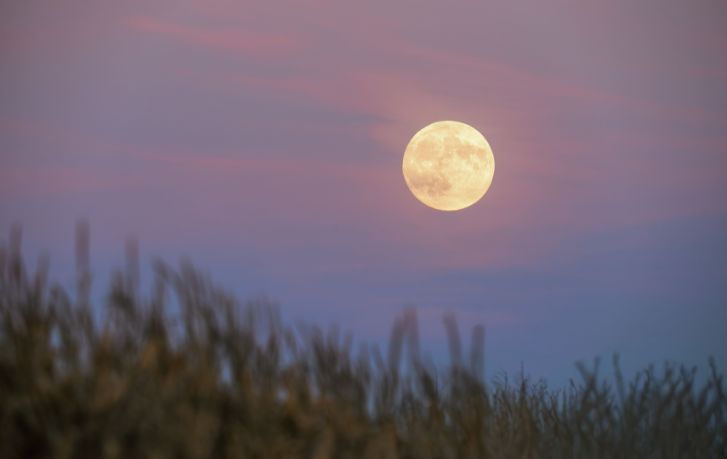
The 2026 Harvest Moon rose near Saturn on September 26, giving skywatchers a pairing they could follow without a telescope. As shown in NASA’s September skywatching guide, the full moon emerged in the east shortly after sunset with the ringed planet appearing nearby as a steady point of light.

The timing and exact orientation depended on the observer’s location. Longitude affected when the objects cleared the horizon, while latitude changed how the pairing was angled in the sky. Local weather and obstructions such as buildings, trees and hills also determined whether the low-altitude view was available.
How the two objects appeared
The Moon was the unmistakable member of the pair. Near the horizon, it could take on an orange or reddish color because its reflected sunlight had to travel through more of Earth’s atmosphere. Shorter wavelengths were scattered more strongly, allowing more red and orange light to reach an observer. The lunar disk could also look unusually large beside buildings or trees, an optical effect known as the Moon illusion rather than an actual change in its size.
Saturn looked like a bright, yellowish or golden point rather than a miniature ringed world. Its relatively steady appearance helped distinguish it from nearby stars, which can seem to twinkle more noticeably. The planet was visible with unaided eyes, but its rings were not. Resolving that structure required a telescope; binoculars could make Saturn easier to locate but would not provide the defining ringed view.
The apparent meeting was strictly a line-of-sight effect. The Moon and Saturn occupied nearly the same region of Earth’s sky, but they remained separated by an enormous distance in space. Such groupings occur because the Moon and planets travel along broadly similar paths across the sky as viewed from Earth.
Neptune completed a wider grouping
NASA also placed Neptune in the area, forming a wide triangle with the Moon and Saturn. That third object imposed a clear equipment boundary: at roughly magnitude 8, Neptune was too faint for unaided viewing. Binoculars or a telescope, darker skies and favorable observing conditions were needed to attempt it.
That contrast made the September 26 event unusually accessible without making every part of it equally easy. The Harvest Moon supplied a prominent visual anchor, Saturn provided the naked-eye planetary target, and Neptune offered a more difficult extension for observers with optical equipment.
Why this full moon carries the Harvest name
The Harvest Moon is the full moon closest to the Northern Hemisphere’s autumn equinox, which occurred on September 22 in 2026. The Moon reached maximum illumination at 16:49 UTC on September 26.
Its historical importance comes from a seasonal pattern in moonrise times, not from a unique color or physical type of moon. On average, the Moon rises about 50 minutes later from one day to the next. Around the Northern Hemisphere’s autumn equinox, however, the Moon’s path meets the eastern evening horizon at a shallow angle. More of its nightly movement carries it sideways along the horizon rather than sharply downward beneath it.
That geometry can substantially shorten the interval between successive moonrises, although the size of the effect varies with latitude and the Moon’s orbital position. For several evenings, a bright, nearly full moon can therefore rise relatively close to sunset. Before artificial lighting became widespread, that sequence supplied additional evening light for farmers gathering crops hence the Harvest Moon name.
The effect is associated with the Northern Hemisphere’s autumn geometry. September marks spring in the Southern Hemisphere, where the seasonal moonrise pattern differs. There is consequently no single rise time, viewing angle or moonrise delay that applies worldwide.
Saturn was the easy planetary companion on September 26, but the Moon’s shallow seasonal path supplied the deeper story: the familiar Harvest Moon refers not merely to one bright night, but to a run of useful early-evening moonlight shaped by orbital geometry.
| More aerospace and engineering stories, right in your MSN feed. Follow AMI on MSN |
By David Whitaker — Associate editor for AMI’s aerospace and drone systems desk, translating flight systems, aircraft programs, spaceflight, and UAV developments into accessible technical stories.