Bay Area Air District May Delay Gas Water-Heater Rule Over $3,500 Added Cost
A Bay Area homeowner whose gas water heater fails could face an electric conversion costing about $3,500 more on average under an air-quality rule adopted in 2023. The Bay Area Air Quality Management District is now considering a one-year delay and broader exemptions after cost, installation space and electrical capacity emerged as significant obstacles. According to the district’s building-appliance rule page, its board is tentatively scheduled to decide on the amendments in November.

The existing timetable applies a zero-nitrogen-oxide emissions standard to small water heaters manufactured after January 1, 2027. District staff have proposed moving that date to January 2028. Neither the delay nor the exemptions are final, but their scope is substantial: exemptions for limited-income households, insufficient installation space or projects requiring a major electrical upgrade could cover as many as 38% of installations.
A product rule becomes a building-systems problem
The regulation does not explicitly require one particular technology. It establishes a zero-emissions limit for nitrogen oxides at the appliance. However, the district says the only commercially available products currently meeting that limit are electric. A natural-gas appliance could remain eligible if one were to meet the standard, but in practical terms many affected replacements would shift to electric water heating, including heat-pump systems.
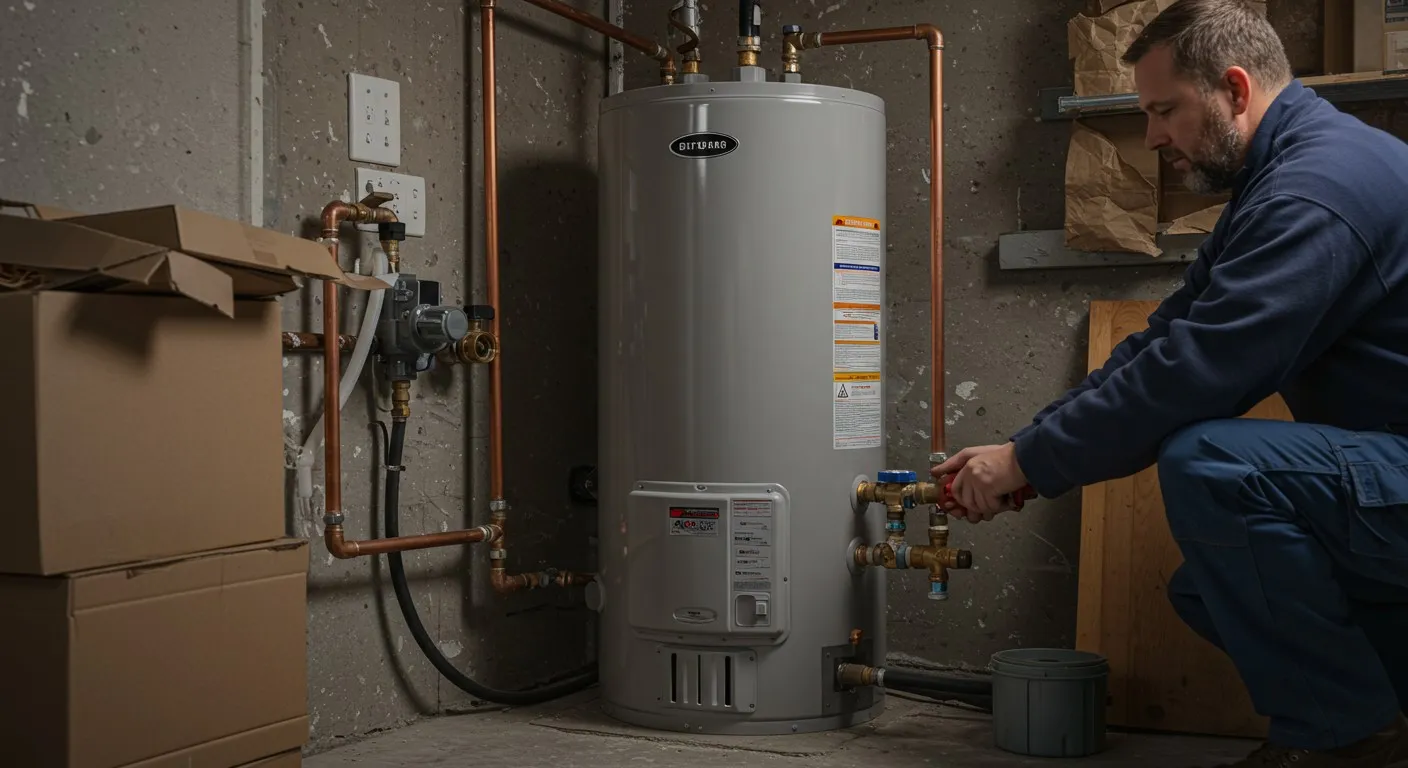
That distinction matters because changing the energy source is not always a direct appliance swap. A gas water heater combines the tank or heating unit with a fuel connection and exhaust arrangement. A heat-pump water heater draws heat from surrounding air and transfers it into the water. This can reduce electricity consumption compared with conventional electric resistance heating, but the equipment generally needs adequate airflow and may use a larger tank.
Homes with water heaters in tight closets or other constrained locations may therefore require relocation or a different equipment configuration. Split heat-pump systems, which separate the tank from the compressor, can provide more flexibility, while some lower-power models can use a standard electrical outlet. Those alternatives can reduce retrofit demands, but they do not make every building equally simple or inexpensive to convert.
Electrical capacity creates a second integration boundary. Whether a home needs a panel upgrade depends on its existing service, total load and the selected heater. In some cases, load-management devices, power-sharing equipment or lower-power appliances can avoid a larger panel. In others, work may extend beyond the appliance circuit to the panel, meter, wiring or utility connection. That is why an exemption based on a major electrical upgrade addresses more than the water heater’s purchase price.
Average cost does not describe every household’s burden
The district’s estimate of approximately $3,500 in average added conversion cost is consequential because water heaters are commonly replaced when existing equipment fails. At that point, the homeowner needs restored hot water, not an open-ended building-electrification project. Averages can also conceal wide differences: one house may already have suitable space and power, while another may require electrical and structural work.
Rebates can reduce the upfront burden, but affordability depends on eligibility, available funding and whether assistance arrives when the replacement is needed. A mandatory standard and a voluntary incentive program also distribute responsibility differently. A mandate guarantees a cleaner equipment mix among covered sales, while incentives preserve more consumer choice but may produce a slower or less predictable transition.
The district attributes major potential benefits to electrifying water heaters and furnaces: up to 85 avoided premature deaths and approximately $400 million to $890 million in annual health benefits across the region. Those figures are modeled district estimates, not measured outcomes from a rule that has already taken effect. Nitrogen oxides contribute to ozone and secondary particulate formation, providing the technical basis for regulation, but the projected regional benefit does not eliminate the household-level financing and installation problem.
Limited direct experience sharpens the accountability question
Only 11 of the district board’s 24 part-time members responded to questions about their residential water-heating systems. Four reported using gas water heaters. Two San Francisco representatives described rental buildings using gas or direct steam, three declined to discuss their residences, and one declined to comment. Steve Young was the only respondent who reported installing an electric water heater at home; he said he noticed essentially no performance difference after electrifying more than a decade ago.
That survey does not establish whether individual members understand the technical record, and personal appliance ownership is not a prerequisite for regulating emissions. It does, however, expose an experience gap: most responding officials had not personally completed the conversion whose cost and practical constraints the rule would place on homeowners. Young supported the 2023 rule but now favors a voluntary transition backed by substantial incentives, illustrating that support for electrification does not automatically resolve the question of compulsion.
The water-heater decision will also test the district’s broader implementation strategy. Zero-emissions requirements for new natural-gas furnace installations are scheduled for 2029, followed by commercial and larger water heaters in 2031. If exemptions ultimately reach 38% of small-water-heater installations, they will show how strongly the existing housing stock not simply appliance efficiency sets the pace of electrification.
| More aerospace and engineering stories, right in your MSN feed. Follow AMI on MSN |
By Thomas Caldwell — AMI’s senior editor for mechanical and mobility engineering, covering vehicle electronics, systems integration, electrification, chassis systems, propulsion, and safety policy.