Ukraine Says Russia Could Order 230 Naval Drones Despite Electronics Shortages
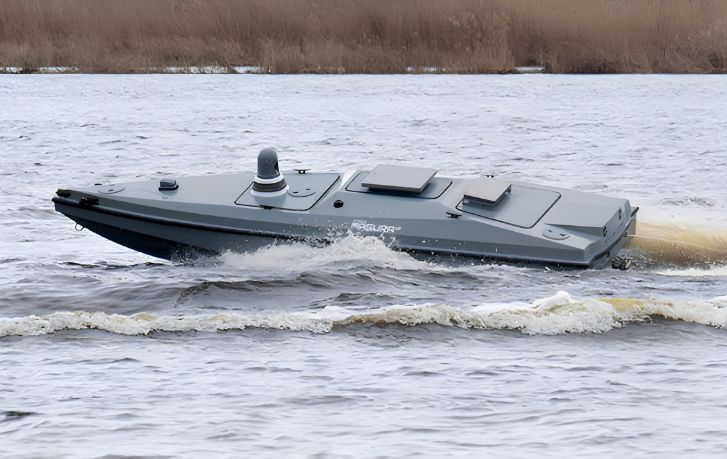
As many as 230 naval drones could be included in Russia’s 2026 government procurement order, according to an assessment from Defence Intelligence of Ukraine. The agency separately expects the Russian navy to receive more than 150 uncrewed surface vessels during the year, pointing to a potentially substantial expansion in unmanned maritime capacity.
Those figures are not a confirmed Russian order or delivery record. They are Ukraine’s intelligence estimate, and the difference between more than 150 expected vessels and a possible 230-unit order is important: procurement demand can exceed completed production, particularly when electronics and communications equipment are in limited supply.
Production volume depends on more than hull capacity
Defence Intelligence of Ukraine says Russia is prioritizing versatile vessel designs, domestically produced components, secure communications, artificial-intelligence technologies and greater operating range. Together, those priorities describe a program seeking not merely to assemble more hulls, but to establish a broader and more self-sufficient uncrewed-vessel ecosystem.
The harder production problem may sit inside the vessels. Controllers, sensors, navigation hardware, computing equipment and communications systems must be acquired, integrated and tested consistently across a fleet. Increasing the number of platforms therefore creates a parallel requirement for more qualified components, software integration work and production-line verification.
Ukraine’s intelligence service attributes current manufacturing complications to sanctions-related shortages of electronic components. “Overall, USV production in Russia is complicated by a shortage of electronic components caused by sanctions,” the agency said. It added that Moscow is finding it increasingly difficult to import or develop communications systems able to operate amid electronic warfare.
An Australian government sanctions advisory illustrates the wider supply-chain pressure. Issued in November 2025, it warns that restricted drone hardware may be routed through third countries, intermediaries or shipments described as generic electronics and radio modules. The advisory does not measure Russian naval-drone output, but it shows why obtaining components at scale can become slower, less predictable and harder to standardize.
Secure connectivity is a fleet-level constraint
Communications availability is not just another line item in the bill of materials. For an uncrewed vessel, the communications architecture affects command links, data transfer and the degree of onboard autonomy needed when connectivity is limited. A design that depends on scarce imported terminals or specialized radio equipment can be difficult to reproduce across hundreds of units, even if basic vessel production is available.
Defence Intelligence of Ukraine says Russian forces had used Starlink terminals to control uncrewed vessels and that restrictions involving the service may have contributed to Russia’s push to develop its own naval-drone technology. That claim remains attributed to the Ukrainian agency; the available information does not independently establish which vessels carried those terminals or how broadly they were used.
Russia is also deploying Rassvet, a planned low-Earth-orbit communications network commonly presented as a domestic counterpart to Starlink. DIU Deputy Chief Major General Vadym Skibitskyi previously said deployment was moving significantly faster than initially planned. However, early spacecraft performance introduces another uncertainty.
Two launches placed 32 operational Rassvet satellites into orbit in 2026, but none had reached its intended operating altitude by September. Tracking assessments indicated that at least three likely suffered outright failures, while several others showed possible problems. Those early results do not prove that Rassvet cannot support naval drones, but they do show that a domestic satellite network is not an immediate or risk-free replacement for established connectivity.
An order ceiling is not delivered capability
The possible 230-vessel requirement signals the scale Russia may be pursuing, while the estimate of more than 150 deliveries offers a nearer-term measure of expected output. Neither figure establishes how many vessels will be completed on schedule, accepted by the navy or equipped to a common operational standard.
For manufacturing and readiness, consistency may matter as much as quantity. A large order spread among prototypes, specialized designs and varying component sets can create heavier integration, maintenance and training demands than a standardized fleet. Previous Ukrainian intelligence reporting cataloged more than 20 Russian uncrewed surface-vessel projects, ranging from concepts and exhibition models to prototypes and systems reportedly placed in production.
Russia’s projected 2026 expansion is therefore substantial but not yet equivalent to 230 delivered, connected and reliable vessels. The decisive gap lies between the procurement ceiling and the industrial ability to supply electronics and resilient communications repeatedly at fleet scale.
| More aerospace and engineering stories, right in your MSN feed. Follow AMI on MSN |
By Stephen Wallace — Editor for AMI’s aerospace integration and unmanned mobility coverage, focused on drone manufacturing, VTOL systems, autonomous networks, and air-ground mobility links.