Tech Explorers Teaches Ukrainian Children to Fly, Build and Repair Drones
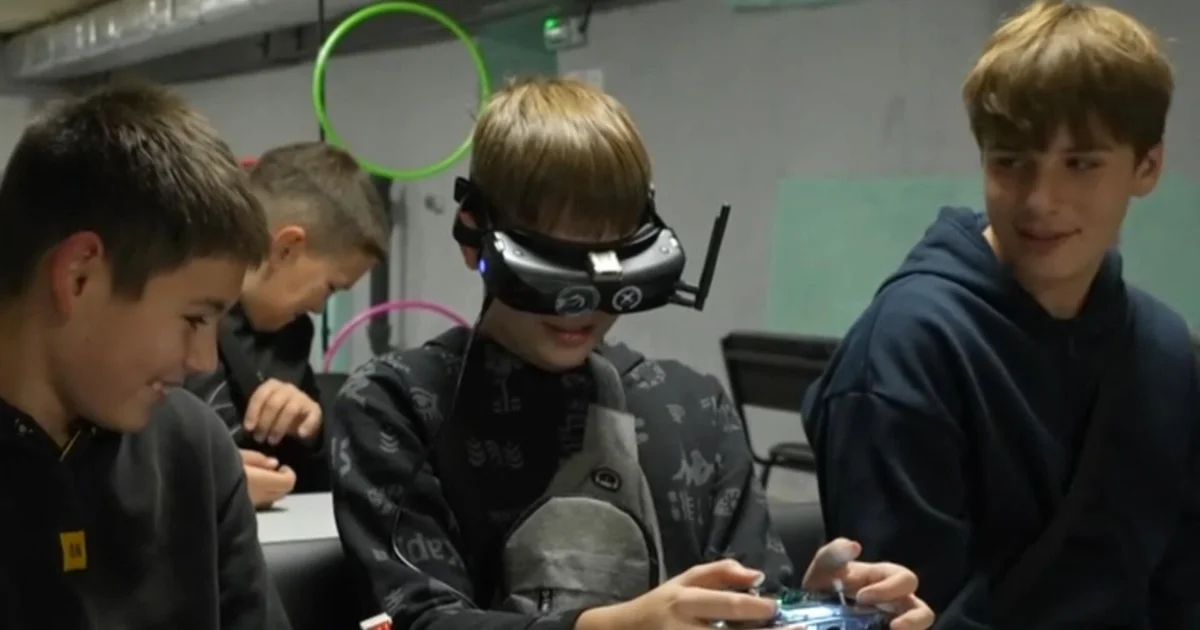
At a school about 20 miles south of Kyiv, wooden boards cover windows shattered during a recent Russian drone attack. In the basement, children are learning to control, build and repair smaller drones through a free after-school program. The contrast defines Tech Explorers: Drones remain instruments of war in Ukraine, but the nonprofit program is treating their underlying skills as a route into engineering and civilian work.
Operated by the Ukrainian nonprofit Dignitas, Tech Explorers serves children of Ukrainian service members. Students move between computer flight simulators, additive manufacturing and indoor flying exercises, creating an integrated path from virtual practice to physical hardware. The program includes robotics, three-dimensional printing and drone piloting for children as young as 10, according to a description of its courses.
The sequence matters from an engineering-education perspective. A simulator lets a student develop basic control familiarity without repeatedly damaging physical aircraft. Manufacturing a frame introduces the relationship between a digital design and a real component. Flying a completed miniature drone indoors then adds the consequences that software alone cannot fully reproduce, including the need to inspect and repair hardware after use.
This is not simply a piloting course. By combining operation, production and maintenance, Tech Explorers exposes students to several roles required by any functioning unmanned-aircraft ecosystem. Drone programs depend on people who can control aircraft, diagnose problems, replace damaged parts, manage digital tools and understand how a design behaves once manufactured.
The reported activities remain introductory, and completing them does not make a child a qualified engineer or professional drone operator. They do, however, provide a practical way to connect mathematics, computing and mechanical systems. That connection can be especially valuable for students who do not respond to those subjects when they are taught only in the abstract.
From a simulator to an engineering goal
Eduard, a 14-year-old participant whose father serves in the Ukrainian infantry, demonstrates that progression. He began on a simulator, moved into recreational drone racing in Kyiv and built aircraft of his own. He has since become skilled enough to assist instructors during lessons.
More significantly for the program’s long-term purpose, the experience changed his view of engineering. “I didn’t really like engineering before,” Eduard said. After learning to fly and understand drones, he said he now wants to attend engineering college.
One student cannot establish how effectively the program will produce future engineers. His experience nevertheless illustrates the pathway Dignitas is trying to create: Give children an accessible control problem, connect it to real manufacturing and repair work, and allow that experience to open a door into more formal technical education.
The instructors are also confronting an unavoidable ethical tension. Sasha, one of the program’s teachers, initially felt conflicted about teaching children to operate technology still associated primarily with military activity in Ukraine. “We don’t know how long this war will last,” Sasha said, arguing that the same technical preparation could help children find useful work in a country transformed by the conflict.
That distinction depends heavily on how the instruction is framed. Tech Explorers emphasizes individual interests and transferable technical knowledge rather than presenting drone operation solely as preparation for military service. Uncrewed aircraft also have expanding roles in agriculture, logistics, delivery and medical transport, all of which need dependable aircraft, trained operators and maintainers.
A broader shift in Ukrainian education
Ukraine’s schools are more broadly adapting education to prolonged national uncertainty. Basic medicine and pre-military preparation have entered curricula elsewhere, while a redesigned compulsory course for older students is scheduled to take effect in September 2027. That national effort has prompted debate over where emergency preparedness ends and militarization begins, as detailed in reporting on Ukraine’s changing school programs.
Tech Explorers occupies a different position as a voluntary after-school program centered on robotics, manufacturing and flight. Even so, the damaged school windows prevent the program from being separated from its wartime setting. The principal estimated that replacing them would cost $500,000, a physical reminder that the technology being studied downstairs is also shaping daily life outside.
For Ukraine’s future technical workforce, the program’s most consequential result may not be how many children learn to guide a miniature drone through an indoor course. It may be whether more students follow Eduard’s path from simulator practice to maintaining real hardware and then decide that engineering is where they belong.
| More aerospace and engineering stories, right in your MSN feed. Follow AMI on MSN |
By Stephen Wallace — Editor for AMI’s aerospace integration and unmanned mobility coverage, focused on drone manufacturing, VTOL systems, autonomous networks, and air-ground mobility links.