HAL Has 30 Tejas Airframes Ready but Cannot Deliver One
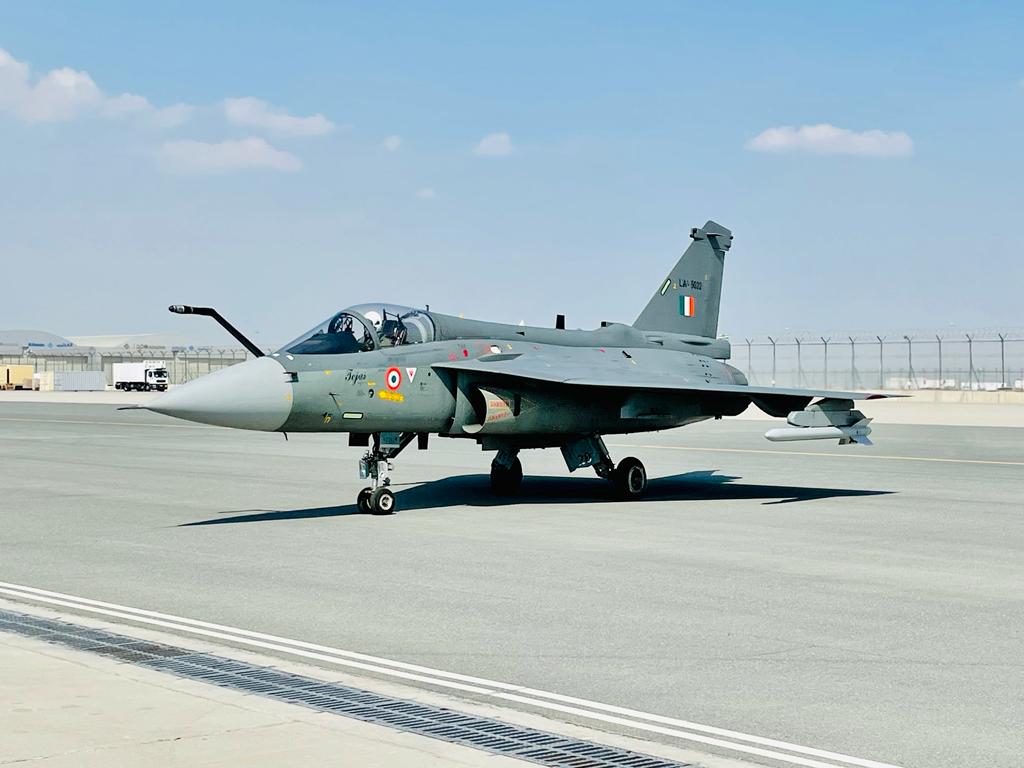
Hindustan Aeronautics Limited reportedly has about 30 Tejas Mark1A fighter airframes ready, yet it cannot deliver a single one to the Indian Air Force. The immediate barrier is not basic airframe production or even the program’s delayed engine supply. Radar to missile integration and its associated testing remain unfinished, leaving the aircraft more than two years behind the original delivery schedule.

HAL Chairman and Managing Director Ravi K said the pending integration issues should be resolved “in a couple of months.” In a separate September 2026 program update, he put the ready airframe count at 27 and said remaining tests involved the active electronically scanned array radar and missile integration. Other reporting places the accumulated inventory at roughly 30 airframes. Either figure exposes the same production tension: manufacturing has moved substantially ahead of the validation work required for acceptance.
An airframe is not yet a deliverable fighter
The first batch of 83 Tejas Mark1A aircraft uses the Israeli Elta EL/M-2052 active electronically scanned array radar. Integrating that sensor with the fighter’s missiles is fundamentally a systems task, involving software, repeated testing and coordination among HAL, India’s Defence Research and Development Organisation and the radar manufacturer.
That distinction matters because a production aircraft must be delivered in an approved configuration. A completed structure cannot simply be handed over while essential radar and weapon functions remain short of their required testing and sign off. The final work can take disproportionate time because changes must be checked across interacting hardware and software rather than on an isolated component.
Ravi K described the aircraft as being 90% to 95% through the relevant work, with a small number of tests still pending. That does not translate directly into a delivery date. The remaining fraction includes validation needed to establish that the integrated configuration meets its requirements. Until that process is complete, the backlog consists of airframes rather than inductable fighters.
This is why producing structures faster does not necessarily recover a delayed aircraft program. Airframe assembly, software maturity, systems integration, flight testing, engines and customer acceptance must converge on the same schedule. If one stream falls behind, inventory accumulates without creating operational capacity.
Only 10 engines are available for the accumulated backlog
Once radar and missile integration is completed, engine availability is positioned to become the next constraint. HAL says it has received 10 General Electric F404 engines, while its reported airframe inventory is roughly three times that number. GE shipped three engines in August, and HAL expected to receive a total of 22 by December, according to an update on the engine deliveries.
The F404 supply schedule was already running late. Deliveries had been scheduled to begin in March 2023, but the interruptions contributed to the wider aircraft delay. Although GE has promised to accelerate output, no detailed revised schedule covering the entire backlog has been provided.
Ten engines do not support delivery of approximately 30 aircraft, even after the integration gate opens. Nor does an engine shipment instantly produce a customer ready jet: installation, checks, ground work, flight activity and acceptance still have to be completed. The practical result could be a phased release in which integration approval allows deliveries to start, but engine arrivals determine how quickly HAL can work down the accumulated airframes.
The Air Force is waiting on a much larger production plan
The Indian Air Force currently operates 40 Tejas aircraft and is waiting for the Mark1A as its wider fighter inventory declines. “We eagerly await induction,” Air Marshal Ashutosh Dixit, the service’s vice chief, said. HAL is scheduled to deliver 180 Mark1A aircraft over the next decade, making the present delay more than a first batch problem.
Experts have recommended stronger project oversight, earlier identification of high risk imported systems and reduced dependence on single foreign suppliers. Those remain proposals, not implemented reforms. Supplier diversification would also be a long-term industrial measure rather than a quick substitute for an engine already designed into the aircraft.
The immediate milestone is completion of the radar and missile work and formal clearance of the production configuration. If HAL reaches that point within the chairman’s stated window, attention will shift quickly from unfinished software validation to a harder numerical constraint: roughly 30 waiting airframes, but only 10 engines received so far.
| More aerospace and engineering stories, right in your MSN feed. Follow AMI on MSN |
By David Whitaker — Associate editor for AMI’s aerospace and drone systems desk, translating flight systems, aircraft programs, spaceflight, and UAV developments into accessible technical stories.