Navy Shipyard Modernization Could Top $200 Billion and Take 50 Years
More than $200 billion and over 50 years: those are the projected dimensions of the U.S. Navy’s effort to modernize its four public shipyards. The figures are not money already spent or a final validated Navy estimate. They are the Government Accountability Office’s assessment of current plans and they approach ten times the program’s original $21 billion estimate while stretching more than twice as long as its initial 20-year schedule.
The GAO assessment dated September 25, 2026, covers the Navy’s Shipyard Infrastructure Optimization Program, launched in 2018. It encompasses Norfolk Naval Shipyard in Virginia, Pearl Harbor Naval Shipyard in Hawaii, Portsmouth Naval Shipyard in Maine and Puget Sound Naval Shipyard in Washington. The Navy accepted all three GAO recommendations addressing reviews of requirements and resources, as well as documentation of organizational responsibilities.
Why the estimate expanded so sharply
The comparison between $21 billion and more than $200 billion requires an important qualification. The 2018 number was a rough early estimate rather than a mature baseline for every project the Navy would eventually undertake. It omitted major elements such as utilities and roads, while later plans added repair work, transportation infrastructure, environmental projects and program-management costs.
That distinction explains part of the numerical jump, but it does not eliminate the public-accountability problem. An early estimate can be preliminary and still shape expectations about affordability, timing and competing demands on public funds. When a program grows by nearly an order of magnitude, decision-makers need a standardized account of what has been spent, what remains unfunded, which assumptions changed and where the largest risks reside.
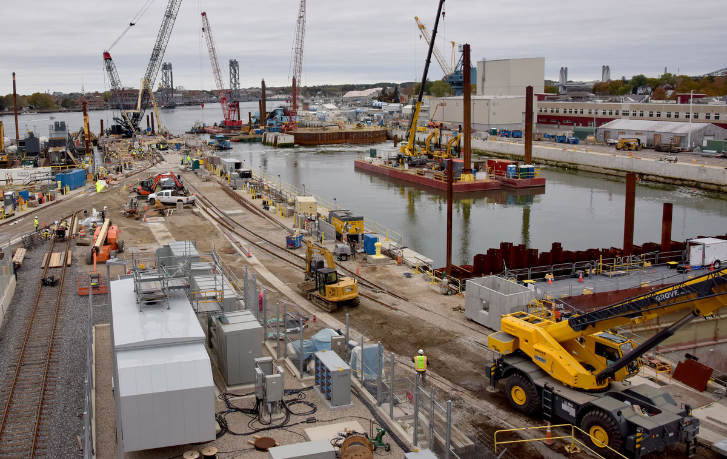
Construction conditions also matter. These are not empty sites where crews can build an entirely new industrial complex without operational constraints. The shipyards must continue maintaining nuclear-powered submarines and aircraft carriers while dry docks, workshops, utilities and transportation routes are rebuilt around ongoing work. That raises staging, sequencing and access demands and can lengthen schedules even when individual projects are technically feasible.
Other increases came from higher prices for materials, deferred maintenance, environmental requirements and newly identified work. At Puget Sound, revised assessments of seismic risk created a need for additional reinforcement and construction. Costs for dry-dock projects at Portsmouth and Pearl Harbor together rose by more than $2.5 billion from the amounts initially requested from Congress. Three major dry-dock projects at Portsmouth, Pearl Harbor and Puget Sound now carry a combined estimated cost of $21.7 billion.
A 50-year program creates a moving target
The schedule itself is a systems-engineering risk. A facility plan extending beyond 2080 must make assumptions about future vessel classes, fleet size, maintenance demand, industrial technology and environmental standards. Some of those assumptions will change long before the final project begins. A dry dock designed around today’s fleet plan may still be useful decades from now, but that cannot simply be presumed at the start.
GAO found that the Navy had established an oversight framework resembling those used for major defense acquisition programs. However, it had not built regular reassessments of objectives and resources into key decision points. That gap matters because long-duration infrastructure needs controlled opportunities to revise priorities without allowing every change to become an uncontrolled addition to cost and scope.
The same concern applies to governance. Multiple organizations oversee projects and coordinate integration with operating shipyards, yet GAO found that their roles and responsibilities were not fully documented. On a program spanning generations of personnel, informal knowledge is not a durable control system. Written authority, decision rights and reporting responsibilities are necessary to preserve continuity as leaders, contractors and fleet requirements change.
The fleet pays for constrained maintenance capacity
The four yards perform work that cannot be treated as ordinary commercial maintenance. Their dry docks, workshops and specialized equipment support complex nuclear-powered vessels, so infrastructure availability directly limits where major work can be performed. Modernizing one part of a yard can therefore improve future capacity while temporarily complicating current maintenance a tradeoff that must be reflected in project sequencing.
The broader submarine position increases the consequence of those constraints. The Navy has 49 attack submarines against a stated requirement for 66, and the fleet is expected to decline to about 46 by 2030. Those numbers do not establish that shipyard modernization delays caused the shortfall. They do show why maintenance throughput and infrastructure availability carry consequences beyond the construction program itself: a submarine awaiting major work is not equivalent to an available submarine.
The Navy has completed more than 60 of over 400 planned facility projects since 2018, so the program is producing physical work rather than remaining entirely on paper. Yet later construction reaches into the 2070s, with the last currently planned projects scheduled beyond 2080. Annual standardized reporting and recurring technical reviews would not make that work inexpensive, but they would give taxpayers and decision-makers a clearer basis for deciding whether each succeeding block still matches the fleet it is meant to support.
| More aerospace and engineering stories, right in your MSN feed. Follow AMI on MSN |
By Thomas Caldwell — AMI’s senior editor for mechanical and mobility engineering, covering vehicle electronics, systems integration, electrification, chassis systems, propulsion, and safety policy.