Russia’s Shturm Robot Tank Loses Remote Link, Then Gets Stuck in Mud
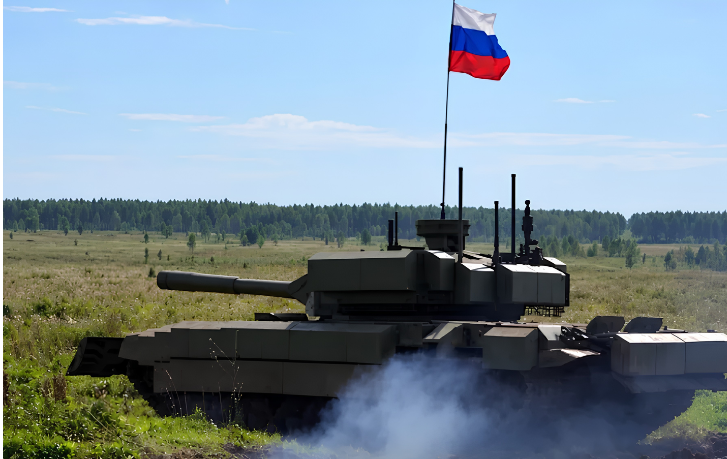
Russia’s new Shturm robot tank repeatedly lost its remote-control connection during its debut at the Tsentr-2026 exercise, according to an October 3 report by Defense Blog. Organizers reportedly responded by putting a human driver-mechanic aboard, but the vehicle still became immobilized in a muddy ditch beside a dirt track.
That sequence exposes two separate constraints in the system. The dropped radio link interrupted Shturm’s defining mode of operation, while the later immobilization was a conventional tracked-mobility problem that direct human control did not prevent. The demonstration does not establish why either failure occurred, but it shows that adding a crewed fallback does not remove the terrain limits of the underlying vehicle.
Remote control is central to the Shturm design
Shturm is a heavy robotic assault-vehicle system developed by Russian manufacturer Uralvagonzavod, primarily for operations in urban environments. It uses modified T-72 and T-90 tank chassis and is intended to be driven remotely by operators inside a separate armored command vehicle.
The stated control range is roughly 3 kilometers. A separate technical description of the system says its vehicles are intended to operate within direct line of sight at approximately 3 to 4 kilometers, with three operators in the accompanying command vehicle. This architecture is examined in more detail by Defense Express.
This is remote operation rather than demonstrated autonomy. Shturm depends on commands crossing a radio connection from another vehicle; it has not been described as independently navigating the exercise route or making its own driving decisions. When that connection repeatedly dropped, organizers reportedly abandoned remote operation rather than allowing an autonomous controller to continue the task.
The distinction matters because a remotely driven machine divides its control loop across two vehicles. Cameras and other onboard sensors provide information, the radio system carries that information to operators, and commands must then return to the vehicle’s steering, braking and propulsion systems. A disruption anywhere in that chain can prevent effective remote driving even if the chassis, engine and actuators remain functional.
A human fallback solved only the control-link problem
Shturm includes an onboard manual-driving provision, and that fallback allowed the demonstration to proceed without relying on the unstable remote connection. It did not, however, change the tank’s ground pressure, track interaction, mass distribution or the condition of the route.
Under manual control, the vehicle entered a muddy ditch and became stuck with its tracks and front hull buried in the soil, according to the account of the exercise. The available information does not establish whether driver input, route selection, soil conditions, vehicle configuration or another factor caused the immobilization. It supports only the narrower conclusion that switching control modes was insufficient to complete the display.
This is an important boundary for robotic ground vehicles built on conventional armored platforms. Removing the operating crew from its normal position can reduce direct human exposure, but it does not automatically improve traction, obstacle clearance or recovery from soft ground. Those capabilities still depend on mechanical design, terrain sensing and how effectively an operator remote or onboard can interpret local conditions.
The Russian Defense Ministry said on October 2 that new uncrewed combat vehicles provided fire support during the exercise’s main stage. Reports of Shturm’s repeated connection losses and eventual immobilization emerged afterward. Tsentr-2026 ran from September 28 through October 3.
Described Shturm configurations include a shortened 125 mm D-414 main gun, twin 30 mm automatic cannons or thermobaric rocket launchers. Those payload options do not alter the control issue demonstrated at the exercise: a heavy robotic vehicle is useful as an uncrewed system only while its operators can reliably sense, command and move it.
An armor expert cited by Defense Blog also criticized the need to keep the command vehicle nearby and alleged weaknesses in parts of Shturm’s protection. Those remain attributed assessments, not official findings. What the debut directly demonstrated was more limited but still consequential: the remote link failed repeatedly, and the onboard human fallback did not prevent the platform from ending its first major display stuck in the mud.
| More aerospace and engineering stories, right in your MSN feed. Follow AMI on MSN |
By Jonathan Barrett — Editor for AMI’s future mobility and autonomous systems section, with two decades covering robotics, e-mobility, drone-vehicle convergence, and transport mechanical systems.