India Needs 40 Fighters a Year, but Engines and Integration Hold Back Tejas
The Indian Air Force needs 36 to 40 new fighters each year to halt its decline from roughly 30 squadrons and begin moving toward its requirement of 42, Air Chief Marshal AP Singh said. The service currently operates 29 fighter squadrons against a sanctioned strength of 42.5, making annual induction rates not simply the number of aircraft ordered the central constraint on rebuilding the fleet. Singh said the shortage and delayed inductions are reducing available numbers.

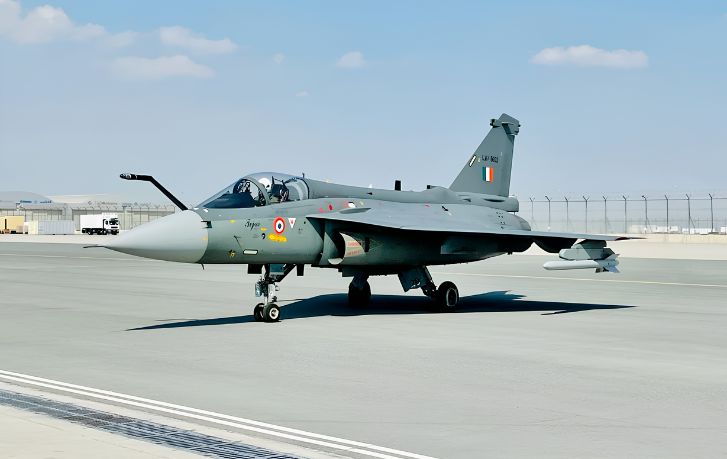
The immediate mismatch is visible on the Tejas Mk-1A line. Hindustan Aeronautics Limited has roughly 30 airframes ready but only 11 GE Aerospace F404 engines, while radar and missile integration work also remains unresolved. That means physical progress on airframes has not yet translated into the rate of completed, accepted fighters the air force needs.
The distinction matters because fighter production is a network rather than a single assembly-line number. An airframe can move substantially through manufacturing while awaiting its engine, software validation, sensor integration or weapons-clearance work. Until those elements converge in a configuration accepted for induction, nominal factory capacity does not equal usable aircraft deliveries.
HAL is contracted to supply 180 domestically produced Tejas Mk-1As. Singh said deliveries of 20 F404 engines annually could eventually support production of about 20 fighters per year across HAL facilities in Bengaluru and Nashik. Only 10 engines are due this year under one stated schedule, however, leaving propulsion supply below the desired steady-state rate.
HAL leadership has separately identified the F404 shortage as a constraint on executing the program. The imported engine is therefore not a peripheral component in the schedule: its arrival rate sets a practical ceiling on how many otherwise advanced airframes can be completed. Adding assembly capacity at a second location helps only when propulsion, avionics, software and test resources arrive in step with it.
The Mk-1A also illustrates why integration can remain on the critical path after major hardware is available. The upgraded fighter introduces an electronically scanned radar, revised avionics and electronic-warfare equipment, aerial-refueling capability and expanded weapons integration. These features increase capability over the earlier Tejas, but they also require system-level testing and validation before aircraft can enter service in the intended configuration. The available information does not establish a final delivery date for resolving the remaining radar-missile work.
Projected production still falls short
India is also negotiating a proposed acquisition of 114 Dassault Aviation Rafale fighters after the Defense Acquisition Council endorsed the program in February. Singh estimated that the contract, if approved and executed, could provide approximately 12 aircraft annually. He explicitly made that rate conditional: If the MRCA contract goes through, we will get about 12 aircraft per year from this contract.
Combining that estimate with approximately 20 Tejas Mk-1As produces about 32 fighters per year. That is eight below the upper end of Singh’s stated annual requirement and four below the lower 36-aircraft threshold. A separate contract for 12 additional Sukhoi Su-30 fighters could narrow the gap temporarily if six arrive in each of two years, but it does not establish a sustained production rate.
The 32-aircraft comparison also has limits. It is not confirmed that Tejas production will reach 20 annually at the same time Rafale deliveries reach 12, and the proposed Rafale contract is still under negotiation. Those figures are therefore planning assumptions rather than a synchronized delivery schedule.
For the Indian Air Force, the harder measure is net squadron strength. New aircraft must cover retirements before they can create growth, which is why Singh framed 36 to 40 annual inductions as the rate needed first to stop the decline and then rebuild. Orders for 180 Tejas fighters and a proposed 114-aircraft Rafale program create a substantial pipeline, but contracts alone cannot fill squadrons.
The near-term test is whether engine deliveries and integration work can convert HAL’s waiting airframes into accepted Mk-1As, then sustain that flow across both production sites. Until that happens, India’s fighter recovery remains bounded by the slowest part of the production network not by the number of airframes sitting in the factory.
| More aerospace and engineering stories, right in your MSN feed. Follow AMI on MSN |
By David Whitaker — Associate editor for AMI’s aerospace and drone systems desk, translating flight systems, aircraft programs, spaceflight, and UAV developments into accessible technical stories.