

Anduril Submarine Plan Joins $6 Billion in Investment-Linked Defense Awards
Anduril Industries’ proposed Maryland submarine-component plant combines $3.7 billion in private capital with a Navy contract worth up to $2.9 billion. It also adds a major procurement decision to a broader transparency issue: companies backed by investment firms tied to President Donald Trump’s sons have received more than $6 billion in active or promised government awards, according to an ABC News analysis published October 7.
The financial connection does not establish procurement influence. Donald Trump Jr. is one of six listed partners at 1789 Capital, which acquired a major Anduril stake through a $2.5 billion investment in June 2025. A spokesperson for Donald Trump Jr. and Eric Trump said they do not participate in government procurement or award decisions. No available information demonstrates favoritism, corruption or actual influence over the cited awards.
Two multibillion-dollar figures mean different things
The $6.6 billion attached to Anduril’s Arsenal-2 plan is not a single government payment. It combines Anduril’s planned $3.7 billion investment with a Navy contract ceiling of as much as $2.9 billion. Anduril says government payments will be tied to demonstrated production outcomes, meaning the maximum value is conditional rather than money already disbursed.
The separate figure of more than $6 billion covers active or promised government awards across several companies backed by Donald Trump Jr., Eric Trump or associated investment firms. That calculation combines agreements with different structures, including contract ceilings and potential orders. It therefore measures the scale of commitments linked to those companies, not a uniform pot of money already spent.
This distinction matters because contract ceilings are common tools for giving an agency room to order equipment or services over time. Actual spending depends on funded orders, performance, delivery and other contractual conditions. Treating every ceiling as an immediate payment would overstate taxpayer exposure; ignoring the ceiling would understate the government’s potential commitment.
Arsenal-2 targets a real production constraint
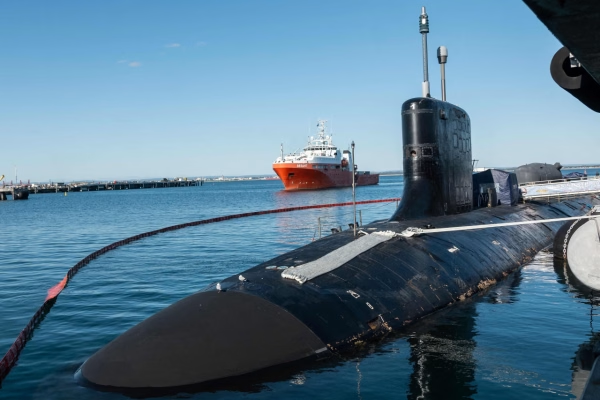
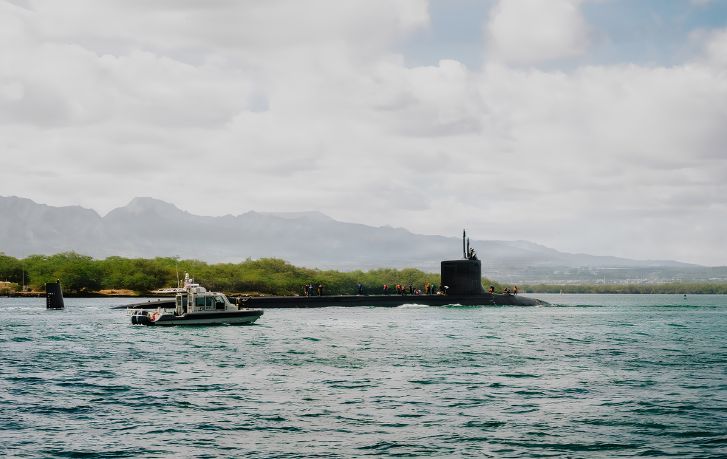
At Sparrows Point in Baltimore County, Arsenal-2 is planned as a more than 2-million-square-foot manufacturing complex for Virginia-class submarine components and large assemblies. Initial work would include torpedo tubes, while Anduril also plans production related to autonomous submarines. The company expects initial Maryland operations in 2030, subject to permitting, construction and other approvals.
Anduril’s proposed role is as an additional component supplier, not a replacement for the two shipbuilders that assemble Virginia-class submarines: General Dynamics Electric Boat and HII’s Newport News Shipbuilding. The production argument is that another source can move more component work in parallel and reduce pressure on a submarine industrial base constrained by specialized suppliers, qualified workers and demanding inspection requirements.
That capacity cannot be created simply by opening a large building. Submarine components require controlled manufacturing processes, traceable records, skilled trades and extensive qualification. Anduril plans to begin developing those processes at a 160,000-square-foot California facility before the Maryland plant opens. That two-year head start is intended to test workflows, train workers and establish quality systems before production scales.
The arrangement consequently presents two separate accountability tests. The first is industrial: whether Anduril can turn private capital, software-managed production and a new workforce into accepted submarine hardware. The second is financial: whether Navy payments remain tied to measurable output rather than the announced size of the facility or its promised capacity.
The investment links warrant review, not a presumption
After 1789 Capital’s June 2025 Anduril investment, the company received 135 other government contracts valued at about $1.8 billion, according to the ABC News calculation. But Anduril’s federal contracting history dates to 2019, before that investment. Timing can establish a sequence worth examining; by itself, it cannot establish why contracting officials selected a company.
The broader list includes drone manufacturers Unusual Machines and Powerus, rocket-engine developer Firehawk Aerospace, quantum-computing company PsiQuantum and automated manufacturer Hadrian. The cited awards range from an agreement for 3,500 compliant drone motors, with a potential 20,000-unit order, to a Powerus award worth up to $90 million for unmanned aircraft systems. Hadrian received a $39.2 million Army agreement and a $900 million Navy deal following a reported $391 million investment from 1789 Capital.
Representatives for Powerus and Firehawk said their awards were based on technical merit. Those responses address the companies’ position but do not substitute for procurement records showing competition, evaluation criteria, milestones and payments. Conversely, the investment relationships do not show that the equipment failed technical review or that contracting officials departed from established processes.
Congressional Democrats have requested a Pentagon inspector-general investigation. Such a review could clarify how the awards were competed, whether required conflict controls were followed and how much money has actually been obligated. For Arsenal-2, the most consequential evidence will arrive through approvals, demonstrated production results and Navy payments not the $2.9 billion ceiling alone. The plant is expected to begin operating in 2030, leaving several years in which its promised capacity and its accountability structure will both have to be proved.
| More aerospace and engineering stories, right in your MSN feed. Follow AMI on MSN |
By David Whitaker — Associate editor for AMI’s aerospace and drone systems desk, translating flight systems, aircraft programs, spaceflight, and UAV developments into accessible technical stories.