Ukraine Says Drone Defense Is Rapidly Consuming Its F-16s’ Service Life
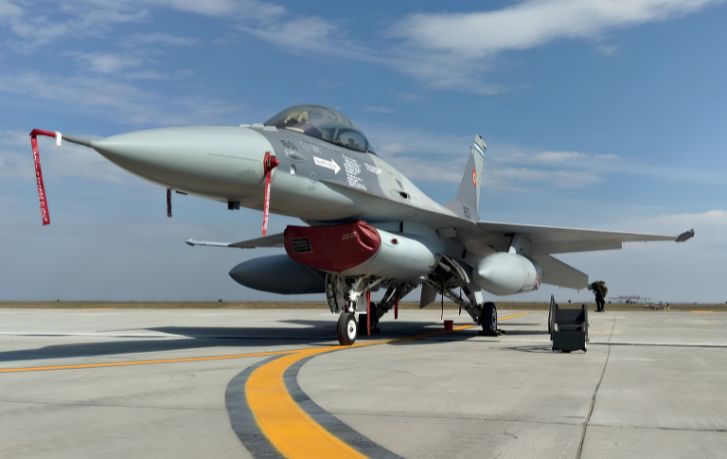
Ukraine’s F-16 fighters are proving useful against Russian jet-powered drones, but the missions are creating a second problem: The operating pace is rapidly consuming the aircraft’s limited service life. Colonel Yuriy Cherevashchenko, deputy commander of the Ukrainian Air Force for air defense, said it is becoming difficult to keep the fighters continuously ready under such intensive use.

Cherevashchenko made the assessment during a meeting of the Verkhovna Rada’s Temporary Investigative Commission. He described continued maintenance and support from international partners as critically important. Ukraine has not disclosed its F-16 sortie rate, remaining service life, maintenance backlog or current fleet availability, so the timing and scale of any resulting reduction in capacity remain unclear.
Every mission draws from a finite aircraft resource
An F-16 does not simply return from a flight ready to repeat the same mission indefinitely. Operating time moves the aircraft and its components toward scheduled inspections, maintenance thresholds and eventual service-life limits. High utilization compresses that work into shorter calendar periods, increasing demand for technicians, inspection capacity, replacement parts and access to deeper maintenance.
Service life is also not a single countdown applying uniformly to every jet. Individual aircraft can have different operating histories and maintenance conditions. Without aircraft-level data, it is impossible to calculate how much useful life Ukraine’s missions are consuming or which maintenance requirement is becoming the dominant constraint. Cherevashchenko’s statement nevertheless identifies the central readiness issue: A limited fleet can become maintenance-bound even while its missions demonstrate clear operational value.
That distinction matters because the number of aircraft transferred does not equal the number available for flight on a given day. Some fighters will be undergoing inspections or repairs, while others must remain supported with qualified personnel, compatible parts and ammunition. Increasing utilization can therefore produce a nonlinear burden: More flying generates more maintenance demand, which can leave fewer aircraft available to carry the next round of missions.
Sustainment now matters as much as aircraft delivery
Ukraine’s reliance on foreign support extends beyond receiving complete fighters. The Netherlands has said it will assist with F-16 maintenance, spare parts and ammunition. Spain, Belgium and Poland have also begun supplying 20-mm ammunition needed in part for F-16 operations against jet-powered drones.
Those supplies address different parts of the same availability chain. Ammunition enables a ready aircraft to perform its mission. Parts and maintenance determine whether the aircraft becomes ready in the first place. A shortage at either end can ground useful capacity, even when pilots and aircraft are otherwise present.
The broader F-16 support system illustrates why parts availability can become a fleet-level issue. In September, a U.S. Air Force depot team dismantled an irreparably damaged F-16 at Edwards Air Force Base to recover hard-to-find and discontinued components for other aircraft. Ukraine’s circumstances are different, but the example shows how an established F-16 operator can use retired airframes and depot infrastructure to sustain jets that remain in service.
Ukraine does not control the full industrial and maintenance network behind the donated fighters. That makes international coordination part of aircraft readiness: Components may have to be sourced abroad, specialized work may depend on outside facilities, and ammunition deliveries must continue alongside maintenance support. The practical bottleneck is therefore not only how many F-16s partners pledge, but how reliably the support network can return aircraft to service.
Three more fighters will not settle the constraint
Belgium plans to transfer three F-16s to Ukraine through an expedited procedure by the end of 2026. Additional aircraft could expand the pool available for operations and maintenance rotation, but there is no confirmed basis for concluding that three fighters will offset aircraft unavailable because of inspection demands or service-life limits.
The next meaningful measure will be sustained availability rather than the delivery count alone. Unless support capacity, spare parts and ammunition grow with the operating pace, the same missions that make Ukraine’s F-16s valuable will continue to push those aircraft more quickly toward maintenance and the limits of their remaining service lives.
| More aerospace and engineering stories, right in your MSN feed. Follow AMI on MSN |
By David Whitaker — Associate editor for AMI’s aerospace and drone systems desk, translating flight systems, aircraft programs, spaceflight, and UAV developments into accessible technical stories.