Ukraine Cuts Direct Chinese Drone Imports, but Critical Dependence Remains
Ukraine has built a fast-moving domestic drone industry to help hold off a larger Russian force, yet a handful of difficult-to-replace Chinese components still constrains how many systems it can produce and at what cost. Supporters concerned about maintaining the current stalemate are confronting an uncomfortable industrial reality: motors, camera components, flight controllers and underlying materials can matter as much as final assembly.
Ukraine Customs data show a substantial shift in direct sourcing. China’s share of imported drone parts fell from nearly 90% at the beginning of 2024 to 28% during the first eight months of 2026 as manufacturers expanded production at home and bought more equipment from Taiwan, Europe and the United States.
That figure does not mean Chinese manufacturing has been reduced to 28% of Ukraine’s imported supply. Some parts listed as arriving from Poland, the Czech Republic and other intermediaries were likely made in China before being routed through those countries. Customs origin can identify the immediate shipping route without settling where every motor, chip or sensor was manufactured.
Local assembly does not eliminate the material bottleneck
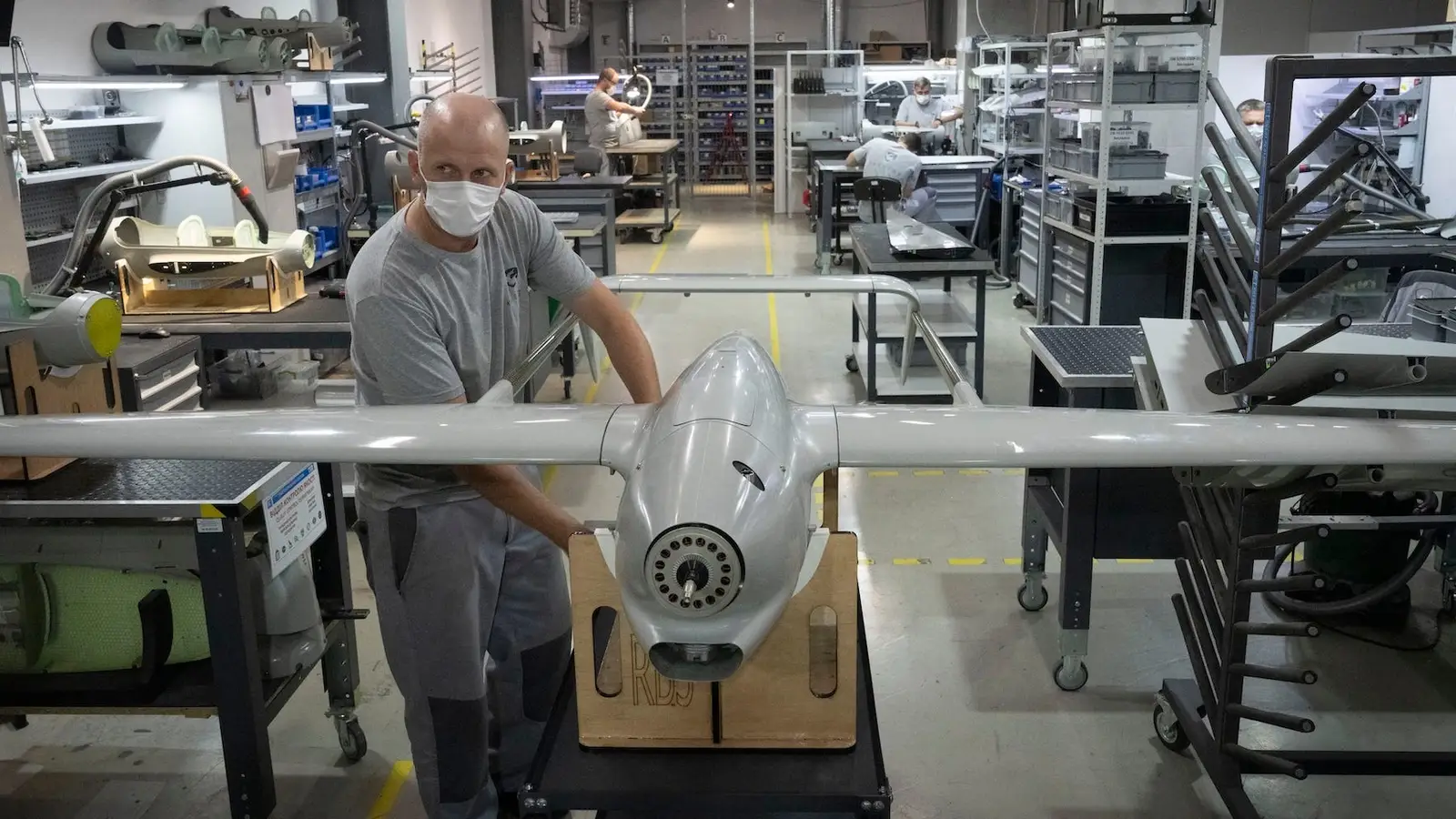
Vyriy founder Oleksii Babenko said his company once obtained nearly 90% of its attack-drone components from China but now makes about 70% to 80% in Ukraine. That is a major localization gain, and domestic manufacturing can also shorten redesign cycles. Serpens Center analyst Artur Savchii said Ukrainian companies can modify some drones and components within days, while changes moving through foreign supply chains can take months.
But localization is not a binary label. Ukraine can assemble batteries while still importing their cells. It can assemble motors while relying on imported magnets and copper. Manufacturers also identify chips, thermal sensors, lenses and flight controllers among the inputs that continue to come largely from China.
Cameras illustrate how a small imported share can control the availability of an entire product. Ukrainian companies can design and assemble thermal cameras, but the sensors and lenses inside remain difficult to obtain in sufficient quantities. Without this 5%, there is no camera, Odd Systems executive Andrii Taganskyi said of the remaining critical content. He put the consequence more bluntly: If China stops their production to us … we are blinded.
Taganskyi estimated that Europe produces about 600,000 thermal sensors annually, compared with an estimated Ukrainian requirement of roughly 4 million. This is not simply a matter of placing more orders with a Western vendor. It is a production-capacity gap involving specialized semiconductor fabrication, prices that work for high-volume systems and supply already claimed by other customers.
The economics are similarly restrictive. TAF Industries executive Oleksandr Yakovenko estimated that replacing all Chinese inputs with Western alternatives could raise costs by as much as 60% while reducing production by a similar amount. Those are an executive’s estimates rather than audited industry totals, but they define the tradeoff manufacturers say they face: greater supply independence could initially buy fewer drones at substantially higher cost.
Export controls add uncertainty to a shared supply base
China has tightened controls on drones and related equipment several times since 2023, including additional restrictions during the summer of 2026. The measures have not stopped shipments to Ukraine, but Ukrainian manufacturers report delays, higher costs and increased use of third-country intermediaries. Beijing says it takes a prudent and responsible approach to military exports and opposes using civilian drones for military purposes.
Enforcement is not merely theoretical. Chinese authorities have charged a technology company and several people over the alleged export of controlled optical lenses without the required licenses. The case involves lenses used in infrared thermal imaging and demonstrates the compliance pressure facing suppliers of dual-use optical equipment.
Both Ukraine and Russia therefore draw from much of the same Chinese industrial base. Analysts describe Russia as even more dependent because Western sanctions restrict its access to alternative markets. That does not establish that Chinese factories have formally prioritized Russian orders. It does, however, leave open the risk of preferential treatment when two high-volume buyers seek scarce components.
“China has leverage,” Royal United Services Institute researcher Robert Tallost said, warning that Beijing could direct more material toward Russia while restricting supplies to Western-aligned buyers. The concern is potential leverage, not proof that China has already cut Ukraine off or adopted such a preference.
New factories offer an answer, but not an immediate one
Ukrainian firms The Fourth Law and Odd Systems have announced Project Foundation, an initiative intended to mass-produce uncooled thermal sensors in Europe and the United States. Its stated three-year goal is to quadruple European output and double US output. Separately, Lithuanian and Ukrainian companies plan a joint factory in Lithuania for drone components and electronic-warfare systems, with production expected to begin in 2027.
Those projects address the right layer of the supply chain: not just assembling finished cameras and drones, but manufacturing the scarce components inside them. Yet planned capacity cannot immediately match an established Chinese ecosystem on scale and cost. Ukraine has proved it can localize quickly; the remaining test is whether allied industry can expand the few production lines whose absence can still stop an otherwise domestic drone from being completed.
| More aerospace and engineering stories, right in your MSN feed. Follow AMI on MSN |
By Stephen Wallace — Editor for AMI’s aerospace integration and unmanned mobility coverage, focused on drone manufacturing, VTOL systems, autonomous networks, and air-ground mobility links.