One U.S.-China Oil Voyage Costs $80 Million, Topping Falcon 9 Launch
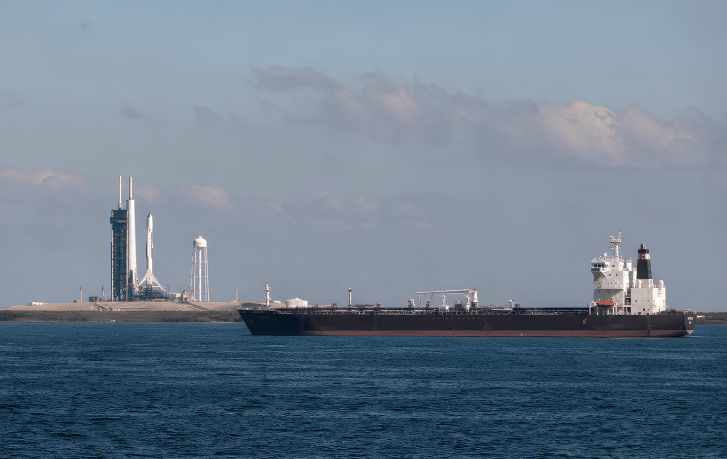
A recent charter to move about 2 million barrels of crude oil from the U.S. Gulf Coast to China reached approximately $80 millionmore than the stated $74 million price of a standard SpaceX Falcon 9 launch. The November-loading tanker fixture worked out to roughly $41 for every barrel transported.
The comparison is striking because the tanker is performing an established transportation job rather than accelerating a payload into orbit. Yet it also exposes the unusual economics of a shipping network operating with too few available vessels, longer routes and added transfer time. Last year, freight on the U.S.-China route averaged $4.50 per barrel. The recent fixture was about nine times that figure.
At $41 per barrel, transportation alone equaled roughly 45% of the price of West Texas Intermediate crude when that benchmark was near $91. That changes the calculation for an Asian refinery: the relevant number is not the quoted price at the oil’s origin, but the total delivered cost after chartering, insurance and other transportation expenses.
The shortage is measured in ship-days
A tanker shortage does not require vessels to disappear from the fleet. Capacity also contracts when each voyage takes longer. Ship-to-ship transfers near the Strait of Hormuz can add approximately one week to a journey. During that additional time, the tanker cannot begin another revenue voyage, so its effective annual carrying capacity falls even though its physical capacity is unchanged.
Repositioning produces a similar penalty. Industry executives said traffic through Hormuz had recovered to about 80% of its prewar level, increasing demand for ships to return to Gulf loading points. Some tankers had previously sailed empty to other regions and must now spend additional days traveling without cargo before entering the most heavily demanded trades.
Other vessels are undergoing repairs after attacks, while some are taking longer routes around Africa. Each change consumes ship-days. When repeated across a global fleet, those days determine how many cargoes the system can actually move in a month. Vitol Chief Executive Russell Hardy summarized the constraint directly: There really aren’t enough ships to meet all the demand.
Shipbroker SSY says inflation-adjusted freight rates are now the highest since supertankers began operating in the 1960s. The U.S. Energy Information Administration had already identified the broader capacity effect in March, when it found that Middle East-to-Asia tanker rates reached their highest level in records extending to 2005. Fewer available vessels also pushed rates from the Americas to record levels.
High freight can close an oil trade route economically
The immediate consequence is not necessarily that oil cannot move between the United States and China. It is that the delivered price may no longer be competitive. Asian refiners can consider crude from the Middle East or Latin America, while U.S. sellers may lower their offers or use smaller tankers. West African sellers are also offering discounts to offset the expense of transporting crude roughly 16,000 kilometers to Chinese refineries.
Smaller ships can reduce the total charter bill for an individual cargo, but they carry substantially less oil. That means the useful comparison remains cost per delivered barrel, not simply the invoice for hiring a vessel. The recent U.S.-China fixture shows how scarce capacity can overwhelm the normal scale advantage of a very large crude carrier.
Building more ships is not a rapid correction. Clarkson Research Services values a modern oil tanker at $240 million, more than 60% above its level at the end of last year. New capacity also requires shipyard slots, construction time, crews and commercial commitments extending beyond the present disruption.
The $80 million figure is one recent fixture, not a permanent price for every U.S.-China cargo. Its significance is the capacity mechanism behind it: an added week here, an empty repositioning voyage there and a longer route elsewhere can remove enough usable ship time to make transporting one load of crude cost more than launching a Falcon 9.
| More aerospace and engineering stories, right in your MSN feed. Follow AMI on MSN |
By Thomas Caldwell — AMI’s senior editor for mechanical and mobility engineering, covering vehicle electronics, systems integration, electrification, chassis systems, propulsion, and safety policy.