Tesla Roadster Prototype Flies, but Production Wait Extends to 2028
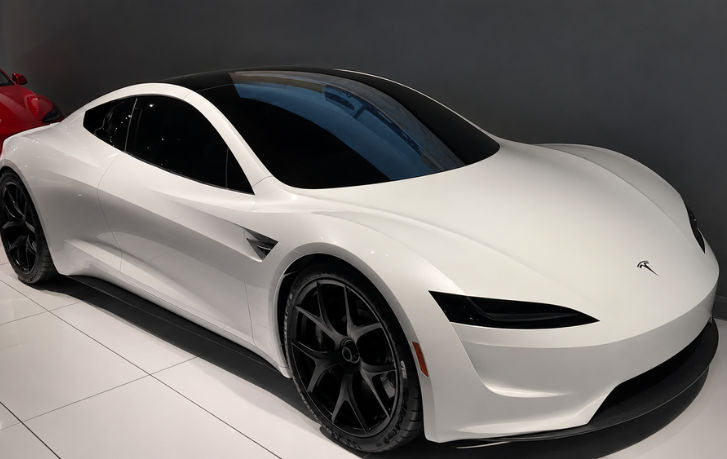
Tesla has finally produced a working spectacle from its second-generation Roadster: a prototype drove along an arch, held itself upside down, flew forward, performed a barrel roll and landed. Yet nine years after the concept first appeared, Tesla still has not announced a price or provided many production specifications. CEO Elon Musk now says manufacturing is expected to begin in 2028, and he acknowledged that the car may not be legal in every jurisdiction.
The October 15 demonstration at SpaceX’s test facility in McGregor, Texas, answered the basic question of whether Tesla had built hardware capable of the promised stunts. It did not establish that customers will receive the same system in a road-legal vehicle. Tesla used separate stunt and stage cars, while the acceleration figures shown at the event came from Tesla rather than independent testing.
Two systems produced the most unusual movements
The upside-down run relied on a fan-based suction system. By actively moving air beneath the vehicle, the system generates a pressure difference that pulls the car toward the surface. Tesla says it can produce enough force to hold the Roadster in place even when the car is stationary and inverted.
This differs from conventional aerodynamic downforce, which generally grows with vehicle speed. Fan-driven ground-effect systems can produce vertical force at low speed, but they add power demand, ducting, controls and hardware. Their performance also depends on managing airflow and maintaining an effective relationship between the car’s underside and the surface.
Tesla said the fan would have a low-speed traction setting and a high-speed mode that opens front and rear sections to increase airflow beneath the car. The company also described an active rear wing with high-drag and high-downforce modes and automatic pitch adjustment.
The flight and acceleration demonstrations added compressed-air thrusters supplied by SpaceX. Tesla said they generated more than 80 kilonewtons of force. Four rear-mounted thrusters assisted two acceleration runs that Tesla claimed reached 60 mph in one second and 0.8 second, respectively.
These are cold-gas thrusters, not combustion engines. High-pressure gas stored in a composite-overwrapped pressure vessel is released through nozzles to create thrust. A technical examination of the prototype system described a large pressure vessel behind the seats, pipes, valves and four rear nozzles. Tesla says the vehicle can recharge its ultra-high-pressure air supply.
That architecture buys a short, forceful burst without jet fuel, but stored gas is finite. The tank, plumbing, valves and actuators also occupy space and add mass to a vehicle that must still carry its battery, electric drive system, cooling equipment and crash structure. Tesla has not disclosed the production car’s weight, battery specifications, usable thruster duration or recharge time.
Three configurations, few production details
Tesla announced Performance, Thrust and Rocket versions. Performance is planned as a two-seat model with the fan system and active rear wing. Thrust would add rear cold-gas thrusters. Rocket would be a single-seat configuration with thrusters around the vehicle, which Tesla says could provide forward and upward movement as well as lateral rotation.
The briefly displayed cabin had butterfly doors, a yoke-style steering wheel and a large horizontal screen. Musk also claimed a speed above 230 mph and said Tesla ultimately wants the Roadster to reach 383 mph. Like the sub-one-second acceleration result, those performance numbers have not been independently validated.
The largest gap is now between demonstrated prototype capability and a vehicle that an owner can register, insure, maintain and use. Thrusters that discharge high-pressure gas and a system intended to lift or rotate a car raise regulatory and practical questions beyond those facing a conventional high-performance electric vehicle. Musk put the uncertainty directly: I’m not sure it’s necessarily legal in all jurisdictions, but there will be such a car that someone can own.
Tesla’s 2028 production target leaves reservation holders who placed deposits years ago facing another extended wait. The company has not announced the production price, finalized specifications or identified where each configuration could legally operate. After nine years, the Roadster is real as a functioning prototype. Whether its most extraordinary hardware survives into an ownable road car remains the unresolved part of Tesla’s demonstration.
| More aerospace and engineering stories, right in your MSN feed. Follow AMI on MSN |
By Robert McKinney — Editor-in-Chief for AMI’s automotive and mobility coverage, with a mechanical engineering background and a decade reporting on powertrain systems, EV innovation, and global vehicle manufacturing.