Mexico Seizes 15 Cable-Controlled Drones That Can Bypass Signal Jammers
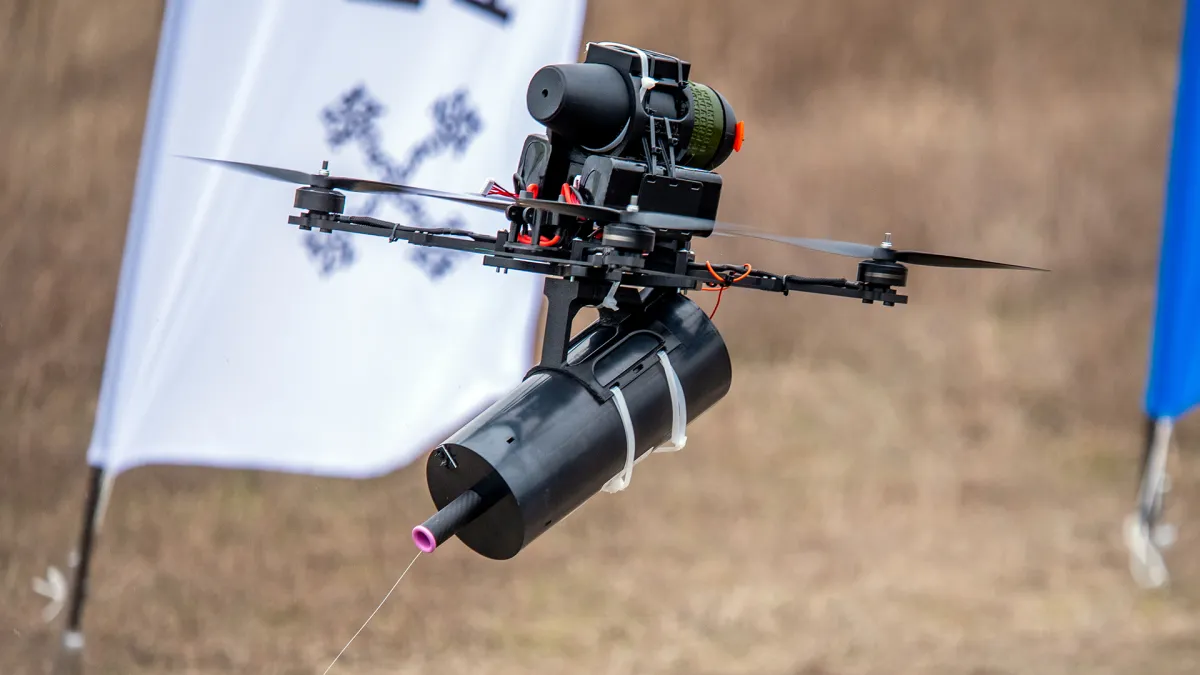
Mexico is expanding domestic surveillance-drone production just as a different class of unmanned aircraft is challenging its principal counter-drone tool. On Oct. 4, authorities seized 15 first-person-view drones and 15 fiber-optic cable spools in El Rosario, in the municipality of Mazatlán, Sinaloa. The discovery was described as Mexico’s first official record of organized crime adapting fiber-optic drone technology.

The cache also contained seven pairs of drone goggles, 15 handheld controllers, three screens and 14 batteries. Its importance lies less in the quantity than in the control architecture: fiber-optic aircraft receive commands through a physical cable rather than the radio link used by conventional consumer drones. That allows them to bypass signal jammers designed to disrupt wireless command and communication signals.
David Mora, a senior Mexico analyst at the International Crisis Group, described jammers as the Mexican government’s basic counter-drone response and said the country has invested heavily in them. Fiber-optic control could leave that investment “rendered obsolete earlier than expected” in locations where defenses depend principally on interrupting radio links.
A different counter-drone problem
Radio-frequency jamming is attractive because it can interfere with a drone without requiring a direct physical interception. Its usefulness, however, depends on the target aircraft needing a vulnerable radio connection. A cable-controlled drone removes that particular dependency, forcing protection systems to rely on other parts of a layered defense.
Those layers can include detection, tracking and a suitable means of stopping an aircraft when electronic disruption is ineffective. The United States is pursuing that broader model through counter-drone programs combining sensors with multiple response technologies. In announcing a 2026 directed-energy pilot, a U.S. interagency task force said there was no single solution for every drone threat and described directed energy as one option that could complement existing capabilities.
That comparison does not supply Mexico with an immediate answer. Counter-drone equipment must be matched to the protected location, surrounding airspace, likely aircraft and acceptable public-safety risk. Rural coverage is especially difficult because sensors and response systems require trained personnel, maintenance, power, communications and dependable logistics across a wide area.
The seizure also does not establish nationwide use of fiber-optic drones. Earlier indications in Mexico had been limited to isolated photographs and videos of individual aircraft, according to Mora. The Sinaloa cache nevertheless changes the readiness question because authorities now have an officially documented group of aircraft and associated cable equipment rather than a single unverified sighting.
Building government drones addresses a different mission
President Claudia Sheinbaum has said the Mexican Navy operates a drone production plant, while the Defense Ministry is developing another model. The interagency effort, involving the Navy, Science Ministry and public research institutions, includes the Quetzal prototype. Officials say Quetzal can remain airborne for up to six hours and cover 50 kilometers, or approximately 31 miles, for missions including security, territorial surveillance and weather monitoring.
Domestic production could improve control over manufacturing, maintenance and mission integration. It does not automatically create continuous protection against unauthorized aircraft. Surveillance drones collect information over the areas where they are deployed; they do not replace fixed detection networks, local response capacity or defenses able to address aircraft that resist radio-frequency disruption.
Mora said it was “virtually impossible” to deploy government drones in every corner of Mexico, particularly across rural communities exposed to weaponized aircraft. The gap is therefore one of coverage and counter-drone architecture, not merely the number or endurance of government-built platforms.
Supply controls have limits but can add another layer
Mora has proposed closer attention to commercial-drone supply chains and manufacturer safeguards such as geofencing and no-fly zones. Geofencing uses onboard location data and software-defined boundaries to warn or prevent compatible aircraft from entering restricted airspace.
European research illustrates both its value and its limits. The GEOSAFE project conducted 280 flight tests in France, Germany and Latvia and found that most tested drones met requirements for basic preflight geofencing. It also found incomplete standardization between countries and concluded that more demanding dynamic geofencing was not yet sufficiently mature for full advanced airspace-service requirements.
Manufacturer controls can reduce misuse among compliant commercial products, but they are one component of a wider system involving procurement oversight, detection, enforcement and local protection. Mexico’s new surveillance aircraft may extend the government’s reach; the 15 drones and 15 cable spools seized in Sinaloa show why extending reach is different from defeating an aircraft whose control link no longer depends on the radio spectrum.
| More aerospace and engineering stories, right in your MSN feed. Follow AMI on MSN |
By Stephen Wallace — Editor for AMI’s aerospace integration and unmanned mobility coverage, focused on drone manufacturing, VTOL systems, autonomous networks, and air-ground mobility links.