Britain Commits £17 Million to Repair Chernobyl’s Drone-Damaged Shelter and Ventilation
Britain has committed £17 million to repair Chernobyl’s damaged protective shelter and ventilation, but the pledge covers only part of a project preliminarily estimated to require at least €500 million. The work is intended to restore containment functions and control corrosion before deterioration threatens the steel structure’s planned 100-year service life.
The British contribution forms part of a wider international program after a February 2025 drone strike breached the shelter’s inner and outer cladding and damaged critical systems. On October 15, 2026, the Group of Seven countries committed €260 million toward urgent repairs, according to the European Bank for Reconstruction and Development, which is coordinating the effort with Ukraine. The bank identifies the incident as a Russian drone strike and says repairs must be completed by 2030 to limit corrosion risk.
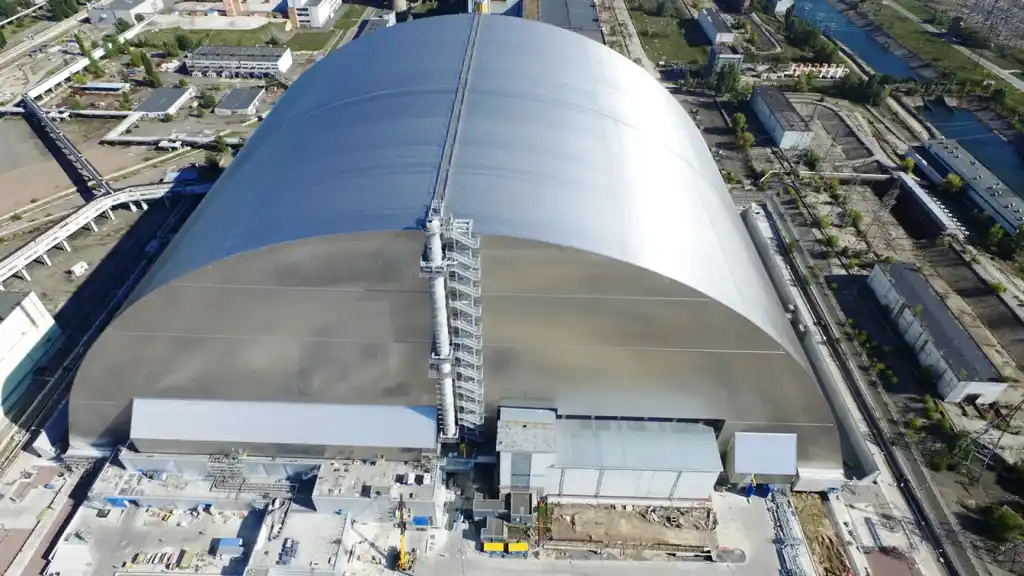
The structure, formally called the New Safe Confinement, is a large steel arch enclosing the remains of Reactor Four and the original sarcophagus built after the 1986 nuclear disaster. Its two central jobs are to contain radioactive material and provide a controlled space in which unstable parts of the older structure can eventually be dismantled. Damage therefore affects more than the weatherproof outer surface: it impairs a system designed to isolate contamination while supporting decades of hazardous decommissioning work.
Ventilation is fundamental to that mission. The arch has an enclosed space between its inner and outer layers where steel supports and beams are located. Its environmental-control system was designed to keep relative humidity below 40 percent, limiting the moisture conditions needed for corrosion. Slight pressure differences also help keep radioactive particles from migrating into the arch structure or escaping from the containment area.
Loss of climate control changes the maintenance problem over time. Water ingress or persistently humid air can accelerate corrosion in structural steel, connections and other components, potentially shortening the useful life of a shelter designed to remain in service for a century. Restoring ventilation is therefore part of restoring the structure itself, rather than a secondary comfort or airflow project.
The funding also illustrates the scale of the public-cost tradeoff. Britain’s £17 million pledge supports a system whose repair estimate is at least €500 million, while the current G7 commitment totals €260 million. Other donors will be needed to close the remaining gap. A donor conference coordinated by France, Ukraine and the EBRD is scheduled for November 9, providing the next opportunity to establish how much additional financing governments and international institutions will supply.
That burden is being shared because the consequences are not confined to one national infrastructure operator. Ukraine is responsible for a damaged nuclear site while also facing competing demands on public resources. International funding spreads the cost among countries that have treated Chernobyl’s long-term containment as a regional environmental and nuclear-safety responsibility. The EBRD has coordinated work at the site since 1995, mobilizing more than €2.5 billion in international contributions and providing over €700 million of its own resources for nuclear-safety and decommissioning projects.
The present program also protects that earlier investment. The New Safe Confinement was built through an international effort costing more than €2 billion, with its corrosion controls, pressure management and internal equipment integrated as one protective system. Allowing environmental controls to remain impaired could increase future repair costs while delaying the dismantling work the arch was built to enable.
Engineering and restoration planning have begun. An initial phase covering technical assessments, targeted inspections and preliminary repair concepts is expected to last about seven and a half months. It sits within a broader €30 million engineering and procurement-preparation program expected to run for approximately 17 months, while temporary work maintains acceptable operating conditions.
Britain has not published a breakdown showing how its £17 million will be divided among ventilation, cladding, structural work or other systems. Nor has the wider program established a complete construction schedule beyond the EBRD’s 2030 deadline. The November donor conference must address the immediate financing gap, while the engineering studies determine what can be repaired, in what sequence and at what final cost.
| More aerospace and engineering stories, right in your MSN feed. Follow AMI on MSN |
By Thomas Caldwell — AMI’s senior editor for mechanical and mobility engineering, covering vehicle electronics, systems integration, electrification, chassis systems, propulsion, and safety policy.