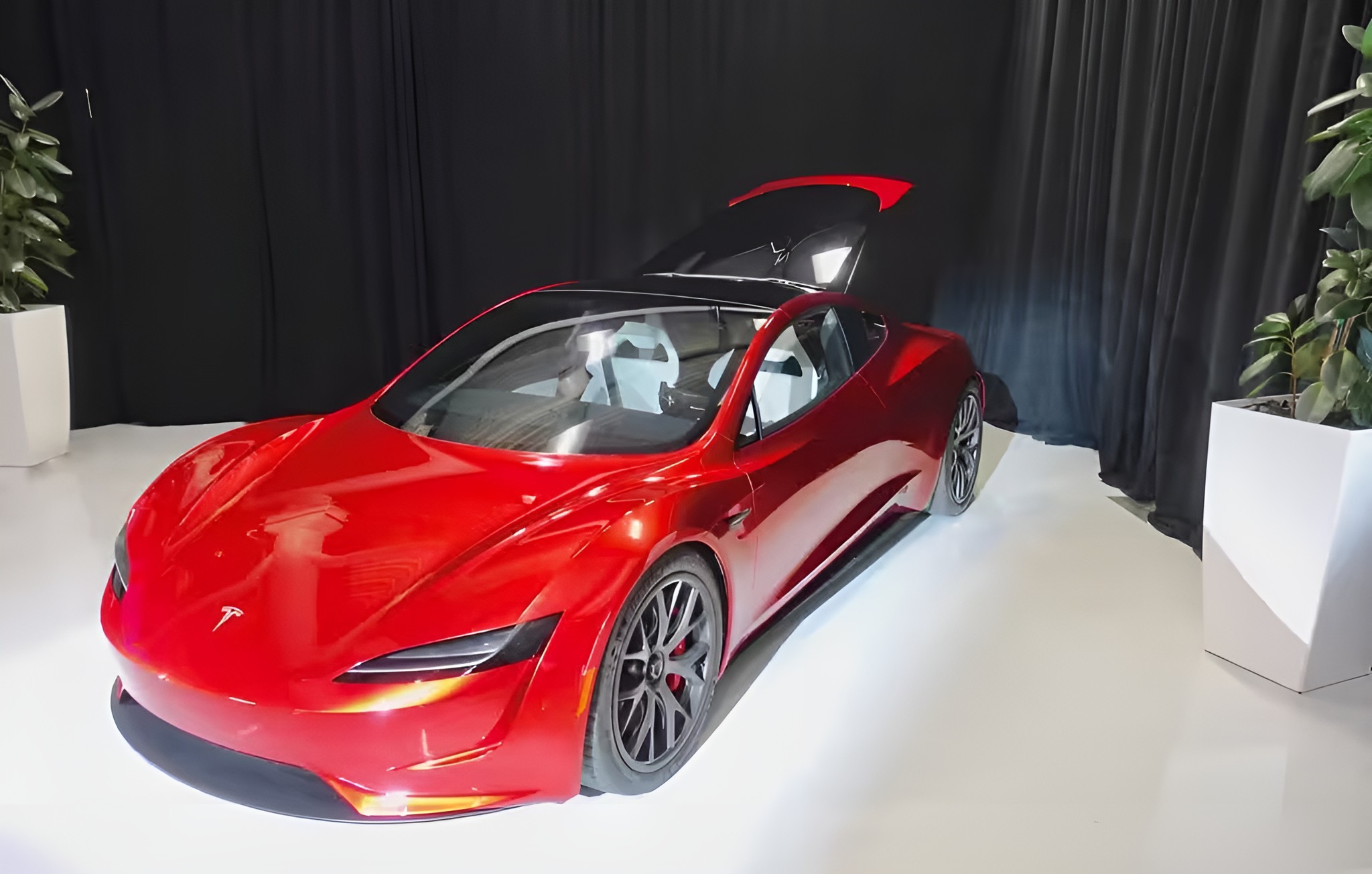
Tesla Shows Pressure-Assisted Roadster After Dropping Promised $25,000 Electric Car
Tesla’s latest Roadster demonstration put an extreme-performance halo car against an unfulfilled affordability promise. The automaker showed a pressure-assisted Roadster performing jumps, a kick flip and wall-driving maneuvers, years after telling prospective buyers that a $25,000 electric car would arrive and later abandoning that conventional low-cost model.
The contrast is sharper because the Roadster’s headline capability is reportedly brief. Performance figures presented with the car included acceleration from zero to 60 mph in 0.81 seconds and a top speed above 200 mph. Yet its current pressure tank can theoretically provide thrust for only seconds before taking as long as six hours to refill. The team is reportedly trying to cut that refill period to 30 minutes.
Peak performance is different from repeatable performance
A pressure-assisted system can add a large burst of force without asking the electric drive motors alone to produce the entire launch. That makes the claimed acceleration figure technically distinct from an ordinary battery-electric acceleration run: the car is drawing on stored pressure as well as its propulsion system.
The engineering constraint is replenishment. A finite pressure reservoir can deliver a dramatic short-duration result, but once depleted, the relevant performance measure becomes how quickly the system can be restored. Under the reported current limitation, the Roadster can make one run at the promised acceleration level before its tanks require refilling.
That does not make the demonstration irrelevant. Halo cars have long been used to explore packaging, controls, materials and propulsion ideas beyond the requirements of a high-volume family vehicle. Tesla also demonstrated an upside-down hold using a fan-based suction system, indicating that the Roadster program is pursuing capabilities well outside conventional road-car performance.
But repeatability determines whether such features function as more than demonstration modes. A six-hour refill would make the pressure assistance unavailable for nearly all subsequent driving that day. Even the targeted 30-minute refill would place a clear operating boundary around the headline acceleration figure. Production specifications, operating conditions and the final hardware have not been published, while the reported 2028 arrival remains uncertain.
The affordable Tesla followed a different path
At Tesla’s Battery Day on September 22, 2020, Elon Musk said the company would bring a $25,000 electric vehicle to market within three years. That deadline passed without the promised car. During an October 23, 2024 earnings call, Musk rejected the idea of a conventional model at that price, saying, “Having a regular, $25K model is pointless. It’d be silly.” Tesla instead tied its lower-cost strategy to autonomous vehicles and the Cybercab concept.
The reversal sits uneasily beside Tesla’s original published master plan. That plan described a progression from an expensive sports car to increasingly affordable, higher-volume cars. The Roadster’s role was to help finance development of a lower-cost family vehicle, rather than become the endpoint of the strategy.
Tesla did achieve substantial scale between those two positions. The Model 3 and Model Y became the world’s best-selling electric cars, according to the available account. But the $35,000 Model 3 was not meaningfully available for more than a brief period, and the specifically promised $25,000 conventional Tesla never reached buyers.
Making that vehicle would have required a different kind of engineering achievement from a thruster-assisted launch. Affordable mass production depends on reducing costs across batteries, structures, electronics, manufacturing steps and thousands of individual components while preserving durability, safety and acceptable ownership performance. Musk acknowledged the difficulty on the 2024 call, describing the effort required to remove 20% of a vehicle’s cost as greater than designing the car and factory in the first place.
The Roadster itself has also had a long gestation. Tesla revealed the second-generation model nine years before the latest demonstration, promising more than 600 miles of range, 1.9-second acceleration to 60 mph, a removable roof panel and 2+2 seating. The company accepted deposits of as much as $250,000, but production has repeatedly remained in the future.
The latest prototype therefore demonstrates two different limits at once. Its pressure system reportedly trades sustained availability for several seconds of extraordinary performance, while Tesla’s product strategy has traded a promised $25,000 owner-driven car for more expensive vehicles and an autonomy-centered lower-cost plan. The Roadster may reach production in 2028, but prospective buyers still have no delivery date for the affordable conventional Tesla promised for 2023.
| More aerospace and engineering stories, right in your MSN feed. Follow AMI on MSN |
By Thomas Caldwell — AMI’s senior editor for mechanical and mobility engineering, covering vehicle electronics, systems integration, electrification, chassis systems, propulsion, and safety policy.