BAE Cargo Drone Intercepts Several Attack Drones Without Landing to Reload
BAE Systems says its modified TRV-150 cargo drone intercepted several one-way attack drones during a single flight without landing to reload. The late-September 2026 demonstration at Eglin Air Force Base in Florida moved the aircraft beyond individual engagements and into successive airborne interceptions using a three-round launcher.
The company announced the result on October 21 after the trial, which formed part of Joint Readiness Experimentation organized by the U.S. Office of the Under Secretary of War for Research and Engineering. BAE did not disclose the exact number of drones intercepted, the number of rockets fired, the target types or how the targets were designated for the laser-guided weapons. Those omissions leave the scale and efficiency of the result unclear.
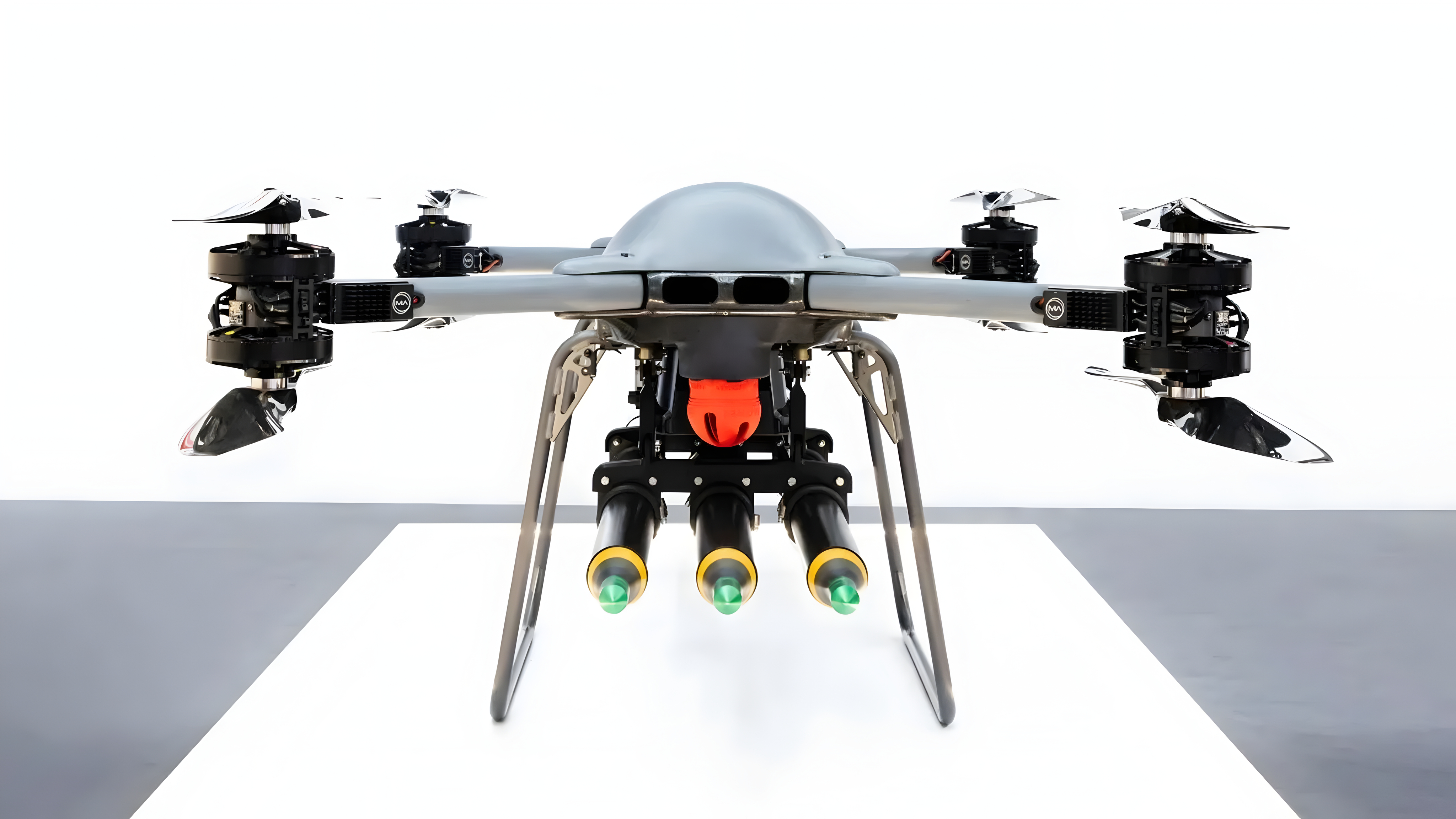
The flight nevertheless marks a consequential step for an aircraft derived from a logistics platform. The TRV-150 carried three Advanced Precision Kill Weapon System rockets and engaged airborne targets in succession. Remaining aloft between engagements is the practical advance: an aircraft that had to return after each shot would offer little persistence against repeated incoming drones.
Launcher capacity also defines the current boundary. Three rounds provide the possibility of multiple engagements, but not an unlimited magazine. Without the target and rocket counts, it is impossible to determine whether the aircraft used one rocket per intercepted drone, retained unused rounds or required more than one attempt against any target. BAE’s description confirms several interceptions in one mission, not the complete engagement record needed to calculate success per shot.
From single engagements to a multi-target flight
The Eglin event followed roughly 16 months of increasingly integrated testing. In May 2025, the aircraft engaged aerial and ground targets at Dugway Proving Ground in Utah. BAE reported no misses and described the airborne engagement as the first of its kind for an APKWS guidance kit launched from an uncrewed aircraft.
Testing at Fort Rucker, Alabama, added the newly integrated three-shot launcher in May 2026. That work examined whether the eight-rotor aircraft could compensate for the forces produced by rocket launches. For a comparatively small electric drone, launch disturbance is a flight-control and structural-integration issue as much as a weapons issue. The aircraft must remain sufficiently stable for continued operation after each release rather than treating every shot as an isolated event.
The September flight combined those earlier developments: an airborne target set, a multi-round launcher and successive engagements without a landing cycle. It therefore tested a more operationally relevant sequence than a single live-fire event, even though the undisclosed counts prevent an independent judgment about how demanding that sequence was.
A cargo platform adapted for interception
The TRV-150 is based on Malloy Aeronautics’ all-electric T-150, an eight-rotor logistics aircraft able to carry as much as 68 kilograms, or 150 pounds. BAE acquired Malloy in February 2024. SURVICE Engineering adapted the aircraft for U.S. military requirements, while BAE’s FalconWorks division developed and integrated the weapons modification.
APKWS adds laser guidance to otherwise unguided 70-millimeter rockets. The system has been carried by combat aircraft, helicopters and the MQ-9A Reaper, so the guidance technology itself is not unique to the TRV-150. The engineering change is putting it on a reusable electric cargo drone small enough to represent a different class of launch platform.
BAE presents that combination as a relatively inexpensive way to counter inexpensive attack drones instead of assigning more costly aircraft or surface-to-air missiles to every target. Broader demand supports the relevance of that concept: the Pentagon has established a framework agreement for as many as 25,000 APKWS guidance kits annually for the U.S. military, subject to subsequent contracts and congressional funding.
The Eglin result, however, does not establish the TRV-150’s comparative cost. No figures were provided for the aircraft, launcher, rockets, support equipment, operators or cost per successful interception. Its economic case will depend not only on the price of each rocket but also on detection and designation support, mission availability, recharge and turnaround requirements, maintenance burden and the number of targets handled per sortie.
BAE and SURVICE next plan to explore operating the armed T-150 at sea, where ship motion, wind, salt exposure and limited deck space would add new integration and reliability demands. Before the multi-target claim can be assessed fully, the more immediate need is basic test transparency: the target count, rockets expended, designation arrangement and complete engagement results. The aircraft has demonstrated that it can stay airborne for successive interceptions; how much defensive capacity one three-round flight actually delivered remains undisclosed.
| More aerospace and engineering stories, right in your MSN feed. Follow AMI on MSN |
By Stephen Wallace — Editor for AMI’s aerospace integration and unmanned mobility coverage, focused on drone manufacturing, VTOL systems, autonomous networks, and air-ground mobility links.