Avenger Missile Systems Deploy Near Mar-a-Lago and Palm Beach Airport
Federal officials have positioned Humvee-based Avenger missile systems beside Mar-a-Lago and near the Palm Beach airport, adding an armed short-range air-defense layer to an area already covered by continuous flight restrictions. The deployment comes as the Federal Aviation Administration considers making the core airspace controls permanent.
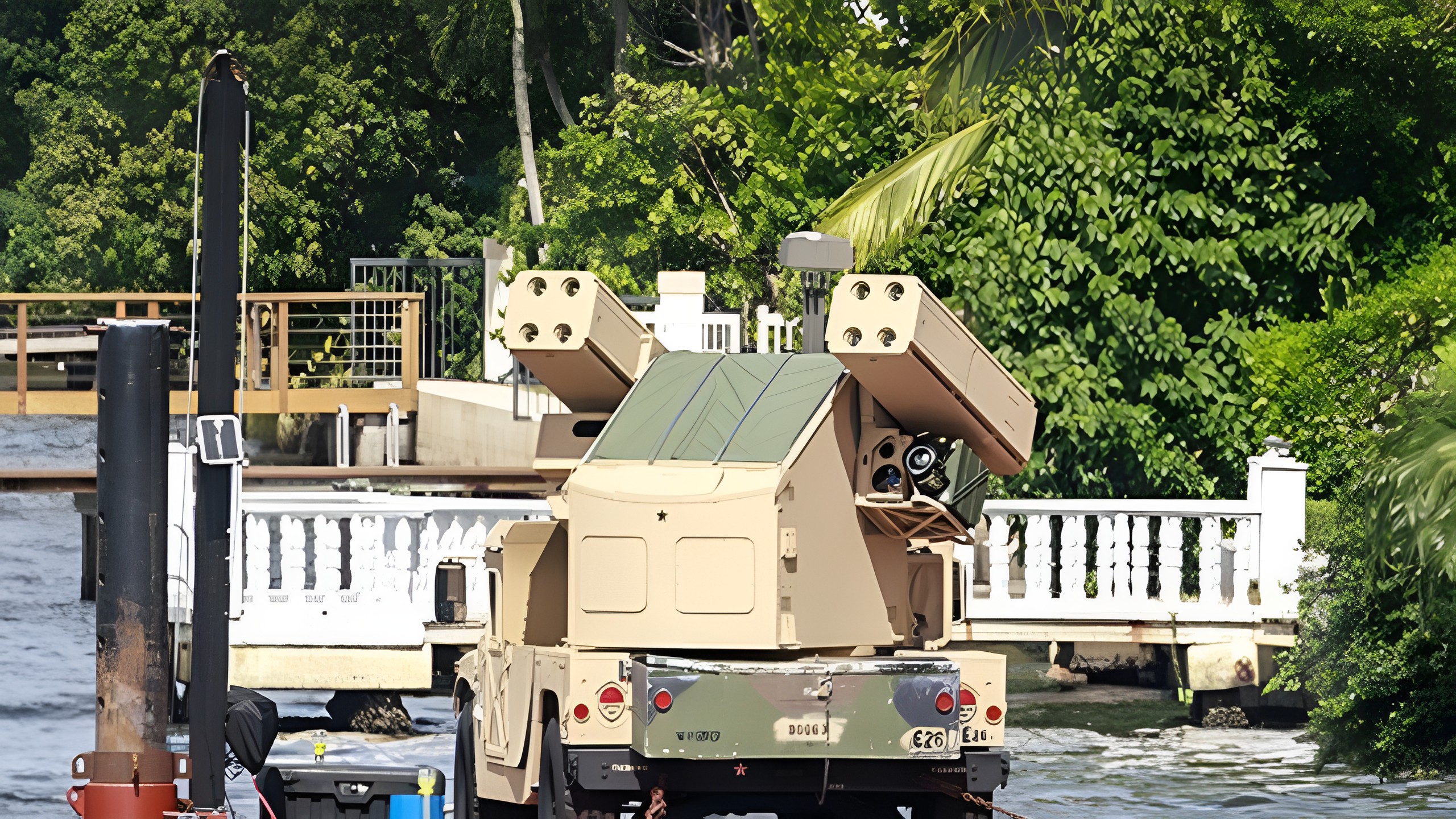
A Palm Beach Daily News photographer first observed the vehicles on Oct. 23, 2026, before President Donald Trump arrived for an overnight stay. Two Avengers were placed on a floating barge in the Lake Worth Lagoon beside the property’s western seawall, while a separate group was positioned on the airport’s south side. Federal defense officials confirmed that the equipment was deployed at the Secret Service’s request.
A mobile defense layer with a defined role
The Avenger is a Boeing-made mobile short-range air-defense system. Each unit combines a modified Humvee with a rotating turret and two pods capable of launching short-range, infrared-homing Stinger missiles. The Army lists drones, cruise missiles, helicopters and low-flying or high-speed fixed-wing aircraft among the types of airborne threats the system is designed to counter.
That mobility is central to the platform’s value. Unlike fixed infrastructure, an Avenger can be transported and positioned to support a temporary or changing protective requirement. Its appearance in Palm Beach applies an established military capability to domestic protective security; Avengers have also been used in the defense of Washington airspace.
The deployment does not replace airspace control. It sits behind a preventive system intended to keep unauthorized aircraft away in the first place. Flight restrictions, air-traffic-control authorization and aircraft identification reduce uncertainty before a potential threat reaches the immediate area. The Avenger adds a physical response capability for the short-range, low-altitude portion of that layered posture.
The scale of the airspace-compliance problem helps explain the layering. An Aug. 11 FAA court filing said more than 160 aircraft and drones had breached the restricted Palm Beach airspace since continuous limits took effect in October 2025. Secret Service Deputy Director Matthew C. Quinn described the airborne threat vector at Mar-a-Lago as “persistent and substantial.” The filing also said the request for restrictions relied partly on information involving terroristic threats.
Permanent rules must preserve airport access
The FAA’s proposed Special Air Traffic Rules, published Sept. 2, would create a permanent one-nautical-mile special flight-rules area around Mar-a-Lago from the surface to 2,000 feet above mean sea level. The proposal remains under review and has not been finalized. Around the clock temporary restrictions have applied whether or not the president is at the property, and those restrictions were extended for another year.
The proposed area is more nuanced than a blanket airport shutdown. Eligible arrivals and departures could continue through it with air-traffic-control authorization, two-way radio communication and an assigned transponder code. Military support, law-enforcement, firefighting, air-ambulance and certain safety flights could also be permitted. More restrictive temporary rules would still apply during protected visits.
This structure reflects a hard geographic constraint: the protected property sits close to the airport’s primary commercial runway. The FAA concluded that a fully prohibited area would effectively prevent many aircraft from using that runway because avoiding the restricted zone would demand turns and climb performance some aircraft cannot meet. The principal alternative runway is about 3,000 feet shorter and cannot support the same level of heavy commercial traffic.
The agency therefore chose a rules-based transit area rather than a complete prohibition. Its analysis says the proposal would preserve airport capacity and impose little or no added operator cost compared with the temporary controls already in force. Pilots and operators have already adapted to requirements including flight plans, radio contact, authorization and discrete transponder codes.
The burden is not distributed evenly on the ground. Palm Beach-area residents, local governments and businesses have argued that altered routes shift aircraft noise over neighborhoods and other noise-sensitive locations. Supporters contend that the change spreads the effects of airport traffic more evenly while maintaining a predictable security boundary. Those are access, noise and community-impact disputes rather than disagreements over the Avenger’s technical function.
The visible missile systems and the proposed airspace rule address different parts of the same problem. Avengers provide a mobile last layer against low-altitude airborne threats; regulated airspace is intended to keep ordinary aircraft and drones from entering that problem set at all. With more than 160 reported breaches already recorded, the unresolved decision is whether Palm Beach’s temporary operating constraints become a permanent part of the local aviation system.
| More aerospace and engineering stories, right in your MSN feed. Follow AMI on MSN |
By David Whitaker — Associate editor for AMI’s aerospace and drone systems desk, translating flight systems, aircraft programs, spaceflight, and UAV developments into accessible technical stories.