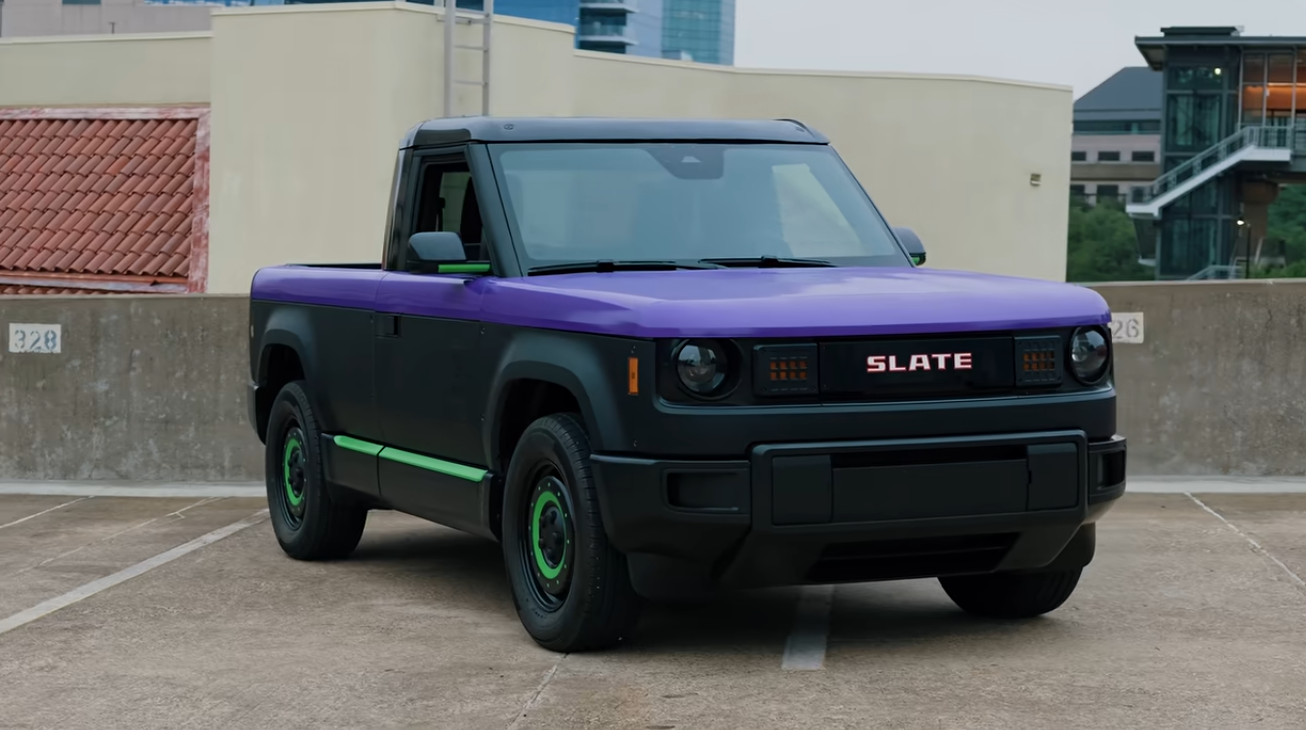
James May Praises $24,950 Slate Truck’s Basic, Owner-Configurable Design
James May favored the Slate Truck precisely because the $24,950 electric pickup leaves out equipment that has become routine in new vehicles. After driving it for about an hour through towns, countryside and freeway conditions, the former Top Gear presenter praised its ride, quiet cabin and deliberately basic, owner-configurable design.
That base price buys a two-seat truck with manual wind-up windows, minimal upholstery, plastic exterior panels and no integrated infotainment screen. A phone mount substitutes for the usual dashboard display. The result is less a low-priced version of a fully equipped pickup than a blank platform that shifts some choices and their costs from the factory to the owner.
Lower equipment content, lower starting price
May’s nearly unchanged configuration remained at the cited $24,950 base price, while co-host Lucy Brown’s accessorized version reached $33,827. Published pricing lists a mandatory $1,450 destination charge, making the base delivered price $26,400 before other fees or options.
The contrast illustrates how Slate Auto’s pricing structure works. Conventional equipment and decorative finishing are removed from the starting specification, while wraps, decals, storage pieces, audio equipment and other accessories can be added separately. Buyers who want another body style can select additional hardware that converts the pickup into an SUV, while a beach buggy-inspired configuration provides a more open, recreational appearance.
This differs from the familiar trim-level model, in which customers often have to buy a larger package to obtain one desired feature. Slate’s approach offers more control over individual configuration, but the final price can move well beyond the attention-grabbing base figure. The Squareback SUV conversion is listed at $5,000, for example, and includes rear seats, airbags, a roll cage and the SUV top.
A simple cabin does not mean simple vehicle dynamics
The truck still uses one-pedal regenerative operation, which slows the vehicle when the driver releases the accelerator and recovers some energy for the battery. May reported completing his mixed-road drive without touching the brake pedal. That observation describes how strongly the regenerative system worked during his route; the truck retains conventional brakes for stopping requirements that regeneration cannot handle.
May also praised the ride, quietness and performance. The published specification gives the pickup an estimated usable range of approximately 200 to 205 miles, acceleration from zero to 60 mph in about eight seconds and a top speed below 100 mph. Those figures position it as a compact utility vehicle rather than a high-performance electric truck.
The drive offers a useful first impression, but it cannot establish long-term range, durability, repair expense or production consistency. Temperature, speed, payload and accessories can all change an electric vehicle’s real-world energy consumption. Added SUV bodywork or other equipment can also alter mass and aerodynamic drag, making the modularity itself one of the variables affecting efficiency.
Replaceable panels shift part of the repair equation
May was particularly interested in the removable exterior panels, suggesting that damaged sections could be easier to replace. Composite panels molded in Slate Gray eliminate conventional paint from the base vehicle, while segmented wraps provide color. In principle, replacing a panel or wrap section could avoid some metal straightening and refinishing work, although actual repair cost will depend on parts availability, labor procedures and the extent of underlying structural damage.
The same design supports personalization without requiring permanent factory finishes. Owners can change exterior colors, trim and functional accessories later, potentially extending the useful life of a configuration as their needs change. May compared that straightforward philosophy with the original Fiat Panda and said he would own the Slate Truck.
Slate remains on the path from pre-production vehicles to customer trucks. The company has said production will begin in Indiana and that some vehicles are planned to ship by the end of 2026, with most deliveries expected in 2027. A recent look inside Slate’s first customer showroom found the manual windows, plastic panels and customization displays intact as production approached. The next test is whether that blank-canvas concept can retain its cost and simplicity when built, delivered and maintained at customer scale.
| More aerospace and engineering stories, right in your MSN feed. Follow AMI on MSN |
By Thomas Caldwell — AMI’s senior editor for mechanical and mobility engineering, covering vehicle electronics, systems integration, electrification, chassis systems, propulsion, and safety policy.