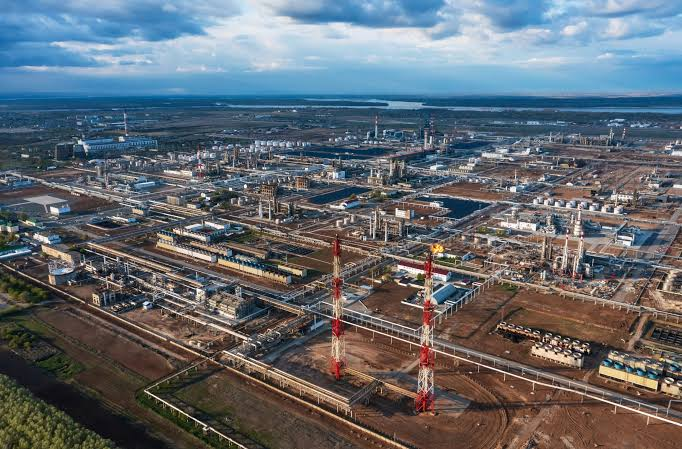
Russia’s Refinery Throughput Stayed Below 4 Million Barrels Daily as Exports Rose
Attacks on Russian refineries slowed in September, but the processing network did not recover with them. Average refinery throughput remained below 4 million barrels per day, while tanker tracking put crude exports at a four-week average of 3.76 million barrels per day through October 4 the highest level since early August.
The two figures describe the same industrial constraint from opposite ends of the oil system. Russia continued producing far more crude than its damaged or idled refinery units could process, so producers reportedly redirected more unrefined oil into export channels. September throughput was roughly 1.4 million to 1.5 million barrels per day below the cited former seasonal level of 5.4 million to 5.5 million barrels per day.
Lower attack intensity did not produce a matching recovery
The reported intensity of Ukrainian attacks on Russian refineries fell to a three-month low in September. Even so, continuing disruptions reportedly outpaced repairs, preventing a substantial rebound in operable capacity. Rystad Energy estimated that throughput would remain between 3.5 million and 4 million barrels per day if the prevailing attack intensity continued.
That repair lag is significant because refinery recovery is not equivalent to restarting a single machine. A refinery is an interconnected processing system in which crude-distillation equipment, conversion units, utilities, storage and product-handling systems must operate together. Work on major industrial units can require specialized labor, inspections and replacement equipment before safe operation resumes.
Even planned refinery maintenance can take weeks or months and requires extensive preparation. The American Fuel and Petrochemical Manufacturers’ overview of refinery turnarounds notes that large projects may involve more than a million worker-hours. Unplanned repair pressure across multiple facilities is harder to schedule because equipment, contractors and alternative supply arrangements cannot necessarily be coordinated in advance.
Crude production and fuel production diverged
Russia produced an average of 8.643 million barrels of oil per day in September, only 38,000 barrels per day below the revised August average. That was a much smaller monthly decline than August’s 174,000-barrel per-day drop from July. Production nevertheless remained 1.306 million barrels per day below Russia’s September quota under the OPEC+ agreement.
The modest change in crude output contrasts sharply with the refinery shortfall. Extraction supplies crude oil; refineries turn that feedstock into gasoline, diesel, jet fuel and other products. When processing capacity becomes the bottleneck, maintaining crude production does not restore finished-fuel supply. It instead increases the pressure to store the crude, reduce production or move more of it abroad.
In September, the export route absorbed part of that imbalance. Bloomberg tanker-tracking data showed Russian crude exports averaging 3.76 million barrels per day over the four weeks through October 4. Other supply constraints, including Middle East hostilities and limited Persian Gulf availability, also supported demand for export barrels.
More exported crude does not replace lost refining
The shift matters beyond Russia because crude oil and refined fuels are not interchangeable in the market. An importing country needs available refinery capacity configured for the crude it receives, along with shipping, storage and product-distribution capacity. Additional crude exports therefore cannot immediately compensate for reduced Russian gasoline or diesel production.
The International Energy Agency’s October oil-market assessment reported that Russian gasoil production and exports had fallen in recent months. Combined net diesel and gasoil exports from Russia and the Middle East dropped by 1.3 million barrels per day from a year earlier in September, contributing to a wider shortage of middle-distillate fuels.
Research from the Federal Reserve Bank of Dallas similarly distinguishes a refining shock from a crude-oil shock. When refineries are unavailable, the price difference between crude and finished fuels can widen because the scarce resource is processing capacity rather than raw oil alone.
September’s numbers capture that separation clearly: Russian crude continued to flow, and more of it reached export markets, but domestic refinery throughput remained at least 1.4 million barrels per day below the former seasonal range. Until repair work restores enough interconnected processing capacity, export growth can relieve the crude surplus without restoring the missing gasoline and diesel output.
| More aerospace and engineering stories, right in your MSN feed. Follow AMI on MSN |
By Thomas Caldwell — AMI’s senior editor for mechanical and mobility engineering, covering vehicle electronics, systems integration, electrification, chassis systems, propulsion, and safety policy.