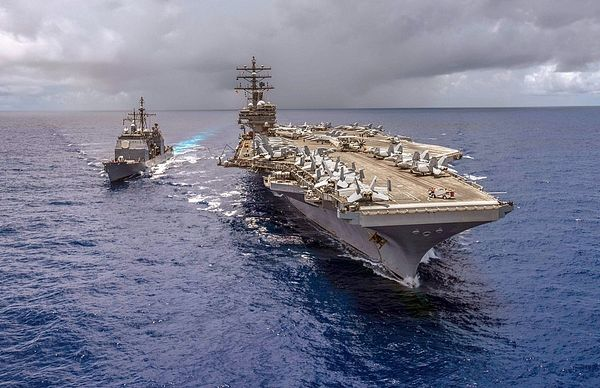
U.S. Navy Warns 10-Month Deployments Mean Years of Fleet Strain
Ten months is becoming the planning figure for U.S. Navy deployments and the consequences will continue after ships come home. Senior Navy leaders say sailors and families should expect longer separations while the service works through resupply demands, displaced maintenance and unplanned costs that could take years to clear.

Master Chief Petty Officer of the Navy John Perryman said the most recently deployed strike group was told to anticipate 10 to 11 months away. Adm. Daryl Caudle, the Navy’s chief of operations, similarly said sailors could generally expect deployments lasting at least 10 months. The remarks describe the service’s outlook under sustained operational demand, rather than a permanent formal deployment policy.
Predictability matters alongside deployment length
The Navy’s commonly cited baseline is about seven months. Caudle acknowledged that sailors may accept serving beyond that scheduled period, but said they want a realistic estimate of how long the extension will last.
Perryman put the problem more directly: families cannot plan when sailors are initially told seven months and then receive a revised return estimate every few weeks. Navy leadership has consequently committed to giving crews a frank 10- or 11-month estimate when that is the expected duration.
The human burden extends beyond the number of days at sea. Housing decisions, child care, household responsibilities and homecoming plans all depend on dates that can move when a ship’s deployment is extended. A RAND study of roughly 2,700 military families examined family readiness across the full deployment cycle, including effects on relationships, health, child well-being and attitudes toward military service.
Perryman said the Navy submits a memo explaining why it considers an extension inadvisable whenever one is proposed, but that the decision to keep ships deployed longer is made above the service. Caudle’s role, as he described it, is to communicate the resulting cost, recovery period and readiness consequences.
A longer deployment shifts the entire maintenance cycle
A ship does not return from an extended deployment and immediately reset to its original schedule. Maintenance periods, training events and preparations for later rotations are linked. Keeping a ship away longer pushes work to the right, while other vessels and shipyards continue operating under their own schedules.
That creates a sequencing problem. Several ships returning around the same period may need maintenance capacity, skilled labor, parts and dry-dock access at once. Previously planned requirements do not disappear; as Caudle said, they begin “stacking up.” The result can be delayed maintenance or compressed time for the training and preparation that precede another deployment.
The current pressure lands on a fleet that already had substantial deferred work. A detailed review of Navy and government maintenance findings notes that the surface-ship maintenance backlog had reached $2.3 billion by August 2022. Private repair companies also accumulated nearly 10,000 days of delays on destroyer work between fiscal years 2015 and 2022, according to a February 2025 Government Accountability Office finding cited in the review.
Those figures do not determine what work any individual returning ship will require. They do show why deployment extensions can propagate through the fleet instead of remaining isolated schedule changes. The practical measure will be each ship’s post-deployment assessment, the work assigned and how long the vessel remains unavailable.
Operational demand also reaches the budget
Caudle said Operation Epic Fury began without having been incorporated into the fiscal 2026 budget. The Navy therefore had to draw money from existing budget lines while continuing to cover scheduled requirements. He said hundreds of millions of dollars have been directed toward various demands as destroyers return to their maintenance periods.
This is more than an accounting adjustment. Funding moved toward immediate operations or returning ships is funding that cannot simultaneously support every previously planned activity on its original schedule. Resupply requirements also rise when ships remain deployed longer, adding another layer of demand before the maintenance bill is fully known.
Caudle offered no fixed date for a return to normal deployment patterns. Perryman said the service is now trying to replace repeated short extensions with more credible estimates at departure. That may give families a firmer basis for planning, but it does not shorten the separation or restore displaced maintenance capacity.
The fleet’s recovery will depend on how returning ships are assessed, funded and sequenced through already constrained maintenance infrastructure. Caudle described that recovery as a years-long process and said there is no workaround meaning the effects of today’s 10-month deployments will remain in Navy schedules well after the crews step ashore.
| More aerospace and engineering stories, right in your MSN feed. Follow AMI on MSN |
By David Whitaker — Associate editor for AMI’s aerospace and drone systems desk, translating flight systems, aircraft programs, spaceflight, and UAV developments into accessible technical stories.