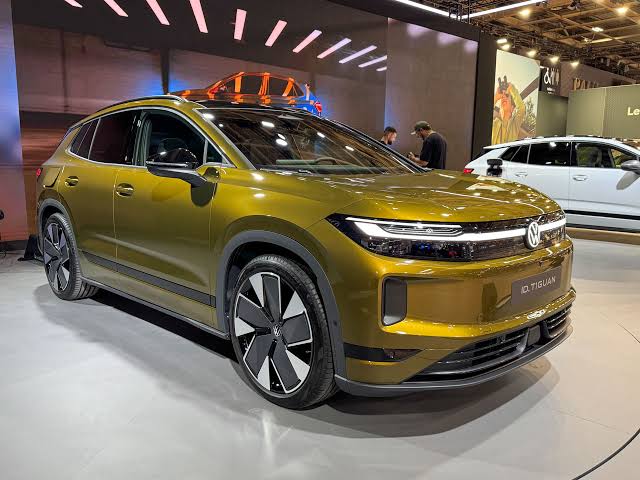
Volkswagen Plans to Replace ID.4 With ID. Tiguan, but U.S. Timing Is Unknown
Volkswagen has confirmed that the electric ID. Tiguan is planned to replace the ID.4 in North America, giving its discontinued U.S.-built electric crossover a named successor. The confirmation on November 1 resolves the future of the model line, but it does not close the supply gap: ID.4 production in Tennessee has stopped, while Volkswagen has not announced when the ID. Tiguan will reach American dealers.
The ID. Tiguan is planned to succeed the ID.4 in the North American market, a company representative said. Volkswagen’s official announcement identifies the ID. Tiguan as the successor to the ID.4 and ID.5 and schedules its European introduction for early 2027. The company said it will provide North American timing and market-specific details later.
The transition has already begun on the production side. Volkswagen stopped assembling U.S.-specification ID.4s at its Chattanooga, Tennessee, factory in April as the plant shifted capacity toward gasoline-powered SUVs. Prospective buyers are consequently limited to remaining dealer inventory, with discounts of up to $12,500 being offered on new ID.4s.
Renaming the successor after the Tiguan also moves Volkswagen away from the numerical identity used for its first generation of dedicated electric models. The conventional Tiguan is an established SUV name, while the “ID.” prefix continues to distinguish the electric version. The two vehicles are intended to coexist with different powertrain choices rather than the electric model simply replacing the combustion-powered Tiguan.
A familiar platform with a revised human interface
The ID. Tiguan is reported to retain the ID.4’s basic electric-vehicle underpinnings, making this an evolution of the existing architecture rather than a clean-sheet replacement. Its exterior will be redesigned, while its cabin is expected to adopt treatments seen in newer Volkswagen electric models.
The most consequential cabin changes involve ordinary controls. The ID. Tiguan is expected to have physical switches for all four windows, along with physical volume and climate controls. Those changes address a persistent criticism of the ID.4, whose touch-oriented interface required drivers to use sliders and screens for functions that can be adjusted by feel in more conventional cabins.
This is more than a matter of styling preference. Controls with distinct shapes and positions can reduce the time a driver spends looking away from the road. Euro NCAP’s 2026 testing protocols encourage direct physical inputs for key driving functions, and the safety organization has reported a broader industry return to buttons and switches. The ID. Tiguan’s expected volume, climate and window controls do not cover every function assessed under those protocols, but they follow the same human-factors principle: frequently used controls should be easy to locate and operate without navigating a screen.
Volkswagen’s Android Automotive-based infotainment system is also expected in the new crossover. That system could support native applications, including audio-streaming services, without requiring every function to run through a connected phone. Software stability and interface organization will remain important, however. The ID.4 experienced software problems early in its life, although those issues were subsequently resolved, and an electronic door-latch recall separately led to a stop sale.
Powertrain details remain the major unknown
Volkswagen has not disclosed North American battery capacities, motor outputs, charging performance or driving range for the ID. Tiguan. Specifications announced or reported for other markets should not be treated as confirmation of the U.S. configuration, where certification, equipment and product positioning can produce materially different results.
The outgoing model provides a useful performance baseline. The 2026 ID.4 offered a 282-horsepower rear-motor configuration with an EPA-estimated 291 miles of range, or a 335-horsepower dual-motor all-wheel-drive version rated at 263 miles. Both used a battery with 77 kilowatt-hours of usable capacity. Those figures establish what the replacement must at least be measured against, but they do not predict the ID. Tiguan’s eventual U.S. specifications.
Volkswagen’s next firm milestone is the European launch in early 2027. Until the company supplies a North American arrival date, production plan and certified powertrain figures, U.S. customers have a confirmed successor but no defined path from the last Chattanooga-built ID.4 to the first ID. Tiguan.
| More aerospace and engineering stories, right in your MSN feed. Follow AMI on MSN |
By Thomas Caldwell — AMI’s senior editor for mechanical and mobility engineering, covering vehicle electronics, systems integration, electrification, chassis systems, propulsion, and safety policy.