Reach Extends 90-Second Quadcopter Flight to 10 Hours Wirelessly
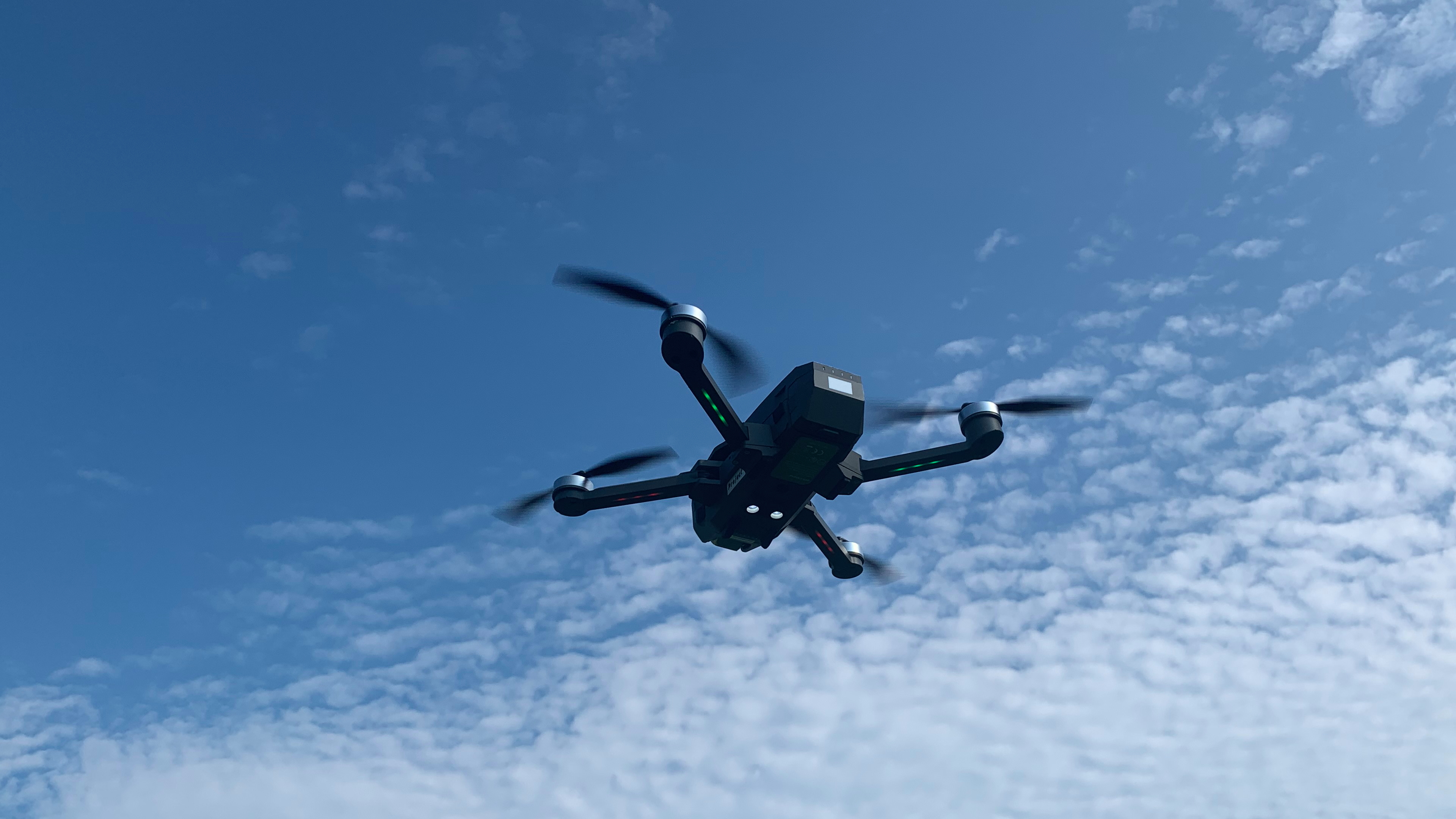
Ten hours is an extraordinary endurance figure for a quadcopter whose battery-only baseline was approximately 90 seconds. Reach Power announced that it achieved that flight by allowing the aircraft to request wireless power beams autonomously, producing what the company calculates as a roughly 400-fold endurance extension.

The September 22 demonstration took place at the Virginia Tech Institute for Advanced Computing during Operational Energy–Innovation’s 2026 Energy Sentry event. Reach said the quadcopter flew without a physical tether, GPS, external flight-tracking sensors, manual flight controls or operator intervention. Participants at the Pentagon received a live stream of the demonstration, according to the company.
The drone managed its own charging cycle
Reach described a closed-loop process involving onboard visual navigation, battery monitoring and electronically steered radio-frequency power delivery. When the battery reached full charge, the aircraft released the power link and moved away from the beam. After its charge declined to a programmed threshold, it returned and requested more energy. The transmitter then reacquired the airborne receiver and resumed delivering power.
That cycle is more consequential than hovering continuously over a fixed charging point. It combines flight control with energy management, making the aircraft responsible for deciding when to leave and rejoin the power link. Reach said the exchanges occurred machine to machine, without external intervention.
The demonstration nevertheless leaves important performance boundaries undefined. Reach did not disclose the quadcopter model, transmitter-to-aircraft distance, delivered power, conversion efficiency, receiver weight, usable operating area or environmental conditions. Its 400-fold comparison also applies specifically to a test configuration with an unusually short 90-second battery baseline. Reach separately noted that small uncrewed aircraft commonly fly for about 30 to 40 minutes, making the baseline unsuitable as a general measure of how the system compares with conventional commercial drones.
Untethered does not necessarily mean unrestricted
Removing the cable changes what the aircraft can do around its power source. A tether physically limits altitude and horizontal movement while adding cable weight, drag and handling requirements. Wireless delivery allows the aircraft to disconnect, maneuver and return, as Reach demonstrated, but useful mobility would still depend on the beam’s operating range, coverage and ability to reacquire the receiver. Those limits were not published.
The comparison with tethered drones also puts the 10-hour result in perspective. Tether specialist Linden Photonics cited a customer operation in which a quadcopter remained airborne for 100 continuous hours during fire detection. That example shows that long-endurance hovering is already possible when an aircraft can accept a cable. Reach’s contribution is a different trade: avoiding the physical tether while using periodic wireless energy delivery and autonomous reacquisition.
Practical adoption will depend on more than elapsed flight time. System designers would need enough power at the receiver to sustain flight while accounting for the mass of the receiving hardware and onboard processing. They would also need to define how far the aircraft can depart, how reliably it can return under changing conditions and what happens when the power link is unavailable. The announcement supplied no independent validation, detailed performance data or safety measurements addressing those questions.
The test therefore establishes a notable company-reported result rather than a complete operating envelope. A quadcopter with only 90 seconds of battery endurance remained aloft for 10 hours, managed its own charge state and repeatedly called for power without a tether, GPS or operator. The next meaningful milestone will be published data showing how much range, payload and environmental tolerance that endurance purchases outside the demonstration setup.
| More aerospace and engineering stories, right in your MSN feed. Follow AMI on MSN |
By Stephen Wallace — Editor for AMI’s aerospace integration and unmanned mobility coverage, focused on drone manufacturing, VTOL systems, autonomous networks, and air-ground mobility links.