Airbus Shelves 2040 Wingman Drone, Targets Ravenstorm Service in 2032
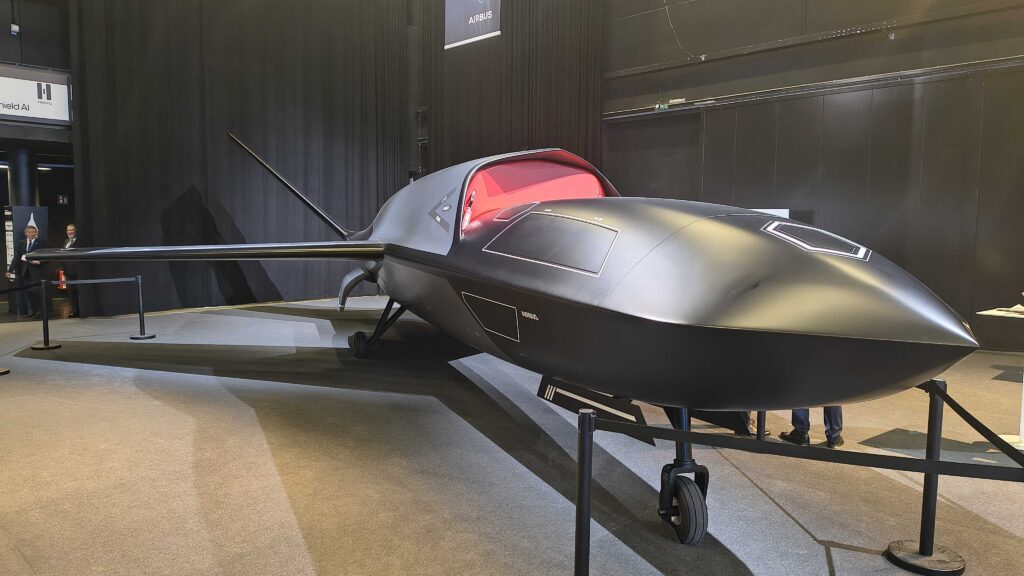
Airbus Defence and Space has shelved its Wingman uncrewed aircraft and replaced it with the U760 Ravenstorm, cutting the targeted wait for service from around 2040 to 2032. Announced November 3 at the International Fighter Conference in Munich, the reversal follows Germany’s push to obtain an uncrewed combat aircraft sooner than the clean-sheet Wingman design could be delivered.
The change is a trade between ambition and schedule risk. Wingman, unveiled at ILA Berlin in 2024, was envisioned as a new aircraft with a bespoke engine and a target cost of roughly one-third that of a crewed fighter. Ravenstorm instead draws on an existing Airbus design lineage and commercially supported propulsion, giving the company a more mature starting point for an accelerated program.
Ravenstorm trades a clean sheet for flown heritage
Ravenstorm is derived from technology developed through Airbus’s Barracuda demonstrator program. Work on Barracuda began in 2003, and the aircraft completed six flight-test campaigns before retirement. That history gives Airbus experience with a large autonomous jet, composite construction, flight controls, data links and cooperation between crewed and uncrewed aircraft.
It does not make Ravenstorm a finished product. A demonstrator validates selected technologies and operating concepts, while a service aircraft still must mature its production design, mission systems, support arrangements and integration with other platforms. Barracuda’s value is therefore risk reduction: Airbus can begin with hardware and engineering lessons that have already reached flight rather than develop every element from a blank page.
The planned Ravenstorm is a high-subsonic aircraft with a 500-kilogram internal weapons bay. It will use a business-jet engine instead of the bespoke powerplant envisioned for Wingman. A commercial engine can reduce the amount of new propulsion development and provide an established support base, although adapting any engine to a new military aircraft still requires integration and qualification work.
Those choices explain how Airbus intends to pull the service target forward by about eight years. Reusing an aerodynamic and systems lineage narrows the development problem, while an existing engine avoids placing a separate clean-sheet propulsion program on the aircraft’s critical path. The result is a less radical design than Wingman, but one aimed more directly at Germany’s revised timetable.
Valkyrie covers the earlier deadline
Even Ravenstorm’s 2032 target comes after Germany’s original 2029 requirement. Airbus is addressing that gap with the U740 Valkyrie, a Kratos-derived aircraft positioned as an interim option and the first of three collaborative combat aircraft in the company’s roadmap. Ravenstorm is the second, while Airbus has not named the third.
The Valkyrie has already progressed into European flight testing. Airbus and Kratos completed their first European test flight with the aircraft on September 29, and further work is planned around Airbus’s mission-system architecture. A joint crewed-uncrewed flight demonstration involving Valkyrie and a Eurofighter Typhoon is scheduled for 2027.
This creates a possible two-stage path. Valkyrie could address the near-term requirement using an aircraft developed with an American partner, while Ravenstorm could follow as a European platform over which Airbus and Germany would have greater control. The first step prioritizes availability; the second seeks more domestic authority over development, integration and long-term support.
Airbus still says it intends to be ready for the original 2029 requirement. Company representative Marco Mehling has also acknowledged that movement toward a 2032 deadline would favor Airbus, because that date aligns with Ravenstorm’s planned entry into service. Neither target guarantees delivery: both aircraft must proceed through testing, integration and procurement decisions before becoming operational systems.
Germany’s competition remains open
Airbus does not have the requirement to itself. Reports in October 2026 said Germany was reconsidering a potential purchase of Boeing’s MQ-28 Ghost Bat. Airbus, Boeing, Helsing and General Atomics are identified as competitors, and the reported renewed attention to the MQ-28 is not a final procurement decision.
Germany therefore faces a choice extending beyond which aircraft can fly first. Earlier availability may favor a platform with more development already completed, while greater European control may carry additional time, cost and engineering risk. Airbus’s answer is no longer to wait for one ambitious aircraft around 2040. It is to offer Valkyrie for 2029 and develop the Barracuda-derived Ravenstorm for 2032 an accelerated roadmap whose next visible test will be the planned Valkyrie-Eurofighter demonstration in 2027.
| More aerospace and engineering stories, right in your MSN feed. Follow AMI on MSN |
By Stephen Wallace — Editor for AMI’s aerospace integration and unmanned mobility coverage, focused on drone manufacturing, VTOL systems, autonomous networks, and air-ground mobility links.