China’s Type 004 Carrier Reaches 322 Metres, Could Become World’s Largest
China’s fourth aircraft carrier has grown to approximately 322 metres (1,056 feet) at Dalian Shipyard, putting its developing hull close to the length of the US Navy’s largest carriers. Satellite imagery indicates substantial construction progress, but the ship’s final dimensions, suspected nuclear propulsion and a possible 2027 launch remain unconfirmed.

The vessel commonly known as Type 004 measured about 46 metres at its widest point by October 2026. Prefabricated hull sections first appeared in imagery in early 2025, and more sections are expected to enlarge the ship as its bow and flight deck take shape. The current measurement therefore establishes the scale of the structure under assembly, not its completed length.
Why a 2027 launch appears possible
The Washington-based Center for Strategic and International Studies assessed that construction had reached a stage comparable to China’s third carrier, Fujian, in May 2021. Fujian entered the water in June 2022, making a Type 004 launch next year plausible. The 2027 projection has also been connected to the August 1 centenary of the People’s Liberation Army.
That comparison is useful, but it is not a construction schedule. Type 004 is larger than Fujian and may use a more complicated propulsion plant. Both factors can increase the amount of structural work, machinery installation and systems integration required before a hull is ready to leave the building area. Beijing has not announced a launch date.
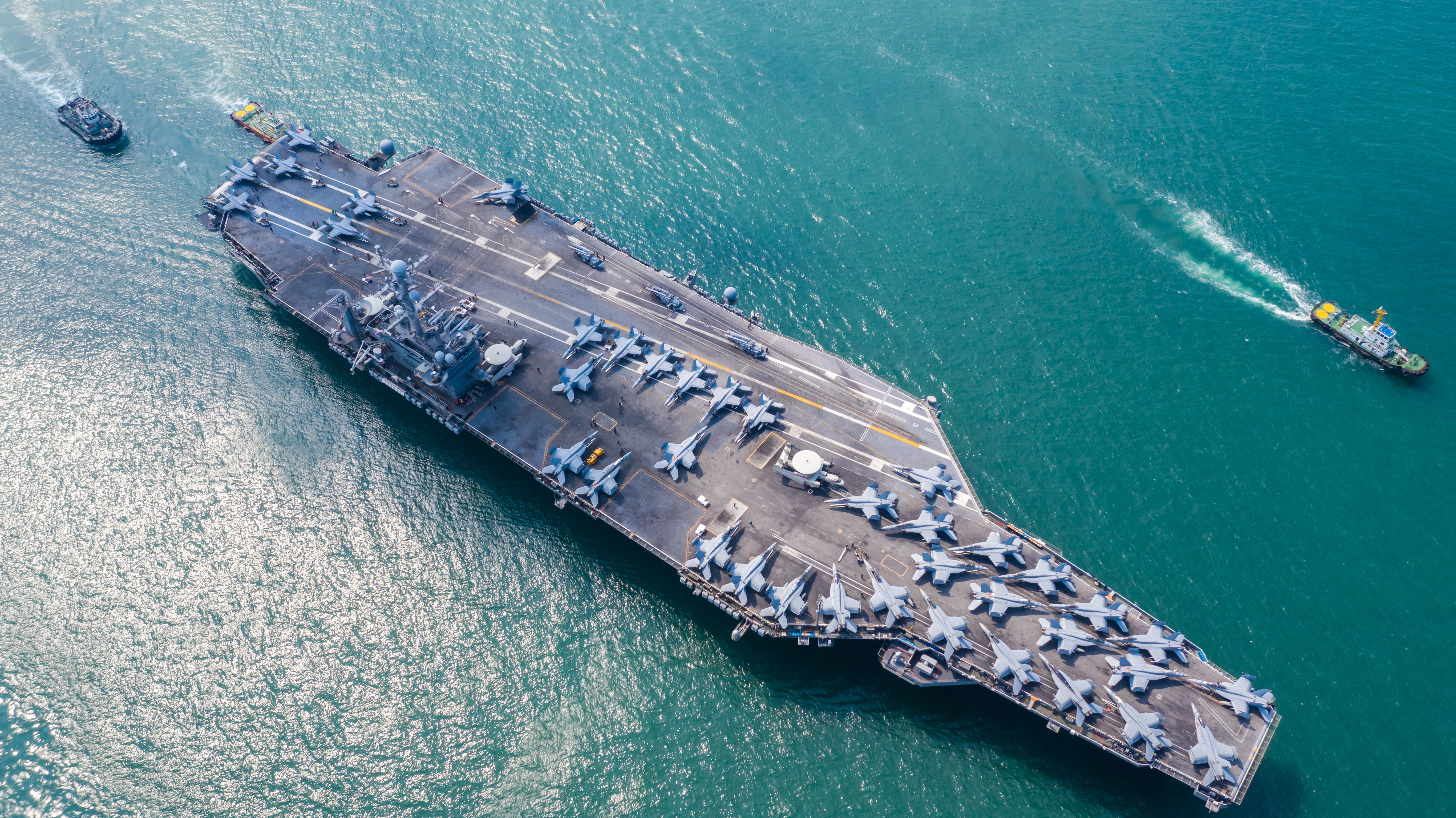
Janes has estimated a possible completed length of 336 to 339 metres. For comparison, the US Navy’s Nimitz-class carriers are approximately 333 metres long, while the Gerald R. Ford class measures about 337 metres. A projected displacement approaching 110,000 tonnes could make Type 004 the world’s largest aircraft carrier if the estimates are borne out, but neither displacement nor final dimensions has been confirmed.
The propulsion question remains open
The most consequential unknown is below the future flight deck. Images released in November reportedly showed internal structures broadly consistent with arrangements for containing a nuclear reactor. They support an assessment that Type 004 could become China’s first nuclear-powered carrier, rather than confirming that a reactor has been selected or installed.
Propulsion affects more than endurance. It influences internal volume, machinery layout, electrical generation, cooling and maintenance requirements. Those demands are especially relevant because the carrier is expected to use an electromagnetic aircraft launch system, which requires substantial electrical infrastructure and power-conditioning equipment.
Electromagnetic catapults use linear motors rather than steam to accelerate aircraft along the flight deck. The US Navy has described the technology as offering more precise end-speed control, smoother acceleration and the ability to accommodate a wider range of aircraft weights. Its Gerald R. Ford testing also illustrates the integration burden: generators, power-conditioning electronics, controls and deck machinery must function as one shipboard system.
China has already crossed part of that engineering threshold with Fujian, an approximately 80,000-ton carrier equipped with electromagnetic catapults. Type 004 would extend the challenge to a larger hull and, if current assessments are correct, a new propulsion architecture.
Size buys capacity but raises the shipyard burden
A larger flight deck and hull can provide more room for aircraft, aviation fuel, weapons, maintenance spaces, crew quarters and machinery. Those gains depend on the completed ship’s internal arrangement and cannot be calculated from length alone. Added size also means more structure to fabricate and join, more equipment to install and a larger set of systems to test before delivery.
The ship is one part of a much broader industrial target. A 2025 Pentagon assessment indicated that China aims to produce six additional carriers by 2035, potentially expanding its fleet from three to nine, according to a USNI News account of the report. Achieving that number would require substantially greater shipbuilding output as well as the capacity to equip, maintain and operate the vessels.
For now, the clearest finding is physical: a roughly 322-metre hull has emerged at Dalian in less than two years after prefabricated sections were first observed. Whether it launches in 2027 and whether it becomes the world’s largest and China’s first nuclear-powered carrier will depend on the unconfirmed machinery and unfinished structure still going into that hull.
| More aerospace and engineering stories, right in your MSN feed. Follow AMI on MSN |
By David Whitaker — Associate editor for AMI’s aerospace and drone systems desk, translating flight systems, aircraft programs, spaceflight, and UAV developments into accessible technical stories.