Secret Deal Gives U.S. 35% of North American Blue Energy and $30 Oil
The United States has secured a 35 percent stake in North American Blue Energy Partners and discounted access to part of its Venezuelan oil production under a secret agreement lasting 50 years. The arrangement offers potentially valuable supplies to U.S. refiners, but it ties that benefit to a major production expansion whose cost, legal foundation and durability are being challenged.
Under the 18-page contract reviewed by The Washington Post, the United States acquired its stake for nearly nothing. NABEP must sell 20 percent of its production to the United States for $30 a barrel, while the United States receives first purchase rights on the remaining output at market prices. Initial shipments reportedly began arriving late last month, including a one-million-barrel delivery.
The discounted allocation comes after Venezuela’s share
The headline price does not apply to all oil produced by NABEP. Separate confidential contracts provide Venezuela with royalties ranging from 16 to 40 percent of production, depending on the site and type of oil. Venezuela takes its share first; the discounted U.S. allocation follows. The United States can then buy additional production, but at market rates rather than $30 a barrel.
That sequence is important for taxpayers and petroleum consumers. A 35 percent equity position gives the United States a direct interest in the producer, while the discounted allocation creates a supply advantage if NABEP can deliver sustained volumes. Yet the available terms do not establish how the government’s ownership will be administered, how associated financial exposure will be handled or how any savings would flow through the refining and fuel-distribution system.
A low crude-acquisition price also does not translate directly into an equivalent reduction at gasoline pumps. Transport, handling, refining, distribution and taxes remain part of the retail price. Francisco Monaldi, director of Rice University’s Latin America Energy Program, said he considers the venture unlikely to reduce U.S. gasoline prices materially and described its prospects as “90 percent smoke and mirrors.”
Production targets require a large industrial buildout
NABEP’s current operation is materially smaller than its long-term target. Alejandro Betancourt said production rose from 18,000 barrels per day in late 2023 to roughly 223,000 barrels per day. He expects 275,000 barrels per day before year’s end, followed by 350,000 the next year and more than 1.015 million barrels per day by 2033.
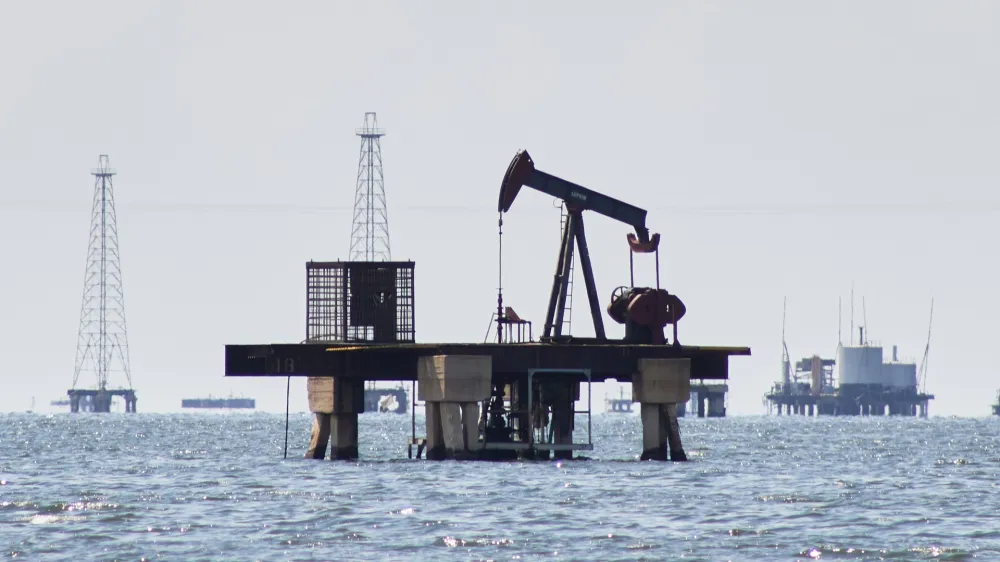
The Washington Post observed drilling at four sites, while Betancourt said 11 sites were operating. NABEP holds rights to 17 sites and fields believed to contain 63.7 billion barrels. Those resource estimates establish potential scale, not production capacity. Wells, rigs, power, transport, processing equipment, storage and export infrastructure must work as one system before underground resources become dependable deliveries.
The Orinoco Belt presents a particularly expensive boundary. Its heavy oil requires diluents to make it easier to move, while development of untouched fields can require heated drilling systems and substantial supporting infrastructure. Energy specialist Oswaldo Felizzola estimated that minimum development of a greenfield site could take five to 10 years and cost $15 billion to $20 billion.
Betancourt said NABEP plans to reinvest virtually all of more than $5 billion in projected 2026 cash flow and expand to 60 drilling rigs, with the remaining equipment purchased and deployed within 36 months. He also said he personally invested $700 million and contributed $300 million in equipment left from Petrozamora when he regained most of the operation in 2023. His dividends cannot begin until production exceeds 1.015 million barrels per day, aligning his payout with the most ambitious production threshold but not guaranteeing that the threshold can be reached.
U.S. refineries can use the crude, if supplies materialize
There is a practical market for additional Venezuelan barrels. Many Gulf Coast facilities are configured to process heavy, sulfur-rich crude, according to the U.S. Energy Information Administration. U.S. imports from Venezuela averaged 701,000 barrels per day in July 2026 before declining to 655,000 in August.
S&P Global estimated that Gulf Coast refiners could absorb another 300,000 to 400,000 barrels per day of heavy Venezuelan crude while increasing use of existing coking equipment. However, that would partly displace lighter U.S. crude into export markets rather than simply add the same volume to domestic fuel supply. Refinery compatibility therefore gives NABEP’s oil a plausible destination, but it does not ensure a proportional increase in total U.S. fuel output or lower consumer prices.
The contract also faces institutional uncertainty over a period far longer than any current administration or Congress. Venezuelan opposition leader María Corina Machado has questioned its transparency and suggested it could be reviewed. U.S. Democrats expected to control both chambers of Congress have challenged its legality and wisdom. Those disputes leave a 50-year commercial structure exposed to future legislative, judicial or Venezuelan policy review.
The next measurable test is industrial rather than rhetorical: NABEP must deploy the planned rigs, finance the heavy-oil infrastructure and move production well beyond the reported 223,000 barrels per day. Until that expansion is demonstrated, the United States holds favorable contract terms on oil whose promised scale remains unproven.
| More aerospace and engineering stories, right in your MSN feed. Follow AMI on MSN |
By Thomas Caldwell — AMI’s senior editor for mechanical and mobility engineering, covering vehicle electronics, systems integration, electrification, chassis systems, propulsion, and safety policy.