Mercedes-AMG EV Hits 637 Kilowatts, but Few Chargers Can Match It
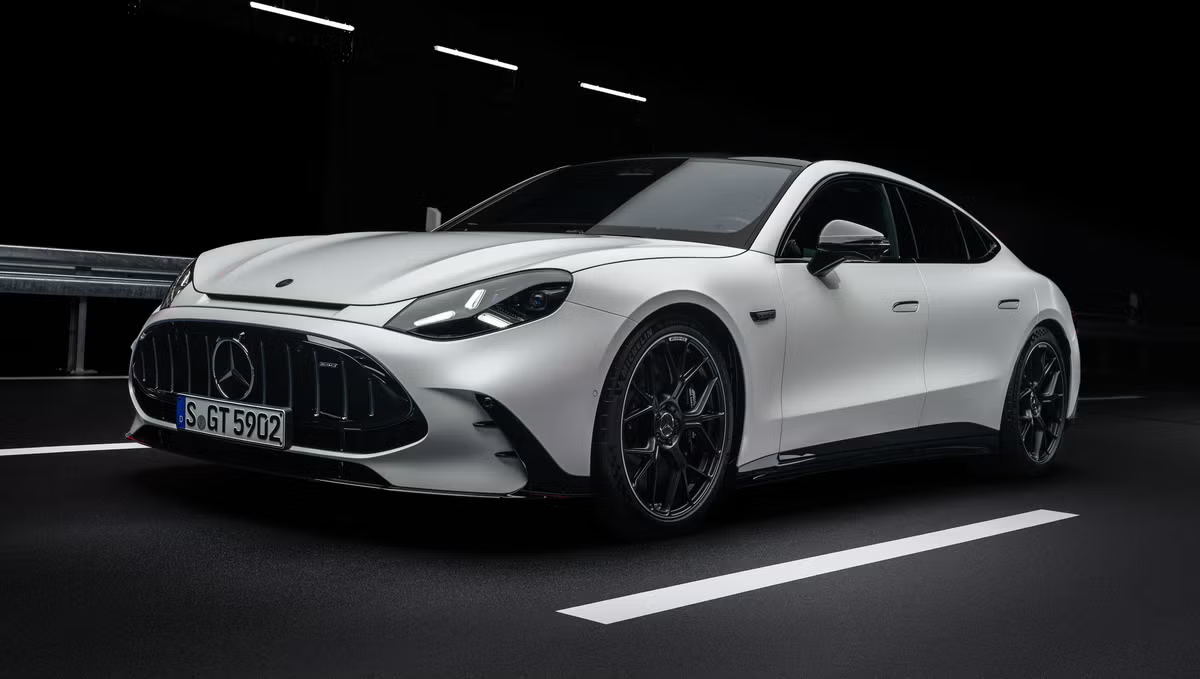
Mercedes-AMG has engineered an electric car capable of charging far faster than most public stations can support. During a two-day road and track evaluation in Spain, the 2027 AMG GT Four-Door Coupe EV reached a 637-kilowatt charging peak and moved from 17% to 80% battery capacity in about 10 minutes. The immediate constraint is outside the car: public chargers able to deliver power at that level remain scarce.
The demonstration was close to Mercedes’ claim of charging from 10% to 80% in approximately 11 minutes. It also showed that 637 kilowatts was a peak rather than a constant rate. Charging power declined to 572 kilowatts at 43%, 400 kilowatts at 60% and 252 kilowatts at 79%. Even that final figure is substantial, and the sustained charging curve is more important for stop duration than one headline peak.
Cooling the cells directly
The charging result depends on controlling heat inside the 106-kilowatt-hour usable battery. Instead of relying only on cooling plates positioned beside groups of cells, Mercedes circulates a proprietary, electrically non-conductive oil directly around the pack’s cylindrical nickel-cobalt-manganese-aluminum cells. Channel widths are tailored to remove different amounts of heat from different areas.
Direct contact reduces the thermal path between each cell and the coolant. That is valuable during very fast charging, when high current generates heat that can force a battery-management system to reduce power. Mercedes chief technology officer Jörg Burzer said the development objective was “extremely high heat energy transmission and getting rid of it,” adding that the company consulted Formula One experts.
The broader engineering principle is supported by experimental research into dielectric-fluid battery cooling. Direct cooling can reduce the thermal resistance associated with plates and interfaces, although coolant flow, temperature uniformity, material compatibility and pumping requirements remain important design variables. In a production car, the cooling system must manage those variables across repeated charging, acceleration and ordinary driving rather than during one controlled demonstration.
Mercedes combines that thermal system with an 800-volt electrical architecture. Higher system voltage allows a given power level to be transferred with less current than a lower-voltage design, reducing resistive losses in cables and other high-voltage components. Reaching roughly 600 kilowatts still places substantial demands on the battery, connector, cable, power electronics and charging station, so the result is a system-level achievement rather than a cell specification alone.
Repeatable acceleration uses the same thermal foundation
The cooling strategy also supports the AMG’s performance objective. The GT 55 and GT 63 use three compact YASA axial-flux motors, with one at the front and two at the rear. These disc-like motors package torque-producing components into a shorter assembly than a conventional radial-flux design, helping Mercedes fit three machines into the chassis.
Boost mode raises stated output to 805 horsepower in the GT 55 for as long as 55 seconds and 1,153 horsepower in the GT 63 for as long as 63 seconds. During the evaluation, repeated Boost runs produced no noticeable decline in acceleration. That observation does not quantify long-term durability, but it does indicate that the battery and motor thermal systems could recover quickly enough for repeated high-output use over the test.
The battery’s mass still creates a chassis-control problem. Mercedes uses active ride-control air suspension, up to six degrees of rear-wheel steering and continuous motor adjustments to manage the car’s responses. A disconnect unit can decouple the front motor during steady driving to reduce energy consumption. Mercedes has not announced a target EPA driving range, leaving a major part of the car’s everyday efficiency picture unresolved.
The charger becomes the bottleneck
A car that can accept 600 kilowatts does not receive that power from a 350-kilowatt station. Still, the AMG may benefit at today’s lower-powered chargers because its battery can hold a high rate longer instead of touching a brief peak and tapering sharply. Actual charging time will also depend on battery temperature, state of charge, station output and whether the site shares power among several vehicles.
Charging hardware is beginning to move toward the AMG’s capability. ChargePoint has announced equipment offered in configurations up to 600 kilowatts, with paired units capable of directing as much as 750 kilowatts to one port under suitable conditions. Deployment, grid connections and shared station demand will determine whether those ratings become routinely available to passenger cars.
Until stations at that level become common, the AMG’s approximately 10-minute demonstration represents capability more than guaranteed convenience. Mercedes has shown that direct cell cooling and an 800-volt system can move the charging bottleneck beyond the vehicle; public infrastructure must now catch up before most drivers can reproduce the result.
| More aerospace and engineering stories, right in your MSN feed. Follow AMI on MSN |
By Thomas Caldwell — AMI’s senior editor for mechanical and mobility engineering, covering vehicle electronics, systems integration, electrification, chassis systems, propulsion, and safety policy.