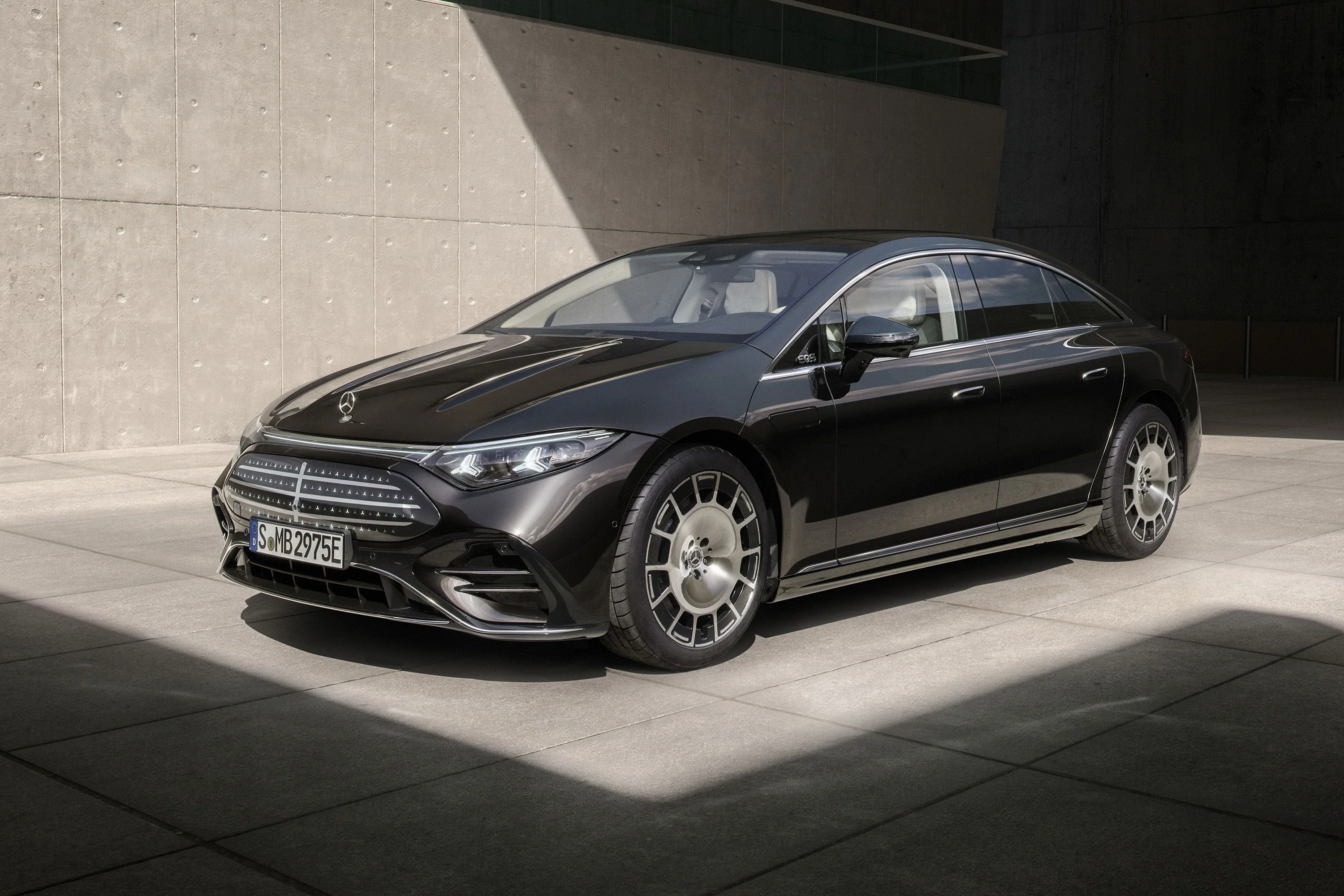
Mercedes EQS Travels 539 Miles, Adds 100 Miles in Seven Minutes
Five hundred thirty-nine miles is how far the 2027 Mercedes-Benz EQS 450+ traveled in Edmunds’ real-world electric-vehicle range test. In a separate instrumented charging session, the luxury sedan added 100 miles of range in 7 minutes and 16 seconds. Together, those results show a substantial advance over the previously tested EQS, although the base price remains above $100,000.
The 539-mile result exceeded the sedan’s 467-mile EPA estimate by 72 miles. Edmunds described the EQS 450+ as the longest-range electric sedan it has tested and ranked it second on its overall range leaderboard, behind the Cadillac Escalade IQ.
How the EQS reached 539 miles
The result came from a defined test rather than an unrestricted highway run. Edmunds uses a predetermined Southern California route targeting a 60/40 city-to-highway split and an average speed of 40 mph. Climate control was set to 72 degrees Fahrenheit in automatic mode, while the EQS was driven in Eco mode with regenerative braking set to high.
Those conditions are important because electric-vehicle range changes with speed, temperature, terrain, climate-control demand and driving behavior. The test offers a controlled comparison with other vehicles evaluated under the same general protocol, but it does not mean every EQS driver will travel 539 miles between charges.
The updated car combines more stored energy with lower consumption. Its usable battery capacity is 122 kilowatt-hours, up from 118 kilowatt-hours in the 2025 EQS 450+ tested by Edmunds. The publication also attributed part of the improvement to revised internal battery chemistry.
Capacity alone does not explain the full gain. Edmunds measured the 2027 car at 26.9 kilowatt-hours per 100 miles, better than its 28-kilowatt-hour EPA estimate. The publication’s range discussion lists the tested 2025 model at 29.1 kilowatt-hours per 100 miles, although a later charging table gives a conflicting 29.7 figure. Under the same range program, that earlier car traveled 464 miles. The new model therefore covered 75 additional miles, an increase too large to come from the four-kilowatt-hour capacity expansion by itself.
Why peak charging power tells only part of the story
Edmunds recorded a maximum charging power of 350 kilowatts and an average of 222 kilowatts during its charging session. The average is especially useful because an electric vehicle does not normally remain at its advertised peak throughout a stop. Charging power varies with battery state of charge, temperature and the vehicle’s charging curve, generally declining as the battery fills.
The EQS achieved an Edmunds charging-rate result of 825 miles of range added per charging hour, placing third on the publication’s charging leaderboard behind the 2027 Mercedes-Benz CLA 250+ and 2024 Hyundai Ioniq 6. That rate is not a claim that the car can charge continuously for an hour at peak power. It expresses how quickly useful driving range was restored during the measured session.
This is where vehicle efficiency and charging hardware interact. Two cars accepting the same electrical power can add usable miles at different rates because the more efficient car needs less energy to travel each mile. The EQS paired its 350-kilowatt peak with relatively low measured consumption, allowing it to add 100 miles in 7 minutes and 16 seconds. The tested 2025 model required 13 minutes and 44 seconds to add the same distance, so the updated car cut that interval by 6 minutes and 28 seconds nearly in half.
The improvement comes in an expensive package. The base EQS 450+ starts at $103,000 including destination, while Edmunds’ test vehicle cost $121,615. That car used two motors and all-wheel drive, produced 402 horsepower and 372 pound-feet of torque, and reached 60 mph in 5.4 seconds.
For long-distance electric driving, the more consequential change is the combination of range and recovery time. The 2027 EQS carried 75 miles farther than the tested 2025 version, then restored another 100 miles in little more than seven minutes. Its price limits the reach of that capability, but the test demonstrates how battery capacity, chemistry, vehicle efficiency and the full charging curve not peak power alone determine how an electric car performs on a long trip.
| More aerospace and engineering stories, right in your MSN feed. Follow AMI on MSN |
By Thomas Caldwell — AMI’s senior editor for mechanical and mobility engineering, covering vehicle electronics, systems integration, electrification, chassis systems, propulsion, and safety policy.