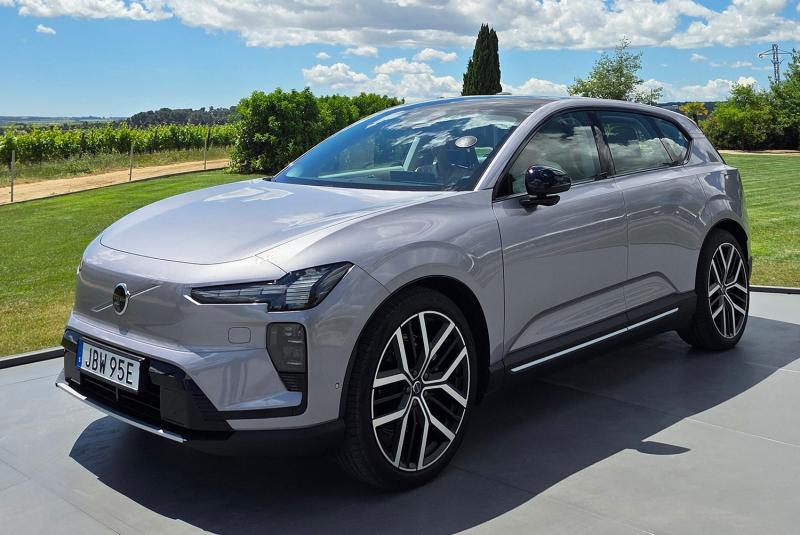
Volvo EX60 Out-Accelerates Porsche Cayenne EV, but $70,000 Test Car Needs Reboots
The 2027 Volvo EX60 delivered a striking contradiction during MotorTrend’s SUV of the Year evaluation. The electric Volvo out-accelerated the Porsche Cayenne EV and ranked among the publication’s quickest-charging vehicles, yet persistent software crashes forced judges to reboot the roughly $70,000 test vehicle.
That combination puts the EX60’s central engineering challenge in plain view. Its propulsion, charging hardware and chassis appear competitive in a crowded premium segment, but software instability can disrupt the everyday experience those systems are meant to support. In a vehicle positioned around an increasingly centralized digital architecture, a reboot is more than an infotainment annoyance when screens also mediate settings and other vehicle functions.
Strong speed without sacrificing composure
MotorTrend did not provide acceleration times for its Porsche comparison, so the result establishes which vehicle was quicker in that evaluation rather than the size of the gap. The tested midrange EX60 P10 weighed 5,092 pounds, rode on 22-inch wheels and nevertheless felt light and engaging to judges. They generally praised its smooth power delivery, supple ride and controlled handling, although some noticed an unusual busyness on flat freeway pavement.
A separate instrumented Car and Driver test helps quantify the P10’s performance. Its dual-motor test vehicle reached 60 mph in 3.9 seconds and recorded a 290-mile result in a 75-mph highway range test. It also charged from 10% to 90% in 23 minutes, averaging 204 kilowatts. Those figures support the broader finding that the EX60 combines substantial acceleration with useful long-distance charging capability, though they come from a different vehicle evaluation.
MotorTrend reported a 280-to-312-mile span between its road-trip range result and the applicable EPA rating. It also described the EX60 as one of its quickest-charging cars on record. Fast charging is particularly important here because it can offset some range shortfall during travel, provided the driver can reach a charger capable of supplying the vehicle’s requested power.
Software is part of the vehicle’s operating quality
The recurring crashes carry more weight because Volvo presents the EX60 as a software-defined vehicle. Its centralized computing system works with an 800-volt electrical architecture, while many cabin functions depend on the central touchscreen. MotorTrend found limited screen customization, and the tested vehicle lacked an advanced hands-free driving option.
The interface problems were accompanied by simpler ergonomic compromises. Judges criticized the unpadded door armrests, awkwardly placed interior door pulls and a vertical center storage bin used instead of a conventional glove box. Opinions differed on the small, squircle-shaped steering wheel, although drivers were able to find a comfortable position and maintain a clear view of the instruments.
Other packaging choices were more successful. The EX60 provides a comparatively generous rear seat, built-in child booster cushions and a cargo floor split into two sections, allowing access to storage beneath one side even when luggage covers the other. Its programmable-opacity glass roof adds another practical use of electronically controlled hardware. An off-road mode also worked effectively in sand during the evaluation.
Adaptive restraints raise the integration stakes
The EX60 introduces a multi-adaptive seat-belt system that uses interior radar and camera information to select among 11 programs according to occupant characteristics and posture. The design varies belt-load management rather than relying on one fixed response for every occupant and seating condition.
No official crash-test results were available for the EX60 at the time of the evaluation, so the adaptive system’s design should not be treated as an independently verified crash-test outcome. It does, however, illustrate why dependable systems integration matters: sensing, software and mechanical restraint hardware must operate as a coordinated safety system.
Efficiency remains another boundary. MotorTrend found that the P10 trailed segment leaders including the Tesla Model Y and fellow finalist Mercedes GLC400 4Matic. The EX60 starts just below $60,000, but the tested P10 approached $70,000, where buyers encounter competitors with different balances of efficiency, controls and refinement.
The test therefore leaves Volvo with an unusually clear development priority. The EX60’s acceleration, charging performance, chassis tuning and packaging already make a strong case for the underlying vehicle. Persistent crashes and required reboots show that its premium execution will depend just as heavily on whether the digital layer can become as polished as the mechanical one.
| More aerospace and engineering stories, right in your MSN feed. Follow AMI on MSN |
By Thomas Caldwell — AMI’s senior editor for mechanical and mobility engineering, covering vehicle electronics, systems integration, electrification, chassis systems, propulsion, and safety policy.