1966 Pontiac GTO’s Standard Three-Speed Has No Known Production Count
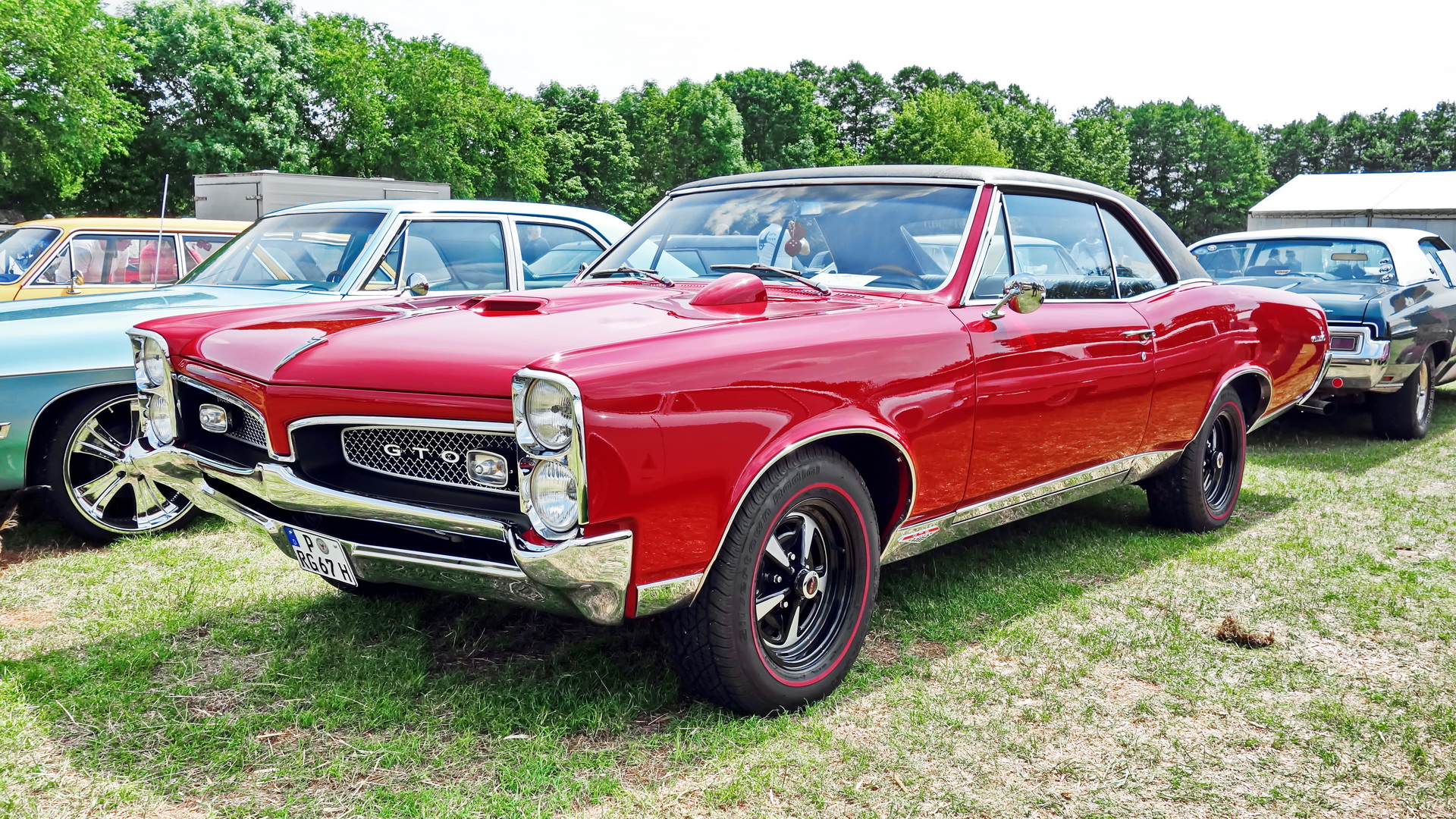
The counterintuitive feature of a bright blue 1966 Pontiac GTO recently encountered at a San Diego classic-car gathering is not an expensive performance option. It is a three-speed manual transmission the basic gearbox that most GTO buyers apparently passed over in favor of a four-speed manual or two-speed automatic.

No production total is known for 1966 GTOs equipped with the three-speed manual. That uncertainty makes the configuration interesting, but it does not establish that the floor-shift transmission in this particular car was installed at the factory. For collectors evaluating a surviving example, the physical presence of a three-speed is only the beginning of the authentication process.
Standard equipment did not mean the popular choice
The three-speed’s scarcity reflects the difference between a manufacturer’s standard specification and what customers actually ordered. Pontiac could use the three-speed as the GTO’s baseline transmission while buyers, attracted by the car’s performance identity, selected more desirable alternatives.
The four-speed held particular appeal in the muscle-car era because it offered both another ratio and the performance image associated with a floor-mounted shifter. As Hagerty’s history of four-speed transmissions explains, the gearbox became closely identified with American performance cars after earlier three-speed manuals often shifted from the steering column had come to represent a more ordinary setup.
That market preference created an inversion. The transmission included without an upgrade became less commonly encountered than the options buyers paid to obtain. It is a useful reminder that rarity cannot be inferred solely from an option list: sometimes the seldom-selected configuration is the standard one.
The available totals leave a critical gap
Pontiac sold 96,946 GTOs for 1966, making it the model’s highest-volume year. That was a substantial increase from the reported totals of 32,000 in 1964 and 75,000 in 1965. The 1966 model was also the first GTO marketed as a standalone Pontiac rather than an option package for the Tempest/LeMans.
A detailed Hemmings account of the 1966 and 1967 GTO lists 61,279 manual-transmission cars and 35,667 automatics for 1966. However, the manual figure does not separate three-speed cars from those ordered with four-speeds. It therefore cannot answer the question central to the unusual configuration: how many of those 61,279 manual GTOs left the factory with three forward gears?
The equipment descriptions add another layer. Hemmings identifies an iron-case three-speed manual as standard and says three-speeds could appear in floor- or column-shifted form. Its model description specifies a column-shifted three-speed as standard for 1966, with a console-shifted three-speed among the available choices. Consequently, a floor shifter alone does not demonstrate exactly how a particular car was originally ordered.
Later swaps complicate the surviving population
Transmission interchangeability also works against a reliable count of surviving factory three-speed cars. Three-speed GTOs could have been converted to the more celebrated four-speed configuration during decades of use, restoration or modification. Conversely, finding a three-speed in a car today does not by itself establish that the gearbox is original to that vehicle.
This is where factory records and component identification become more important than visual impressions. The car’s ordering documentation, transmission codes, build dates and the consistency of associated drivetrain components can help distinguish a factory configuration from a later conversion. Hemmings notes that incorrect transmission or rear-axle assemblies can be costly to replace, underscoring the practical consequence of identifying those components accurately.
The featured GTO’s three-speed is therefore best treated as a reason to investigate, not as proof of factory originality. The known production figures establish that manual GTOs were plentiful in 1966, but they do not disclose the three-speed share. Until documentation fills that gap for an individual car or more detailed factory records establish a model-wide total the GTO’s nominally standard transmission remains one of its least quantifiable configurations.
| More aerospace and engineering stories, right in your MSN feed. Follow AMI on MSN |
By Thomas Caldwell — AMI’s senior editor for mechanical and mobility engineering, covering vehicle electronics, systems integration, electrification, chassis systems, propulsion, and safety policy.