Hoffman Badger Turns Tesla Model 3 Into 11-Seat Minibus Without Crash-Test Results
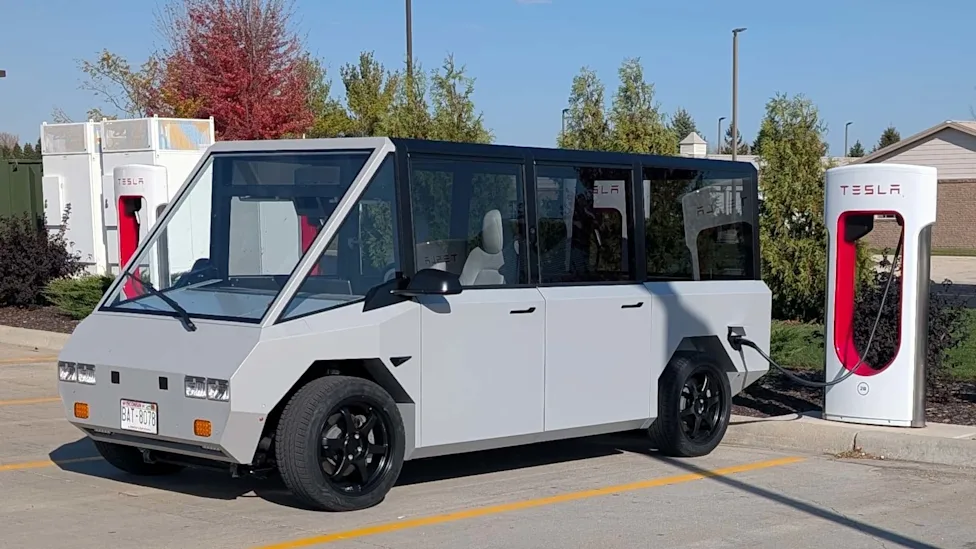
A used Tesla Model 3 now sits beneath an 11-seat electric minibus, but the transformation has moved faster than the data prospective buyers will need. Wisconsin-based Hoffman EV has built and road-demonstrated the Badger while acknowledging that it has not completed crash testing or published a range figure.
The independently developed prototype debuted at the 2026 SEMA Show in Las Vegas after Hoffman drove it from Madison, Wisconsin, using Tesla Superchargers along the way. The trip demonstrates that the vehicle can operate and charge over a long route; it does not establish repeatable range, crash performance or production readiness. Hoffman is targeting U.S. availability in 2027 and is assessing demand for both a conversion kit and a completed vehicle.
A new vehicle structure around Tesla systems
The Badger is more than a Model 3 with a tall body attached. Hoffman removed the car’s original unitary structure and substituted a new chassis and powder-coated aluminum body. According to the company’s technical and purchasing FAQ, the converted vehicle will receive a manufacturer-issued vehicle identification number rather than retain the donor car’s identity.
Major Tesla systems remain. The Badger carries over the donor vehicle’s battery, motors, front and rear suspension assemblies, electronics, dashboard, seats and door handles. Hoffman says Tesla app controls, Supercharger access and Full Self-Driving (Supervised) driver assistance continue to function. A donor’s single- or dual-motor configuration can also be retained, and Hoffman says the platform can accept components from a Model Y.
This reuse strategy avoids developing an electric powertrain, battery pack and electronic architecture from the ground up. It also creates a substantial systems-integration task: components engineered as parts of a Model 3 are now operating within a vehicle with different structure, mass distribution, aerodynamics, seating capacity and occupant environment. Hoffman says Tesla service centers will not service the Badger, leaving Tesla-related work to independent service providers. It also states that Tesla components will not receive a Hoffman warranty, while its chassis and body will have a one-year warranty against manufacturing defects.
More space changes the operating envelope
The prototype retains the Model 3’s wheelbase but is shorter overall, with the driver moved farther forward for visibility. Its battery sits about 38 millimeters higher relative to the suspension assemblies. Hoffman claims approximately 203 millimeters of ground clearance and 37-degree approach and departure angles, although it does not position the vehicle as a rock-crawling design.
Removable doors, a removable roof and mostly removable seats give the Badger several possible configurations. Hoffman says a roughly 1.2-meter-wide plywood sheet fits between the wheel arches. The company lists a 1,000-pound payload and a 3,500-pound towing capacity. Because the vehicle has 11 seats, its final loading information will need to make clear how passengers, luggage and optional equipment fit within its certified weight and axle limits. Seating capacity alone does not determine how much usable payload remains.
Aerodynamic drag is the more immediate efficiency penalty. The Badger may be lighter than its donor, according to Hoffman, but its larger, boxier body has a higher drag coefficient and delivers less highway range than the Model 3. No standardized or estimated range number has been released. Aerodynamic revisions are planned for early 2027, making the final body shape and its highway efficiency important preproduction milestones.
Crash performance and pricing remain open
Replacing a unitary passenger-car body changes the structure responsible for managing impact loads and protecting occupants. Hoffman says the Badger retains Model 3 airbags except for the side-curtain system, as well as crash-avoidance functions, but the completed vehicle has not undergone crash testing. Results for the new aluminum structure not the donor Model 3 will be necessary to evaluate occupant protection in the 11-seat configuration.
Final pricing is also pending. Hoffman’s current planning figures target $10,000 for the chassis, $40,000 for the chassis and van-body kit, and another $10,000 for assembly. Its own example reaches $70,000 before taxes when combined with a $20,000 donor vehicle, but the company says aluminum-price fluctuations mean pricing will not be finalized until early 2027.
The Badger has already shown that a Model 3 battery, motors, suspension, controls and charging access can survive a radical change in vehicle format. The harder stage comes next: quantifying range, validating the new structure in crashes, defining certified loading limits and turning provisional costs into a saleable 2027 product.
| More aerospace and engineering stories, right in your MSN feed. Follow AMI on MSN |
By Thomas Caldwell — AMI’s senior editor for mechanical and mobility engineering, covering vehicle electronics, systems integration, electrification, chassis systems, propulsion, and safety policy.