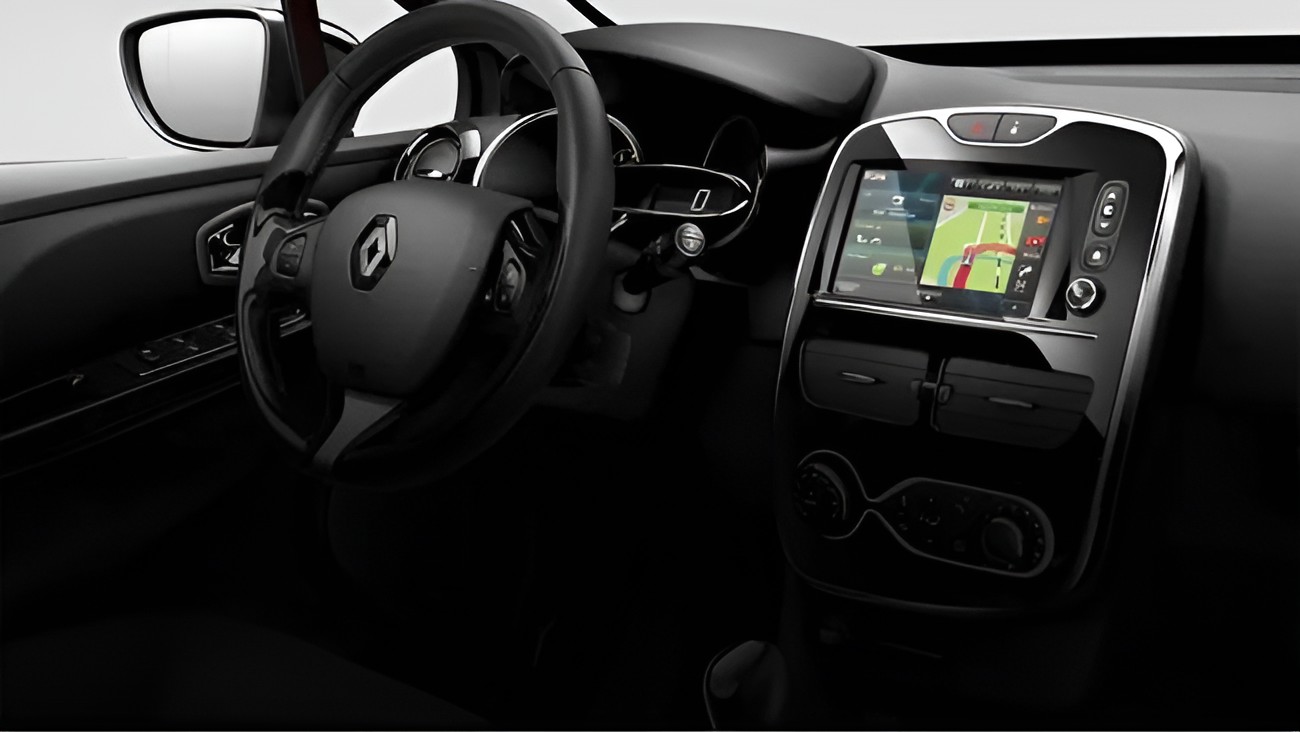
Missing TomTom Map Card Locked a 2014 Renault’s Clock Settings
Changing a car’s clock should not require security research. Yet Rasmus Moorats found that the date-and-time menu in his used 2014 Renault Latitude was inaccessible because the original TomTom navigation map card was missing. When daylight saving time left the display an hour out of sync, an ordinary adjustment became a reverse-engineering project.
The previous owner had warned Moorats that the navigation card was necessary to change the displayed time. Moorats recalled thinking, “I didn’t really find that believable,” particularly because any maps on the old card would already have been badly outdated. The car appeared to reinforce his skepticism: one settings menu still provided access to Bluetooth and Phonebook controls.
The other menu behaved differently. Selecting it produced the message “No maps detected!” instead of opening a submenu. The unavailable navigation medium had therefore blocked access not only to maps, but also to a basic vehicle setting that the driver reasonably expected to control independently.
A small dependency with an outsized consequence
The failure illustrates a recurring systems-integration problem in older infotainment platforms. Features that look separate to the driver may share the same application, storage medium or startup checks underneath. If software treats successful navigation initialization as a condition for loading a broader settings interface, losing the map card can take unrelated controls with it.
TomTom’s current memory-card compatibility guidance shows how important removable storage was to parts of its earlier product range. It lists Carminat TomTom LIVE among devices with an SD card and no internal memory. That documentation does not establish the architecture of every Renault-TomTom installation, but it provides useful context: in some systems of this period, the card was a central operating dependency rather than optional expansion storage.
Moorats examined the Latitude’s head unit and found a customized Linux-based TomTom operating system running on a Samsung system-on-chip. He extracted and analyzed the firmware, created an emulated environment for studying it, examined its scripting system and identified multiple vulnerabilities. He ultimately obtained root-level access through a kernel-level approach.
Those steps are far beyond normal vehicle maintenance. They also carried risk: privileged changes to embedded software can corrupt data or disable functions if performed incorrectly. The significance of the case is therefore not the access method as a reusable owner workaround. It is the amount of specialized effort required to restore control over a clock.
The clock used an offset, not a conventional time zone
Once inside the system, Moorats located the date-and-time configuration in a custom binary settings file. His analysis indicated that the unit received its reference time from GPS but represented local time as an offset measured in minutes. In his description, the system “doesn’t really have a concept of time zones at all.”
The stored offset was 180 minutes. Moorats changed it to 120 minutes, correcting the one-hour discrepancy. This design explains why a functioning GPS receiver did not automatically resolve the daylight-saving change: GPS supplied the time reference, while the separate local offset still had to be updated.
Using a numeric offset is not inherently defective. Embedded systems often favor compact representations and limited configuration models. The owner-facing problem arose because the interface for changing that value was coupled to navigation availability. The clock continued to operate, but the normal path for correcting its local display disappeared with the map card.
A better-integrated design would keep essential owner controls available even when an optional or aging subsystem cannot initialize. At minimum, the clock menu could be separated from map validation, or the system could provide a fallback setting path when navigation data is absent. Such isolation reduces the chance that one missing component will disable an unrelated function.
The available account does not establish how many vehicles share this behavior, whether it affects other Renault models or whether Renault or TomTom offered an approved repair path. No response from either company was included. For this particular Latitude, however, the dependency was concrete: a removable card containing obsolete navigation data stood between the driver and a two-number change in a settings file.
| More aerospace and engineering stories, right in your MSN feed. Follow AMI on MSN |
By Thomas Caldwell — AMI’s senior editor for mechanical and mobility engineering, covering vehicle electronics, systems integration, electrification, chassis systems, propulsion, and safety policy.