Mercedes-Benz Will Auction First C111, Then Wait 25 Years
Mercedes-Benz refused to sell the C111 when prospective customers reportedly sent blank checks after its 1969 debut. More than half a century later, the company will finally let one enter private hands and then close that door again for at least 25 years.

The automaker will offer a rotary-powered C111-II through RM Sotheby’s in Paris on February 3, 2027. It will be the first C111 sold by Mercedes-Benz, which has contractually committed not to release another during the following quarter-century. Only 17 C111 prototypes were built, and 13 survive in the company’s collection.
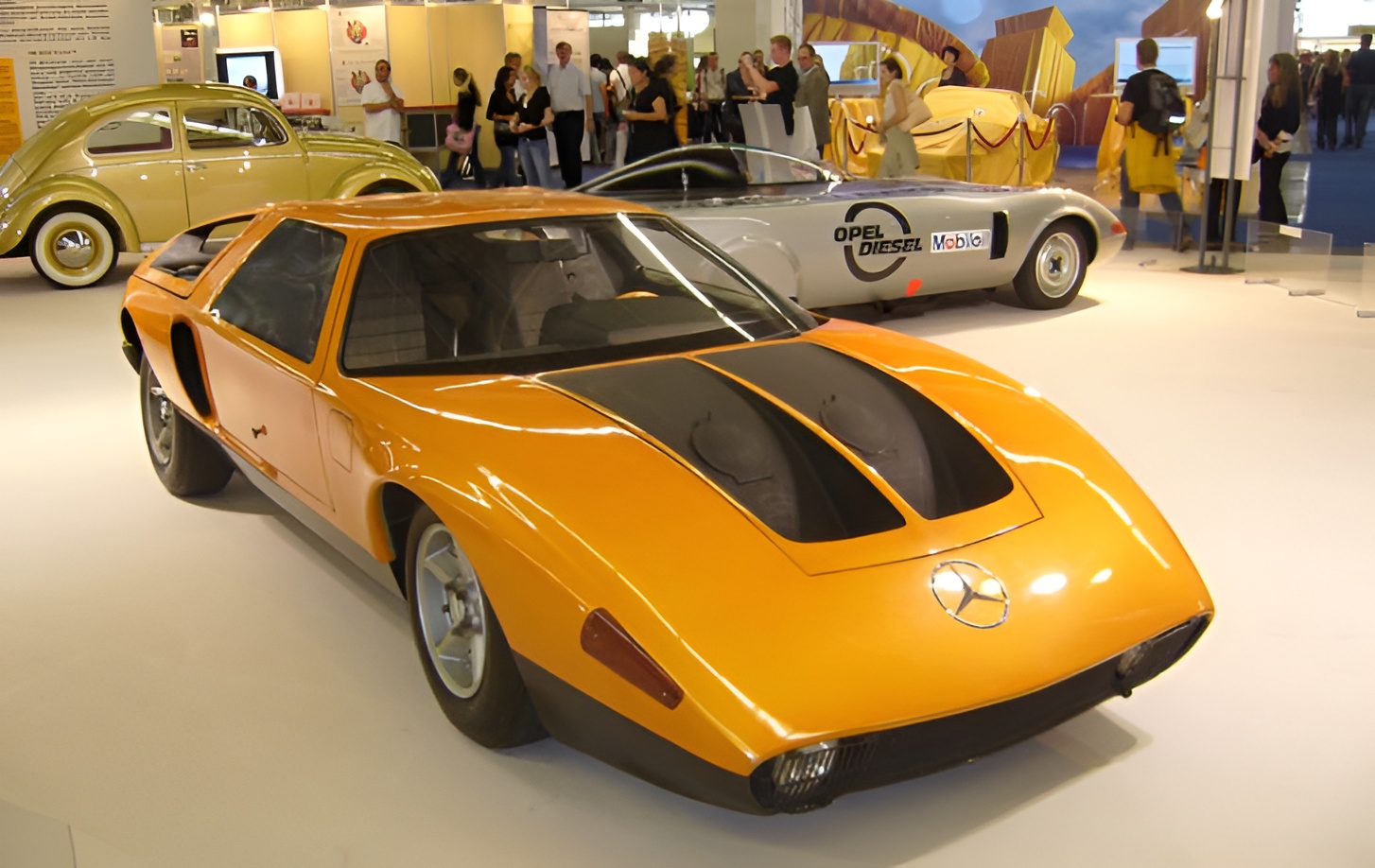
That scarcity grew out of an engineering program rather than a deliberately limited production car. Conceived as a successor to the W198 300SL Gullwing, the two-seat C111 debuted at the 1969 Frankfurt auto show with a mid-engine layout, a fiberglass body and gullwing doors. Its appearance and proposed performance generated enough interest that would-be buyers sent blank checks to Mercedes headquarters, but the car remained an experimental platform.
A production candidate overtaken by cost and regulation
The revised C111-II appeared at the 1970 Geneva show. Its central engineering proposition was a 2.4-liter, four-rotor Wankel engine mounted ahead of the rear axle. Rotary engines offered high output from a compact, relatively light package, with fewer major moving parts than a conventional piston engine. Those attributes suited a low, mid-engine sports car whose proportions and structure were designed around a small powerplant.
The C111-II’s engine produced 345 horsepower, while the car weighed 2,734 pounds. Mercedes-Benz claimed a top speed of 186 mph and acceleration from zero to 62 mph in 4.8 seconds. A five-speed manual transmission sent power to the rear wheels.
Its route to production was less convincing. Mercedes-Benz attributes the program’s cancellation to tighter emissions requirements, high production costs and the 1973 oil crisis. The rotary engine’s packaging and performance advantages therefore arrived with fuel-consumption, emissions and durability challenges at an increasingly unfavorable moment. Replacing it with a larger conventional engine would also have eroded the packaging logic around which the car had been developed.
Mercedes continued using the C111 name for experimental vehicles, including diesel-powered versions in 1976 and 1978, but the orange rotary sports car customers had tried to buy never became a showroom model.
The auction car remains a working prototype
The car going to Paris is known internally as Car 33. Completed with its four-rotor engine in August 1970, it joined the Mercedes test fleet and ran at the Hockenheimring. Its assignments included evaluating the even draining of two side-mounted fuel tanks and measuring temperatures in the rear luggage compartment.
Its equipment reflects the unusually complete state of the C111 program. The car has gullwing doors, gray-and-white houndstooth seats, a Becker Europa radio, twin fuel tanks and an early anti-lock braking system. The anti-lock function is no longer active, an important distinction between a preserved experimental car and a fully supported production vehicle.
The Weissherbst orange C111 currently rides on modern 8-by-15-inch alloy wheels. Its original wider magnesium wheels are included, but Mercedes-Benz says their age and condition mean they “are now suitable only for display purposes.” That limitation illustrates the practical problem of keeping a one-off development vehicle operational: original components can retain historical value after they cease to be appropriate for road use.
Car 33 entered the company collection in 1975 and has been displayed at the Mercedes-Benz Museum since it opened in 2006. Mercedes sympathetically restored the car to running condition in 2024, preserving its exterior and interior patina while overhauling the powertrain and adding a fire-suppression system in the engine compartment. The odometer showed 24,766 kilometers, or 15,389 miles, when photographed in October 2026.
Proceeds from the sale are intended to support the museum’s development, including digitization through the “Mercedes-Benz Museum 2.0” project. The auction will consequently exchange one physical artifact from the factory collection for funding intended to make the broader collection more accessible.
For the buyer, the C111 will be both a drivable artifact and an unsupported branch of Mercedes engineering history: fast, highly developed and never industrialized. With the other 12 survivors remaining unavailable for at least 25 years, the February 2027 sale is designed to remain the factory’s only transfer of a C111 to private ownership for a generation.
| More aerospace and engineering stories, right in your MSN feed. Follow AMI on MSN |
By Robert McKinney — Editor-in-Chief for AMI’s automotive and mobility coverage, with a mechanical engineering background and a decade reporting on powertrain systems, EV innovation, and global vehicle manufacturing.