BMW iX5 Beats Lucid Gravity by 43 Miles, Then Needs Restart
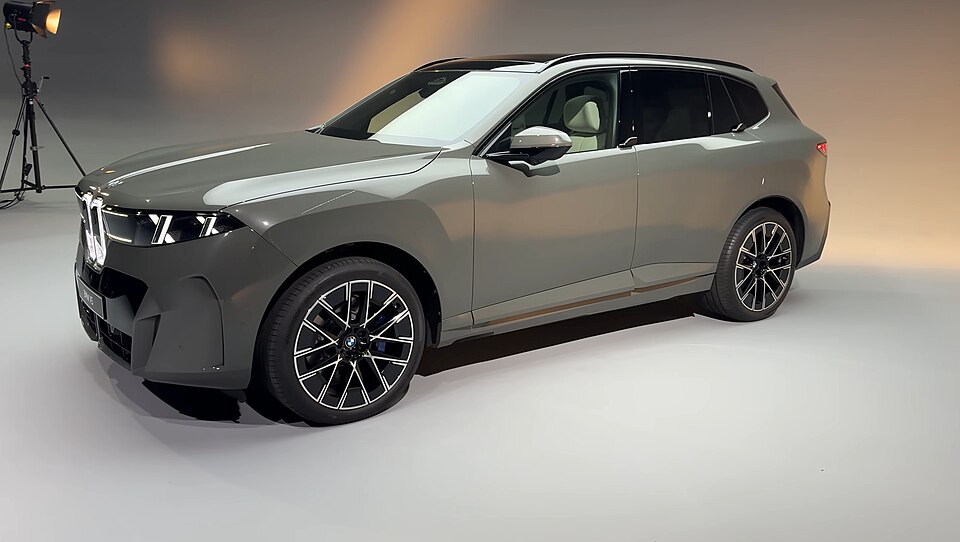
The BMW iX5 traveled 410.8 miles at a constant 70 mph in an Out Of Spec Testing group range test, finishing about 43 miles ahead of the Lucid Gravity Grand Touring. It also outlasted the Rivian R1S Dual Max and Porsche Cayenne Turbo Electric, but the winning distance came with an unusual complication: the BMW shut down near 400 miles and had to be restarted before completing its final 10-plus miles.

The results put the Lucid at 367.7 miles, the Rivian at 349 miles and the Porsche at 309 miles. That made the iX5 the clear distance winner in this test, reaching close to its stated EPA range of 435 miles despite holding 70 mph rather than following a mixed city and highway driving schedule.
The biggest battery beat the more efficient SUVs
The BMW did not win by extracting the most miles from every kilowatt-hour. Its main advantage was a stated 144-kilowatt-hour usable battery, the largest energy supply in the group. That capacity allowed the iX5 to keep traveling even though the Lucid and Porsche used less energy per mile.
The Lucid Gravity Grand Touring covered 367.7 miles with a 123-kilowatt-hour battery and delivered more miles per kilowatt-hour than the BMW. The Porsche was also more energy-efficient, but its 108-kilowatt-hour battery was the smallest of the four. Its lower consumption could not offset a capacity deficit of 36 kilowatt-hours relative to the iX5.
This is the central distinction between range and efficiency. Highway range reflects both how efficiently a vehicle converts stored electrical energy into motion and how much usable energy it carries. Aerodynamics, rolling resistance, drivetrain losses, thermal management and accessory loads influence consumption. Battery capacity determines how long that consumption can continue. In this comparison, BMW purchased the longest distance primarily through more stored energy rather than the lowest energy use.
A larger pack carries engineering costs. Added cells increase mass, and that weight must be accelerated, supported and managed by the suspension. It can also work against efficiency. The test nevertheless shows why a sufficiently large capacity advantage can outweigh those penalties during a steady-speed run.
A shutdown complicates the 410.8-mile result
The BMW reportedly displayed a zero-percent charge for about 10 miles and initially shut down near the 400-mile mark after consuming almost exactly its stated 144-kilowatt-hour usable capacity. Testers then restarted it and accessed approximately 4 kilowatt-hours of additional energy. The iX5 resumed traveling at 70 mph and ultimately reached 410.8 miles.
Host Kyle Conner theorized that the vehicle could be programmed to stop after delivering its rated usable capacity while retaining energy that becomes accessible following a restart. BMW has not confirmed that explanation. The supported result is narrower: the vehicle stopped, restarted and then traveled farther with additional reported energy available.
That sequence makes 410.8 miles a less straightforward endpoint than the headline number suggests. A driver ordinarily treats a propulsion shutdown as the end of usable range, not as a routine prompt to restart and continue. The run still demonstrated that the battery held additional accessible energy, but the distinction between the first shutdown and the final stopping point is important when comparing how vehicles manage their low-charge reserves.
Standardized tests answer different questions
A constant-speed road test is not equivalent to an official range rating. The EPA combines and adjusts laboratory test cycles designed to represent a broader mix of operating conditions, including city, highway, high-speed, hot and cold testing. Weather, tires, climate-control use, traffic and battery condition can all change a road-test result.
Battery condition may have been particularly relevant to the Rivian. Testers extracted about 136 kilowatt-hours from its nearly 30,000-mile pack, compared with roughly 145 kilowatt-hours in an earlier test. The figures establish a difference between the two runs, but they do not by themselves identify its cause.
An earlier Lucid Gravity test that ended at 345 miles is not directly interchangeable with this group result. Lucid identified a possible rear drive-unit problem, while the conditions and endpoints differed. The comparable figure here is the Gravity’s 367.7 miles from the same group exercise.
Within that test, the hierarchy was clear: BMW carried the most usable battery energy and went the farthest, while Lucid and Porsche converted their smaller energy supplies into miles more efficiently. The iX5’s 410.8-mile finish stands, but its first shutdown near 400 miles remains the more useful marker for understanding what a driver encountered as the battery reached empty.
| More aerospace and engineering stories, right in your MSN feed. Follow AMI on MSN |
By Robert McKinney — Editor-in-Chief for AMI’s automotive and mobility coverage, with a mechanical engineering background and a decade reporting on powertrain systems, EV innovation, and global vehicle manufacturing.