Robinson R44 II Rotors Struck Biscayne Bay During Fatal Filming Turn
A Robinson R44 II was turning extremely close to Biscayne Bay when its rotor blades struck the water, causing the helicopter to crash during an aerial-filming flight on November 4, according to preliminary findings from the National Transportation Safety Board. The pilot died, while a photographer and camera operator suffered serious injuries.
The helicopter was recording an offshore powerboat event near Bill Baggs Cape Florida State Park, off Key Biscayne. A photographer told investigators that it had flown low and parallel to the right side of a boat, then turned and moved ahead to obtain a better shot as the vessel passed underneath. The camera operator saw the blades contact the water at that point. Nearby boaters called emergency services, and Miami-Dade Sheriff Rosie Cordero-Stutz said a bystander attempted to help one victim.
The first confirmed mechanical sequence
The preliminary account establishes a concise pre-impact sequence: very-low-altitude filming, a turn ahead of the powerboat, rotor contact with the bay and an immediate crash. It does not yet provide the NTSB’s final probable cause or resolve the broader operational and human-factor questions surrounding the maneuver.
For investigators, the rotor strike is important because it identifies a direct physical interaction preceding the loss of the aircraft. A helicopter’s rotating blades occupy a broad disk around the airframe, so clearance must account for the entire rotor path rather than only the fuselage or landing skids. During a low turn, the relevant margin is the distance between that disk and the surface. In this case, the camera operator’s account places the blade contact while the helicopter was repositioning for the shot.
The filming task also created a moving geometric relationship among the helicopter, powerboat and water. The aircraft was not merely traveling over an open, stationary surface; it was flying alongside a vessel and then moving in front of it. The preliminary findings establish that sequence, but they do not yet specify the helicopter’s precise altitude, bank angle, speed or control inputs. Those details would be necessary for a fuller reconstruction of how the available clearance changed during the turn.
Low-altitude rules depend on operating context
Federal altitude rules treat helicopters differently from fixed-wing aircraft because helicopters have distinct operating characteristics. The Federal Aviation Administration’s guide to low-flying aircraft explains that helicopters may operate below certain general minimum altitudes when the operation is conducted without hazard to people or property on the surface and complies with any specifically prescribed helicopter routes or altitudes.
Over open water or sparsely populated areas, the general rule for aircraft is 500 feet from any person, vessel, vehicle or structure, while the helicopter provision allows operations below the fixed-wing minimums under its stated conditions. The preliminary crash account does not contain a regulatory finding, and the final investigation will have to address the flight’s operating context before any compliance conclusions can be drawn.
Some doors had been removed to facilitate photography and video. That configuration explains how the aircraft was being used, but the available findings do not connect the removed doors to the rotor strike, occupant injuries or crash sequence. Investigators can separately examine mission planning, aircraft configuration, crew coordination and the visual demands of tracking a moving subject without assuming that any one factor caused the accident.
Water changes the survival problem
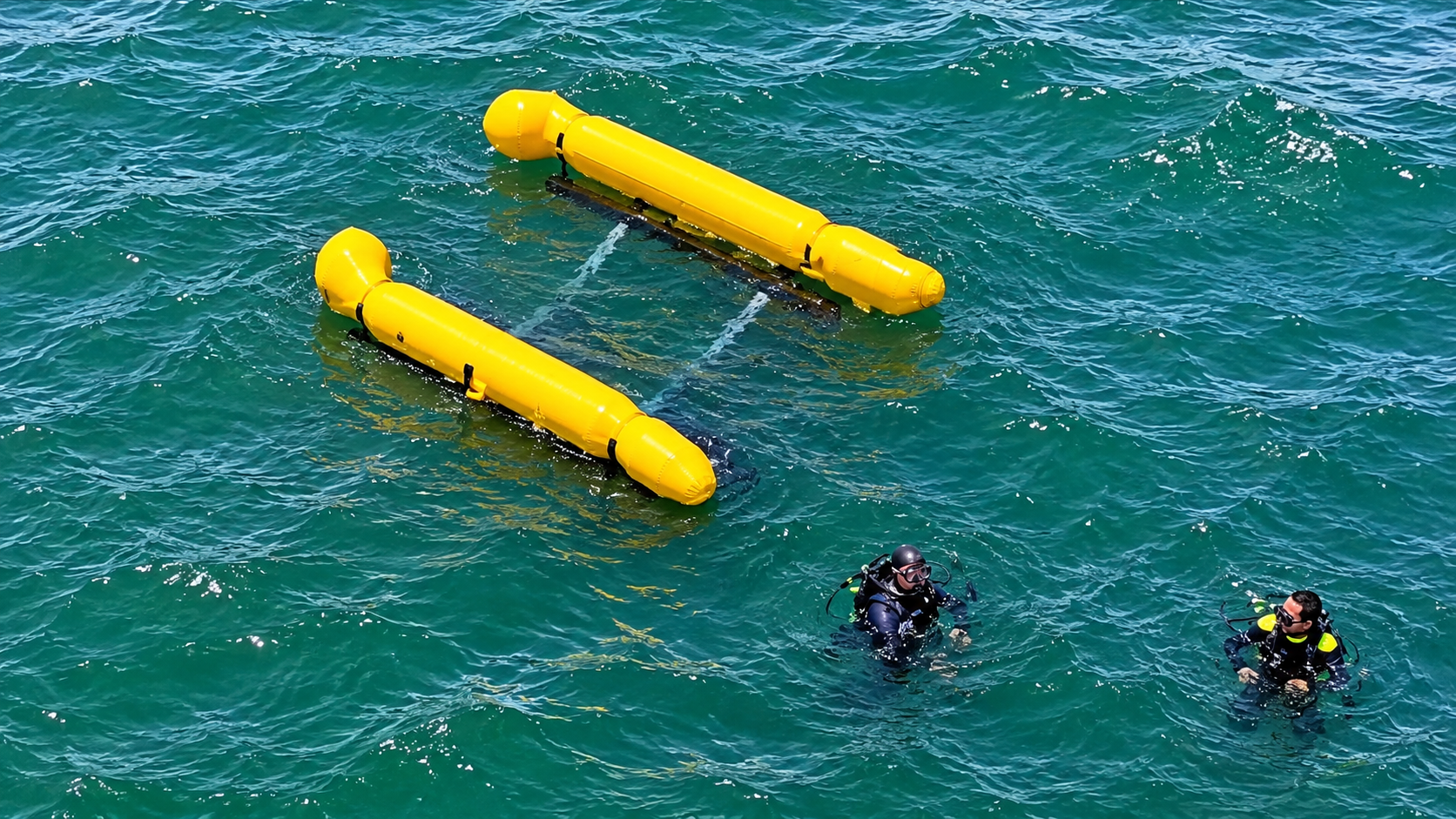
Images from the scene showed the helicopter overturned underwater with two yellow emergency flotation devices attached to its landing skids. Such equipment is intended to help an aircraft remain afloat during a water landing, but no finding has been issued about its activation or performance in this crash.
Water accidents can leave occupants with little time to respond. A 2008 analysis of 46 Canadian civilian helicopter water accidents found that lack of warning time, rapid sinking and inversion were recurring survival factors. That historical dataset does not determine what happened aboard this R44 II, but it explains why investigators document aircraft orientation, flotation equipment and occupant outcomes after a water impact.
The NTSB’s continuing work must now move beyond the observed blade contact to determine why the helicopter’s rotor disk reached the surface during the filming turn. Until that work is complete, the strongest established conclusion remains narrowly mechanical and consequential: the R44 II was maneuvering at very low altitude for a closer powerboat shot when its blades struck Biscayne Bay.
| More aerospace and engineering stories, right in your MSN feed. Follow AMI on MSN |
By Thomas Caldwell — AMI’s senior editor for mechanical and mobility engineering, covering vehicle electronics, systems integration, electrification, chassis systems, propulsion, and safety policy.