California High-Speed Rail Clears 494 Miles but Could Run Out of Cash
California High-Speed Rail has environmentally cleared its entire planned 494-mile route, but a new warning sharpens the gap between regulatory progress and an operating railway. The state inspector general warned in July that the authority could run out of cash by December 2027 without new financing. No track has been laid, and Southern California service is not expected before 2040 at the earliest.
The California High-Speed Rail Authority board completed the environmental-review stage by approving documents for the final 33-mile section between Los Angeles Union Station and Anaheim. That gives the full planned San Francisco to Anaheim corridor environmental clearance, establishing an approved alignment and allowing design, permitting and financing work to advance.
Clearance does not provide construction money, award tunnel contracts or produce an operable railway. The project is now estimated to cost between $128 billion and $231 billion, compared with figures of $33 billion to $45 billion presented around the 2008 vote authorizing nearly $10 billion in future bond sales. Trains were then expected to begin operating by 2020.
A cash deadline changes the near-term calculation
The inspector general’s December 2027 warning introduces a much nearer deadline than the system’s long-range opening dates. The immediate policy challenge is no longer only how California eventually finances the full route; it is also whether the authority can maintain the construction and procurement sequence needed to reach its first operating segment.
The authority has said it has $39 billion in funding on hand, most of it intended for the Bakersfield to Merced section. Separately, $4 billion in previously committed federal funding was withdrawn. The inspector general’s warning indicates that the program still faces a cash-flow risk despite the funding identified for its current work. New financing would be required to prevent that risk from interrupting progress.
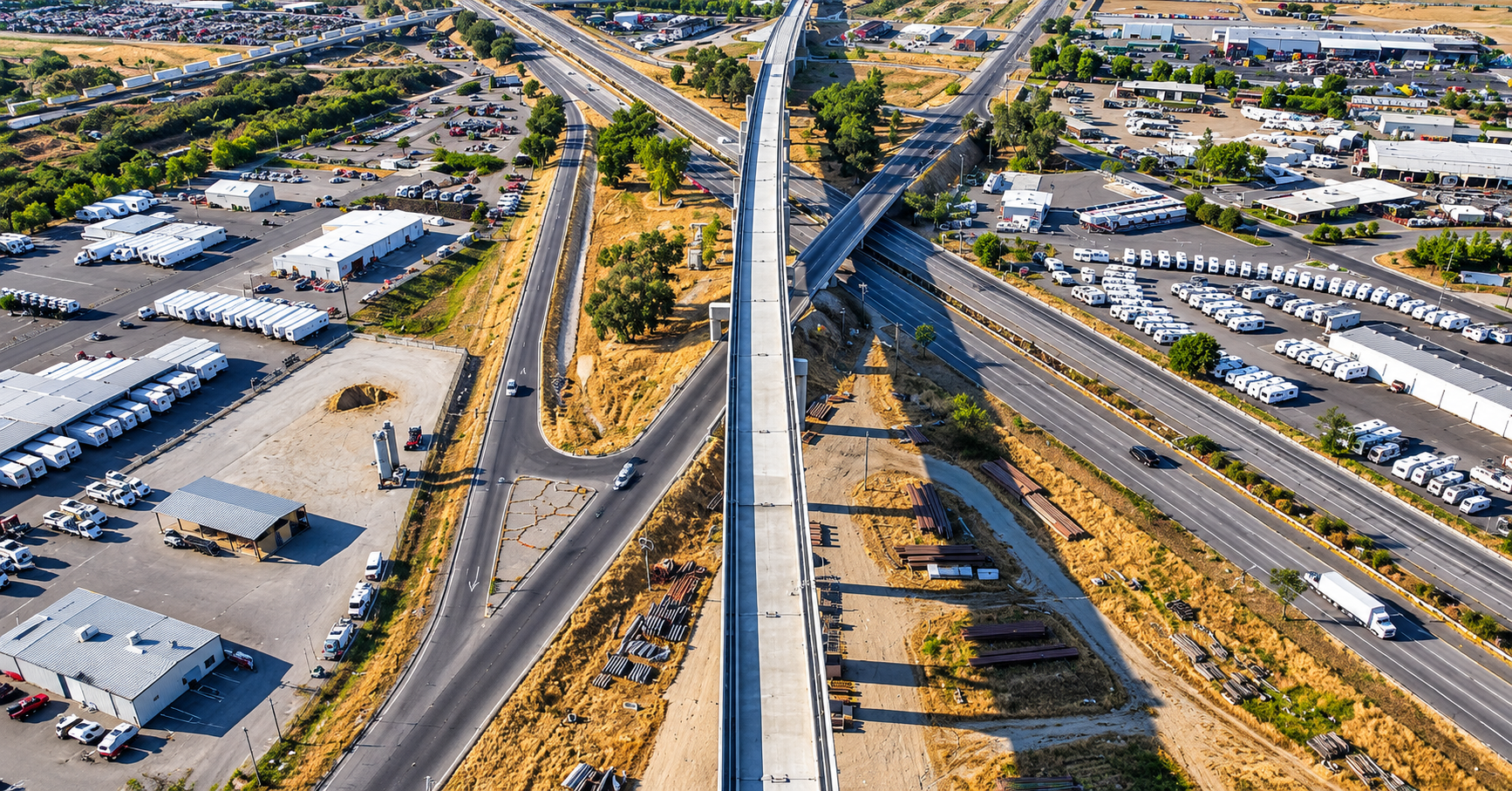
Concentrating resources in the Central Valley is intended to produce a usable railway sooner. Construction has continued for nearly 12 years along a 119-mile section between Bakersfield and Merced, although track installation has not begun. Authority spokesman Jim Patrick said laying track there could start as soon as the end of this year. The plan is to begin fare service on the broader Merced to Bakersfield portion and use fare revenue to support further construction.
That sequence carries an access tradeoff. It creates a defined first operating objective, but the initial service would remain separated from the Bay Area and Los Angeles basin. Taxpayers and bondholders across the state would continue supporting a system whose full intercity benefit depends on extensions that are much more expensive and remain incompletely funded.
Southern California requires a $42 billion mountain connection
The hardest physical barrier lies between Bakersfield and Burbank. Reaching Anaheim would require nearly 40 miles of tunneling through the Tehachapi and San Gabriel mountain ranges. The San Gabriel plans alone call for four tunnels totaling 28 miles, including two at least 12 miles long. The authority’s 2026 business plan estimates the two Bakersfield to Burbank segments would cost $42 billion.
Long high-speed-rail tunnels are established technology, but their scale makes geology, ventilation, emergency access, ground disturbance and system integration major design and certification tasks. A Mineta Transportation Institute analysis examined 67 tunnels longer than 4.5 miles in 28 countries, including 32 high-speed-rail tunnels. Those precedents demonstrate feasibility, not a standardized cost or schedule: each alignment must be designed around its own ground conditions and safety requirements.
The authority is exploring private financing and interim Metrolink improvements between Union Station and Palmdale. Such upgrades could improve regional connections, but they do not eliminate the need for the dedicated mountain infrastructure required to bring high-speed trains into the Los Angeles basin.
Shared tracks reduce construction needs and train speeds
The railway passengers eventually receive would also differ from the original fully dedicated concept. Planned operations in the Bay Area and much of Los Angeles County would share tracks with regional trains, limiting high-speed equipment to about 80 mph on those sections. Shared infrastructure reduces the need to acquire and build a separate urban right of way, but it also requires high-speed service to fit within existing regional operations.
The original proposal described maximum speeds of 220 mph and a Los Angeles to San Francisco journey of two hours and 40 minutes. The current projection is just over four hours from San Francisco to Los Angeles, followed by another 37 minutes to Anaheim.
Environmental clearance has settled where the 494-mile system may be built. The December 2027 cash warning now places a near-term constraint ahead of the much larger challenge: financing and constructing the mountain tunnels, installing and certifying the railway, and integrating slower shared-track sections before Southern California passengers can board a train in 2040 or later.
| More aerospace and engineering stories, right in your MSN feed. Follow AMI on MSN |
By Thomas Caldwell — AMI’s senior editor for mechanical and mobility engineering, covering vehicle electronics, systems integration, electrification, chassis systems, propulsion, and safety policy.