Homes and Failed Proposals Raise California High-Speed Rail’s 2033 Risk
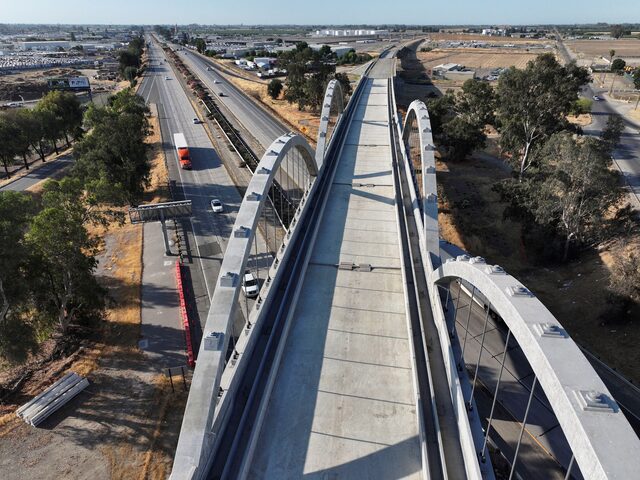
Two-story homes are rising in a Lennar subdivision in Shafter that sits in the planned path of California’s high-speed rail line, adding a concrete property conflict to the policy constraints surrounding the project’s 2033 target. The construction comes after most 2026 legislation the California High-Speed Rail Authority considered necessary to protect the Merced to Bakersfield schedule failed to advance. Only Senate Bill 1425 became law, creating a permit mechanism for outside work on authority controlled land.
The failed proposals leave a key schedule assumption unresolved. A July review by the Office of Inspector General called it “overly optimistic” for the authority’s business plan to expect lawmakers to approve its priorities almost immediately. Those measures were intended to accelerate utility negotiations, environmental reviews and property disputes, among other processes. Neither the authority nor the inspector general has calculated how much delay could result.
The active home construction in Shafter illustrates why corridor control is more than an administrative detail. A rail alignment must be available not only for major civil works but also for utility relocation, track installation, railway systems and testing. A development in the planned path can require property acquisition, design coordination or another resolution before dependent work proceeds. The available information does not quantify the subdivision’s schedule or cost effect.
The new permit law addresses only one interface
Gov. Gavin Newsom included SB 1425 in his September 27 legislative update. The law allows utilities, local governments and private developers to seek authority permits before performing work on its operating right of way or other controlled property. That gives the authority a formal way to review outside construction and protect the railway corridor.
Its reach is limited. SB 1425 does not empower the authority to compel utilities to relocate existing power lines, pipes or other infrastructure, nor does it establish deadlines for those moves. Chief Executive Ian Choudri said in August that some utilities identified as construction obstructions in 2017 remained in the project’s path.
That distinction exposes the project’s larger systems-integration problem. Issuing permission for new work on controlled land is different from clearing pre-existing obstructions from a construction site. A civil contractor may have labor, designs and materials ready, yet still be unable to release a work front if another organization controls infrastructure within it. Delays at one interface can then propagate into trackwork, power, signaling and commissioning activities.
The authority also sought changes to accelerate environmental review for renewable-energy facilities, resolve property disputes more quickly and exempt construction materials from sales tax. Most remained concepts rather than enacted laws. Authority spokesperson Micah Flores said the agency does not draft legislation and that lawmakers can independently turn its concepts into bills. Sen. Dave Cortese, who authored SB 1425, said the authority and governor’s office had not provided legislators enough assistance. Those positions offer different accounts of the outcome without assigning sole responsibility.
Funding proposals create another corridor dispute
The 171-mile Merced to Bakersfield segment is scheduled to receive support from $1 billion in annual carbon-market auction proceeds through 2045, although new state climate rules could cut that revenue by half. Senate Bill 1411 would have removed a $500 million cap on specified climate-fund spending outside the Central Valley segment, potentially allowing more design, engineering and property acquisition elsewhere. Lawmakers shelved it in May amid concern that broader spending could divert resources from the first operating segment.
Another authority concept considered sales and property-tax revenue within a half-mile of the route. Eleven mayors warned that redirecting those receipts could reduce funding available for local services and road repairs. Flores later said the authority was consulting local governments and was not proposing to override local tax or land-use powers. The unresolved tradeoff is between a more dependable corridor funding stream and the fiscal burden placed on communities hosting the infrastructure.
The statewide system is estimated by the authority at $126 billion to $231 billion, so assumptions about property access, utility coordination and legal authority carry substantial public consequences. Failure to pass a requested law does not translate automatically into a defined delay; existing contracts and administrative processes could still resolve some conflicts. But those alternatives need credible owners, deadlines and contingency allowances if they are to support a 2033 opening.
The authority plans to revisit similar legislative concepts next year and release updated cost and schedule information in March. That update will need to show how the Merced to Bakersfield program accounts for the powers it did not obtain and how active conflicts such as homes being built in the planned Shafter alignment fit into the path to passenger service.
| More aerospace and engineering stories, right in your MSN feed. Follow AMI on MSN |
By Thomas Caldwell — AMI’s senior editor for mechanical and mobility engineering, covering vehicle electronics, systems integration, electrification, chassis systems, propulsion, and safety policy.