Hubble Found a Tiny Comet Spinning Toward Self-Destruction
Sometimes the solar system hides its strangest behavior in old data. A fresh analysis of images taken by the Hubble Space Telescope has revealed that the comet 41P/Tuttle–Giacobini–Kresák did something that astronomers had never observed before: slowed down its rotation so much that the only explanation is that the comet has actually reversed its rotation. To scientists who study small icy bodies in the solar system, the study of the comet is significant not only because of the comet itself but also because of the implications of the study. As the scientists themselves note, the study is significant because it demonstrates the rapid changes that can occur in an object that is only 0.6 miles in diameter and how such changes can cause the object to become unstable in a relatively short period of time.
41P is a Jupiter family comet that returns to the inner solar system every 5.4 years after having been deflected long ago from the Kuiper Belt. In the 2017 pass of the comet near the sun, the Lowell Observatory observed the comet’s rotation period to be about 20 hours in March. In May of the same year, the Swift observatory of NASA observed the comet’s rotation period to be between 46 and 60 hours. In December of the same year, the Hubble Space Telescope observed the comet’s rotation period again and saw the comet rotating in a period of 14 hours. This is the reason why the scientists who conducted the study believe that the comet has actually reversed its rotation.
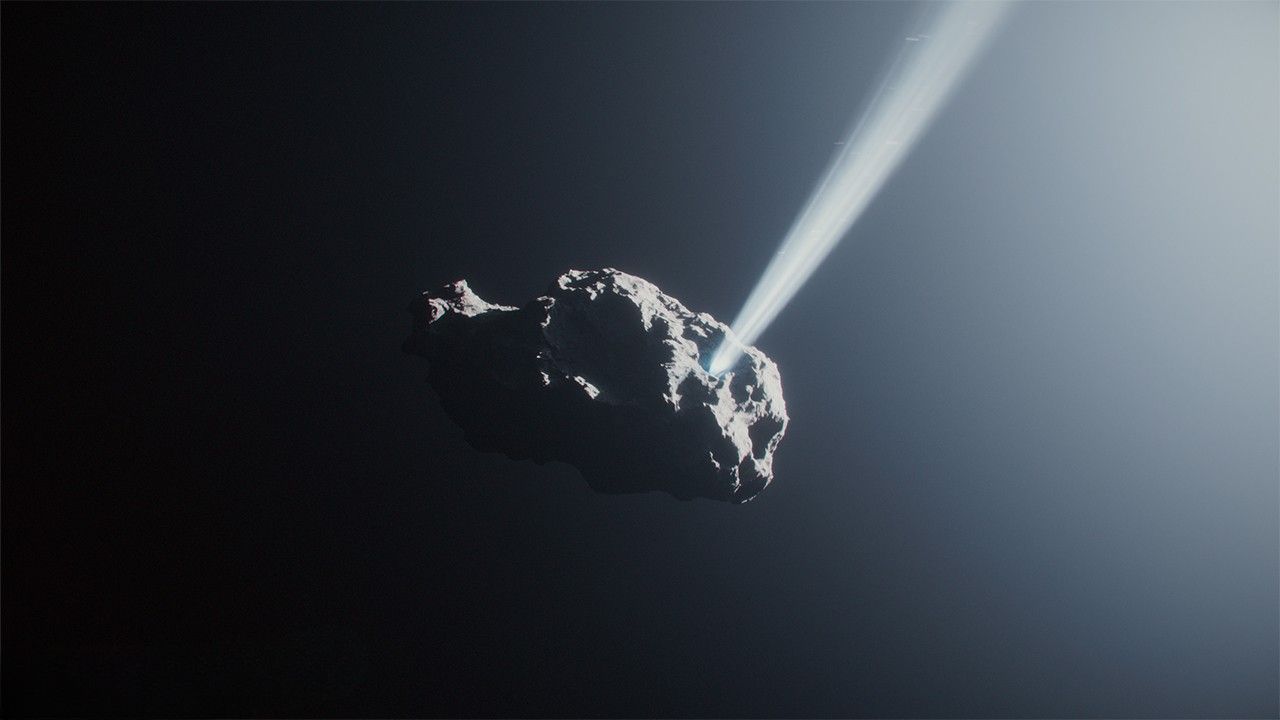
“Jets of gas streaming off the surface can act like small thrusters,” David Jewitt of UCLA said. If those jets are unevenly distributed, they can dramatically change how a comet, especially a small one, rotates. The mechanism is well known in principle, but rarely seen in such a dramatic form. As comets near the sun, surface and near-surface ice layers warm and discharge into space, creating a dust and gas cloud. Hubble has already seen this in another small comet, in a dust jet that rotated in place, where a change in direction of a rotating jet traced out a pattern of spin, like a lawn sprinkler. What is unusual in this case is the apparent scale of the torque. A small body like this is easily rotated, and once a spin is opposed by a sufficient opposing force, it is possible for it to slow down and reverse. “It’s like trying to turn a merry-go-round until it slows down and goes in reverse,” Jewitt said.
The general lesson is that comets are not passive objects, but change over time both mechanically and chemically. Outgassing can change, for instance, both spin and orbit, since gases leave behind momentum, like a rocket exhaust. Over a series of orbits, this same process could strip away volatiles, hide active ice under a layer of fallen dust, or even cause a body to break apart.
This is already known to happen. Hubble in 2025 has already captured images of a comet named K1 disintegrating into at least four pieces, a long history of disintegration for comets in our solar system. Older research from JPL has already posited that some families of comets continue to disintegrate in orbits far from the Sun, not just when they pass close to the Sun. Seen in this context, the spin reversal of 41P is no longer a curiosity, but a symptom of a larger pattern of decline.
There is another reason why this discovery is notable. The key images from Hubble were not taken especially for this research. They were actually drawn from the Mikulski Archive for Space Telescopes years after and analyzed again. The recovery of these images is actually an uncommon research on instant small body evolution. “I expect this nucleus will very quickly self-destruct,” Jewitt said.