NOAA Aurora Forecast Lets iPhones and Pixels Capture Colors Eyes Miss
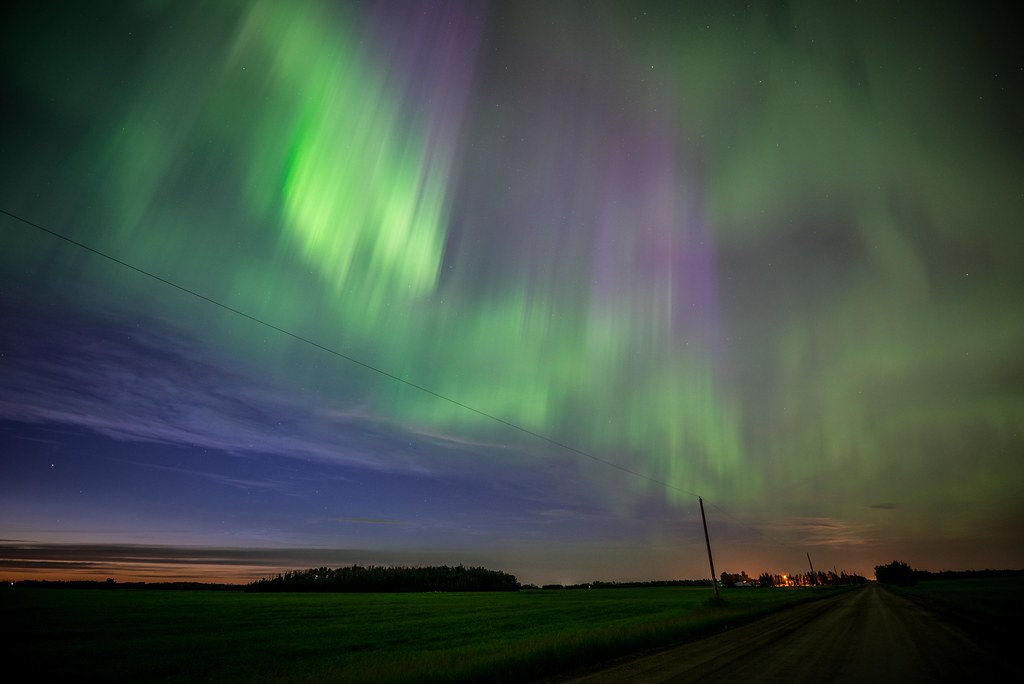
A faint aurora can look pale, gray or nearly white to an observer while appearing green, pink or otherwise more colorful in a smartphone photo. That contrast could become relevant across the far northern United States as NOAA forecasts elevated geomagnetic activity through November 9. An iPhone or Google Pixel may reveal more color than the eye can distinguish, provided the phone remains motionless during its long exposure.

NOAA’s three-day outlook, issued at 00:30 UTC on November 7, called for a minor G1 geomagnetic storm and allowed for a chance of moderate G2 conditions. It forecast storm-level activity from 03:00 to 06:00 UTC on November 7 and again from 4 to 7 p.m. Eastern on Sunday, November 8. A Kp value of 4.67 just below storm level was forecast from 10 p.m. Sunday to 1 a.m. Monday.
Those figures describe geomagnetic activity, not a guarantee of a visible display. The storm’s strength and peak timing remained uncertain, and clouds or urban lighting could erase the practical advantage of a favorable forecast. NOAA’s aurora-viewing guidance identifies location, geomagnetic activity, local weather, light pollution and moonlight as major factors. For this event, the best chances were expected in the far northern United States.
Why the camera may see color first
The eye and phone solve low-light imaging in different ways. In darkness, human vision relies heavily on rod cells. Rods are sensitive enough to detect a dim glow, but they do not perceive color. An aurora can therefore register as a pale structure without producing enough light for a strong color response.
A phone does not have to interpret the scene instantaneously. Its camera can gather light over a longer interval, raise sensitivity and combine several frames. Computational processing then reduces noise and adjusts color and detail. Multi-frame fusion is a standard computational-photography technique, allowing several imperfect low-light exposures to contribute to one cleaner image.
The result is not necessarily a literal reproduction of what an observer saw. It is an image assembled from more light over more time, with software shaping the final appearance. That is why a phone photograph may look brighter, cleaner and more colorful than the sky did to the person holding it.
iPhone and Pixel take different routes
On the iPhone 11 and later, Apple’s Night mode activates automatically when the camera detects low light. The user can open the Night mode controls and move the exposure setting to Max. Flash and Live Photos need to remain off because enabling either turns Night mode off.
Google Pixel phones use Night Sight, with a further astrophotography mode available when a supported phone detects that it is stationary and pointed toward the sky. On the Pixel 4a (5G) and later, astrophotography operates only at 1x zoom or greater. A Pixel astrophotography capture can take as long as four minutes, according to 9to5Google.
That duration exposes the shared constraint behind both systems: stability. A long exposure can collect faint auroral light, but it also records unwanted camera movement. Handholding the phone defeats much of the advantage because motion can soften stars, smear auroral structure and interfere with frame alignment.
A tripod is the most reliable support, although a firm surface can work if the phone will not shift. The device must remain untouched throughout the capture. Reducing screen brightness helps preserve the observer’s dark adaptation, while a clear northern horizon and distance from city lights improve the signal reaching both eye and camera.
Moonlight should be less troublesome during this forecast period. U.S. Naval Observatory data placed the new moon at 07:02 UTC on November 9, producing a darker background than a full moon would. Cloud cover can still block the display entirely, so local weather remains as important as the geomagnetic forecast.
The comparison ultimately favors the eye for immediacy and the phone for accumulation. Human vision sees the sky continuously but sacrifices color sensitivity in deep darkness. Night mode trades time for light, merging multiple exposures into a more colorful record. If the aurora remains faint, the ordinary phone fixed firmly in place may show the display more clearly only after the exposure ends.
| More aerospace and engineering stories, right in your MSN feed. Follow AMI on MSN |
By David Whitaker — Associate editor for AMI’s aerospace and drone systems desk, translating flight systems, aircraft programs, spaceflight, and UAV developments into accessible technical stories.