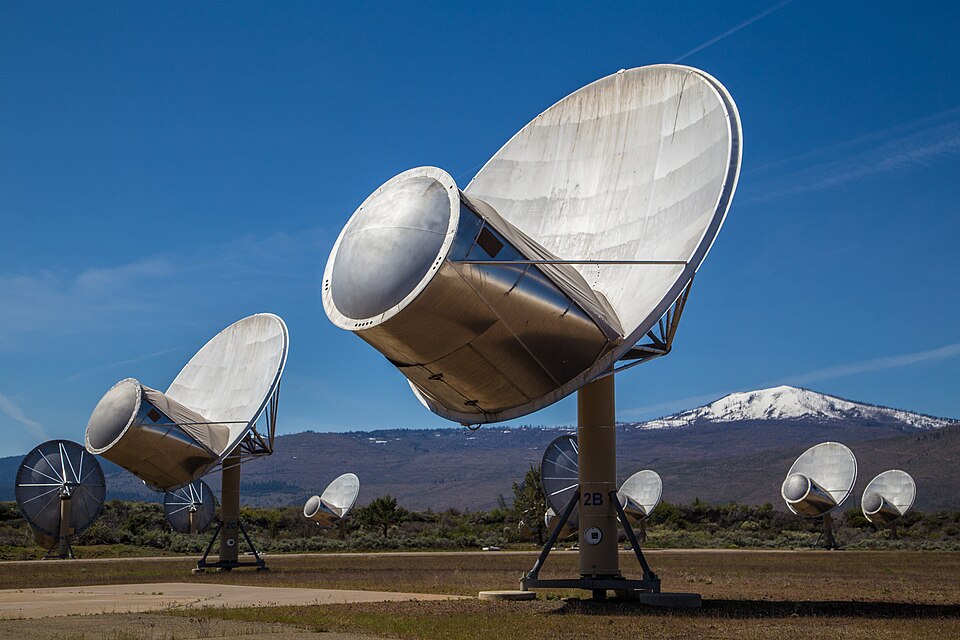
Allen Telescope Array Ruled Out Strong Signals From 3I/ATLAS
The Allen Telescope Array located in Northern California has achieved a clean null result regarding its latest subject of investigation. According to the researchers at the U.S. radio telescope facility, there is no indication of artificial narrowband radio signals being emitted from interstellar comet 3I/ATLAS. Although the lack of results can be seen as disappointing, the effort proves to be important in many aspects. Specifically, it demonstrates how quickly an already established facility could switch to investigating the newly discovered object and successfully turn a large and messy dataset into an upper bound on potential transmitter power around the object.

The significance of 3I/ATLAS becomes evident once we learn that it is only the third confirmed interstellar object spotted by astronomers since its first observation. In particular, the ATLAS project, based in Chile’s Deep Random Survey remote telescope, identified the interstellar comet back on July 1, 2025. Further analysis conducted throughout the astronomy community indicates that all three of such objects spotted so far have natural origins, as 3I/ATLAS appears to be a comet ejected from a different planetary system into the interstellar space.
As you may guess, such circumstances explain why searching for unusual signals coming from the new object is especially crucial for science. In order to spot the anomaly in the future, scientists need to figure out what is normal when it comes to interstellar objects. As Sofia Sheikh, who is the leading author of the paper, explained, “Eventually, our own Voyager spacecraft will be extraterrestrial artifacts in other stellar systems”. “Given that, it is important that we understand the natural distribution of interstellar objects so that we will be able to identify any anomalies that could one day be signs of an artificial interstellar object.”
A research team made use of the Allen Telescope Array operated by the SETI Institute not long after 3I/ATLAS was identified as an interstellar object. In particular, they performed nearly seven hours of observations in search of narrowband radio emissions signals which are not generated by any known natural process. The results of their search were published in The Astronomical Journal.
Although a lack of signal detection is important, a more interesting aspect of the whole operation would probably be the data processing that led to this outcome. The initial amount of candidate signals recorded by the telescope amounted to almost 74 million items. The number does not mean much in terms of detecting unusual features of the comet; however, it sheds light upon the nature of the radio telescope’s operating conditions.
In particular, a set of filters allowed for getting rid of manmade interference as well as signals that could be attributed to the motion of the object. This step reduced the size of the candidate list to approximately 200 signals. They were then found to have been caused by Earthly technology or orbital satellites. In other words, the Allen Telescope Array demonstrated precisely the efficiency that such devices are designed for: capturing a broad spectrum of signals and rejecting those that are not interesting.
The outcome of this investigation is not only the negative result but also an established constraint. According to SETI Institute, “The observations place upper limits on the power of any possible radio transmitter on or near 3I/ATLAS. For example, a transmitter of a certain strength would have to have been within the range of 10 to 110 watts to be detected by the survey.” This way, we now know what to expect when it comes to 3I/ATLAS.
In addition to providing the important constraint, the new discovery demonstrates an advantage of the Allen Telescope Array in comparison with other facilities. Since the observatory has been designed exclusively for this type of tasks, it could respond quickly to any targets of opportunity a quality that is vital when dealing with fast-moving interstellar objects.
Valeria Garcia Lopez, co-author of the study, summarized their results saying, “The results from 3I/ATLAS show how realistic it is to detect a signal with the technology we have today”. “That is why it is important to keep searching for technosignatures, even from objects we might not expect to have signals.”
Another significant point worth noting is the value provided by the Allen Telescope Array for space science in general. Even though this is not the largest instrument, it demonstrates great efficiency when it comes to analyzing fast-moving and relatively rare phenomena. More precisely, it allows for quickly collecting data, filtering manmade noise, and setting constraints to help with further investigation.
To sum up, the comet under discussion is unlikely to emit any unusual signals, but the investigation carried out by a group of researchers provides additional information regarding its physical characteristics. At the same time, the study shows the importance of developing a special observatory to deal with such cases. In aerospace and space systems engineering, it is vital to ensure that a target gets quickly and effectively analyzed.
By David Whitaker – Associate editor for AMI’s aerospace and drone systems desk, translating flight systems, aircraft programs, spaceflight, and UAV developments into accessible technical stories.