Vertical’s Second Valo Prototype Expands Certification Test Capacity
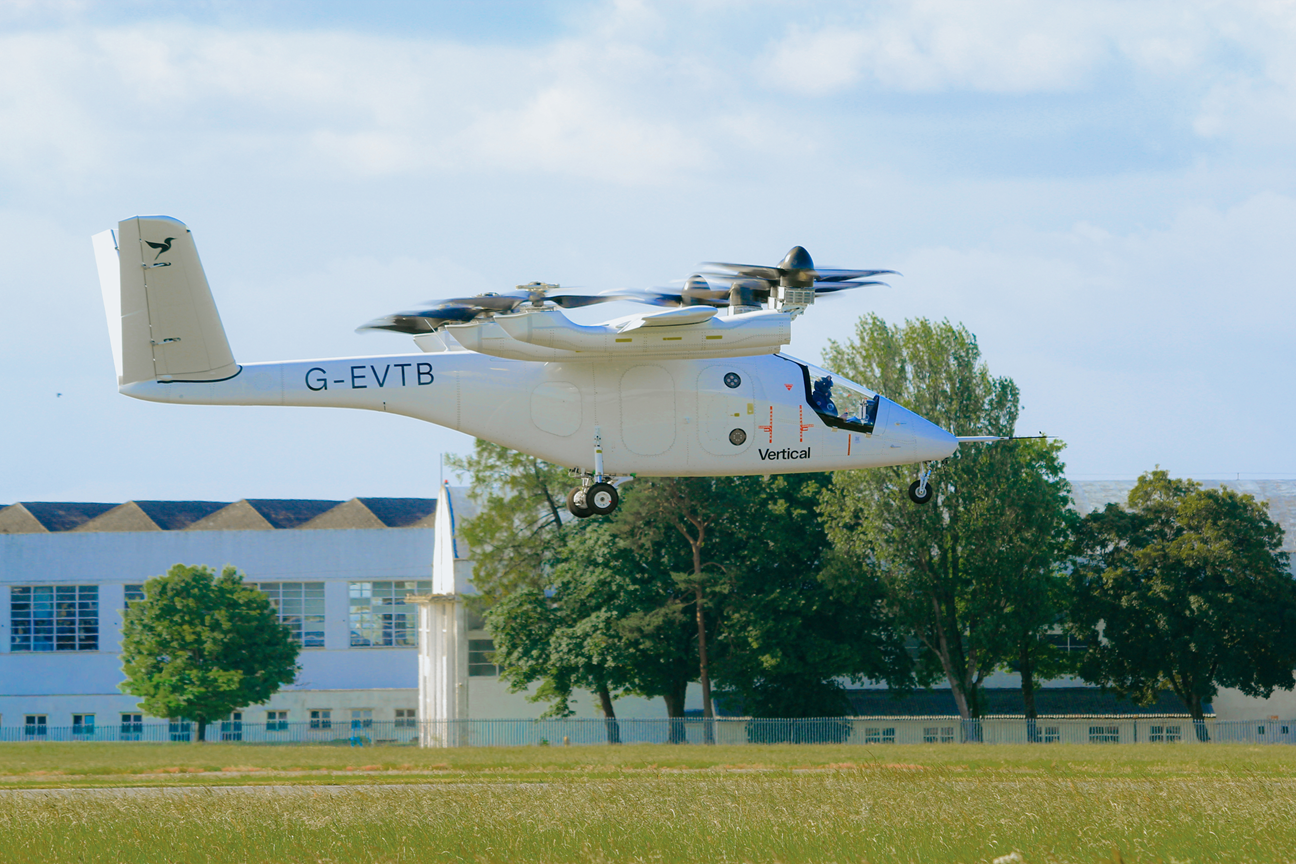
After successfully flying the first full-scale prototype of its eVTOL Valo aircraft, Vertical Aerospace announced that it has another full-scale prototype flying in parallel to the former. The Valo has taken off recently as per the permit to fly from the UK Civil Aviation Authority, received after completing testing and validation of the craft. Vertical now boasts of two full-scale Valo prototypes, having planned commercial certification of the aircraft in 2028.
The presence of the second full-scale aircraft becomes more useful in the case of eVTOLs because it increases the capacity of the flight-test program for collecting data and performing maneuvers. In this regard, it should be noted that Vertical already has the aircraft which performed flights in thrustborne and wingborne configurations, as well as a full bidirectional transition from one configuration to another. The first aircraft continues operating as part of data collection operations, while the new prototype repeats the same sequence of activities.
This issue becomes especially critical since transition presents the key challenge for tilt-rotor and lift-and-cruise aircraft in general. The Valo has eight rotors. Four rotors located in the rear stay fixed and stow in cruise configuration, while four rotors mounted in the front tilt 90 degrees when the aircraft goes from vertical lift configuration to forward flight configuration. When the speed reaches 80 knots, the role of the wing increases as far as lift creation is concerned, and the control system should adapt to new aerodynamics.
In this regard, it can be stated that Honeywell fly-by-wire systems handle the mentioned transitions, making Honeywell a key American partner of the Valo project. From the perspective of certification process, this issue becomes critically important because flight-control integration is the key activity in the flight-test program. It is not only necessary to validate the capabilities of hovering and cruising, but it is vital to prove repeatable handling qualities and system behavior through the transition.
It can be explained by the fact that the company has already demonstrated the key challenges of its flight-test program. For instance, according to Vertical Aerospace, by September 2024, its Valo flight-test program had made a first crewed hover flight in tethered configuration. By February 2025, the company had already demonstrated vertical maneuvers, and by May 2025 it had performed its first wingborne flight. Then, on April 14, 2026, the company’s chief pilot Simon Davies had made what Vertical Aerospace calls the first complete, piloted, bidirectional transition under civil regulatory oversight. Thus, the second prototype has a certain path in validation process.
It should be noted that this moment becomes crucial in view of the fact that this aircraft is the last prototype before Critical Design Review. In aerospace development, CDR is the point where a program finalizes the design of the aircraft. Thus, the mentioned aircraft prototype becomes not only an additional test platform but also a link between experimental efforts and the configuration that can be used for the pre-production aircraft. According to Vertical Aerospace, after CDR the company begins assembly of its first pre-production aircraft.
Therefore, it becomes even more important to stress the issue of commonality. In this regard, both full-scale prototypes use the same configuration, and the company stresses that its flight-test program uses the aircraft whose architecture, systems, and flight characteristics are close to production-standard Valo aircraft. For certification-oriented tests, this issue becomes crucial because the value of each flight hour depends on the degree to which it helps to inform the aircraft the company wants to certify.
Apart from controls, the partner stack indicates where the program directs its efforts. As already mentioned, Honeywell is responsible for avionics and flight controls, while Syensqo provides advanced materials and Aciturri provides aerostructures. This information is not a side detail because in the case of eVTOL nearing design freeze, materials choices, structural execution, and control system maturity are key aspects of manufacturability and repeatability of the aircraft and the evidence package the regulators expect to see.
Vertical Aerospace specifies that its published specifications of Valo include the capacity for a pilot and up to four passengers, cruise speed of 150 mph, and the range of up to 100 miles. After the new prototype performs its full cycle of thrustborne, wingborne, and transition testing in all-electric configuration, the company plans to convert it to hybrid-electric configuration as the testbed for applications requiring more range and payload, including logistics, defense, and extended commercial transport. While the latter becomes the key benefit of the conversion, the importance of this issue lies in another sphere.
Thus, the immediate benefit for the Valo program from the new aircraft becomes clear. For the Valo eVTOL, it means more opportunities to collect flight data before design freeze. For the U.S. market, the most important information is not the information about orders but systems maturity. In this regard, the second full-scale aircraft flying with Honeywell flight-control hardware becomes the evidence of transformation of the eVTOL development from concept validation into industrial discipline.
By Stephen Wallace — Editor for AMI’s aerospace integration and unmanned mobility coverage, focusing on drone manufacturing, VTOL systems, autonomous networks, and air-ground mobility links.