

CSIS Estimates China Can Build Up to 5,000 Satellites Annually
The Center for Strategic and International Studies has published an assessment of China’s commercial space expansion estimating that the country can produce 4,100 to 5,000 satellites annually. CSIS also found that Guowang and Thousand Sails, China’s two leading low-Earth-orbit broadband networks, each plan to deploy more than 10,000 spacecraft. That combination of factory capacity and constellation scale presents a direct industrial challenge to U.S. satellite operators, although China still trails the United States in commercial launch capability.
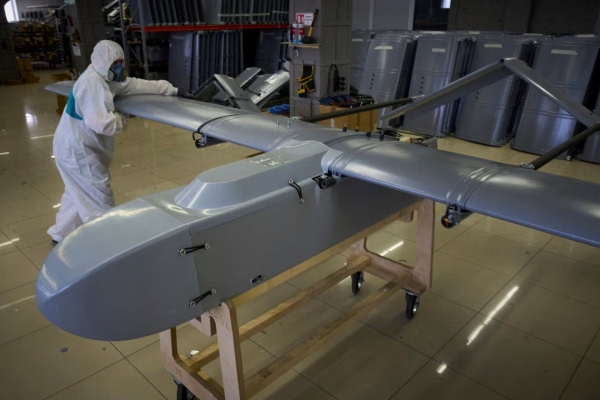
The manufacturing estimate represents a sharp change from an annual production rate of about 500 satellites three years earlier. CSIS attributes the increase to an expanding network of automated factories, technology centers and commercial companies. China’s broader commercial space sector has grown from a few dozen companies to approximately 600 since private investment was permitted in 2014.
Capacity, however, is not the same as sustained output. Producing thousands of satellites requires more than final assembly lines: suppliers must deliver structures, solar arrays, propulsion components, communications payloads and other subsystems at repeatable cost and quality. Spacecraft also must complete testing and be matched to available launch slots. The CSIS figure therefore indicates the scale of China’s industrial base, not confirmation that 4,100 to 5,000 satellites are already leaving factories every year.
Two constellations create a launch-demand problem
Guowang and Thousand Sails are each intended to exceed 10,000 satellites, putting their planned scale in the same broad megaconstellation class as SpaceX’s Starlink. Thousand Sails had reached 200 satellites in orbit after two launches in June 2026, while Guowang had 168, according to reporting on the programs. Those totals show that deployment is underway, but they remain a small fraction of the stated plans.
The gap between planned networks and deployed spacecraft makes launch throughput the controlling constraint. Even a factory capable of producing thousands of satellites cannot translate that output into an operational network without rockets, launch sites, ground processing and a cadence able to absorb the flow. CSIS identifies commercial launch as one of the few space sectors in which China still heavily trails the United States.
At least 10 Chinese launch start-ups now compete alongside the state-run Long March program, and the country is expanding its launch infrastructure. China also achieved its first controlled recovery of a rocket during an orbital mission in July 2026, when the Long March 10B first stage returned to a sea-based recovery platform after delivering a satellite to orbit. That was a significant engineering milestone, but one recovery does not establish routine reuse, economical refurbishment or the rapid turnaround demonstrated by SpaceX’s Falcon 9 fleet.
The unresolved benchmark is a reusable medium- or heavy-lift service that can fly repeatedly at high cadence. Reuse has operational value only if inspection, maintenance and component replacement between flights cost less and take less time than building another stage. China must also demonstrate reliable recovery across multiple missions and convert successful tests into scheduled commercial service. CSIS does not provide a confirmed date for reaching that level.
The U.S. consequence extends beyond rocket performance
If that launch constraint eases, China could connect its satellite factories to a much larger deployment pipeline. CSIS conditionally assesses that lower costs, manufacturing scale and reusable launch could allow Chinese companies to increase cadence and challenge U.S. providers in international markets. That outcome is not established, but the industrial ingredients are increasingly visible.
China is already exporting satellite communications, remote-sensing and navigation services. Thousand Sails has rural-broadband agreements with Brazil and Malaysia and is discussing service with more than 30 countries. Galaxy Space has established a regional hub in Thailand and reached agreements with more than 10 countries, according to the assessment. These arrangements matter because constellation competition includes ground terminals, service contracts and technical ecosystems not just the number of spacecraft in orbit.
For U.S. companies, the near-term advantage remains an integrated launch-and-satellite system with demonstrated operating tempo, particularly SpaceX’s combination of Falcon 9 and Starlink. China’s estimated production capacity shows that satellite manufacturing may no longer be its principal bottleneck. The decisive test is whether its launch sector can turn factory scale into reliable, repeatable deployment without creating costly inventories on the ground.
By David Whitaker — Associate editor for AMI’s aerospace and drone systems desk, translating flight systems, aircraft programs, spaceflight, and UAV developments into accessible technical stories.