Ukrainian Drone Alerts Halt Russian Airport Flights Without Direct Attacks
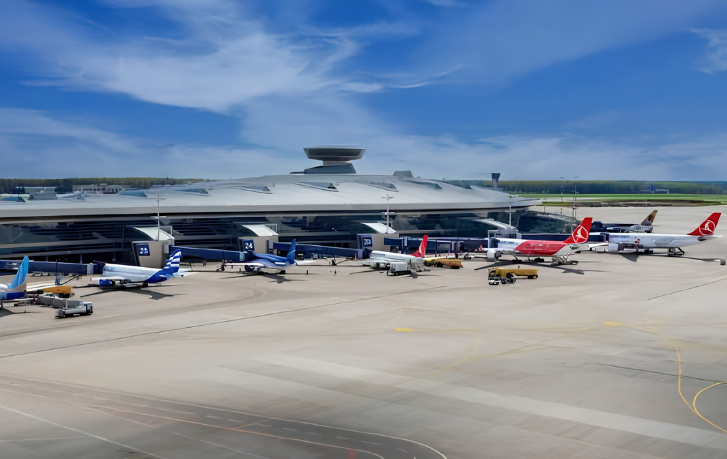
A drone does not have to strike an airport to stop its flights. Under Russia’s Kovyor, or “carpet,” procedure, detection of a drone in the relevant area can suspend arrivals and departures while authorities assess the airspace. That precautionary mechanism has repeatedly halted operations at major Russian airports, at times affecting all four principal airports serving Moscow.
The operational pressure increased on September 2, 2026, when Ukraine said it had formally notified the International Civil Aviation Organization that Russian airspace was unsafe for civilian aviation. President Volodymyr Zelensky warned airlines and insurers that expanding Ukrainian drone activity had to be included in their risk calculations, while saying civilian aircraft were not intended targets. Russia rejected that characterization, and President Vladimir Putin described the warning as a declaration of state terrorism. The immediate civil-aviation issue, however, is the disruption created by alerts rather than confirmed attacks on airport infrastructure. Airlines contacted about the warning said they were monitoring security conditions and reviewing schedules or routes.
For airport operators, the problem begins with uncertainty. Once an unidentified or hostile drone is reported in airspace connected to an airport, controllers must manage conventional aircraft without assuming the alert will remain distant from flight paths. A temporary suspension creates separation in time and space, but it also removes runway capacity immediately. Aircraft approaching the airport may have to hold, divert or delay departure from their origin.
That interruption can continue affecting the schedule after the restriction ends. An arriving aircraft may be needed for a later outbound flight, while its crew, passengers, baggage and ground services all depend on the original arrival time. A short closure can therefore propagate through an airline network as missed connections, aircraft-positioning problems and cancellations. Repeated alerts are more difficult to absorb because airlines cannot treat them as a single isolated delay.
The scale of that operational exposure remains contested and should not be confused with a complete closure of Russian airspace. FlightRadar24 showed many aircraft operating over Russia on Wednesday, including arrivals and departures at its two main airports, with some delays and relatively few cancellations at the time observed. Pegasus canceled Russia flights on Tuesday and Wednesday for what it called technical and operational reasons, but said later services remained scheduled. There is no confirmed basis for attributing those cancellations solely to Zelensky’s warning.
Other carriers are preserving flexibility rather than announcing a broad withdrawal. Qatar Airways said its planning relies on continuous monitoring of airspace security, safety assessments and geopolitical developments. FlyDubai said it would adjust schedules and routings as necessary. Those statements reflect how airline risk management works: a route can remain legally and physically available while becoming less dependable for scheduling, insurance and passenger connections.
Some Chinese, Turkish and Gulf carriers continue to use Russian airspace even though most Western airlines have avoided it since Russia’s full-scale invasion of Ukraine began in February 2022. The attraction is straightforward. Russian overflight access can shorten certain journeys between Europe and Asia, reducing flight time, fuel consumption, crew demands and aircraft utilization compared with longer southern routings.
Drone-related suspensions weaken that advantage without necessarily eliminating it. A shorter planned route does not deliver the expected efficiency if an airport closes temporarily, a departure misses its slot or an aircraft must carry additional operational margin for an uncertain arrival. Airlines must compare the time and fuel saved on a normal flight with the probability and network cost of disruption. That calculation can differ by carrier, destination and day, which helps explain why airlines have not responded uniformly.
Moving flights away from Russia also has system-level limits. Alternative corridors through the Caucasus, Central Asia and parts of the Middle East already handle traffic displaced by conflict-related restrictions. Concentrating more aircraft into those routes can increase journey times and reduce scheduling flexibility. It does not mean the corridors are unusable, but it makes rerouting more consequential than drawing a different line on a map.
Repeated alerts also place sustained demands on detection, air-traffic coordination and readiness. Authorities must decide when a report justifies restrictions and when normal operations can safely resume. Osprey Flight Solutions assessed that daily attacks deeper inside Russia were almost certain to continue during 2026 and warned that miscalculation or misidentification was likely in conflict-related areas. That is an advisory assessment, not proof that every reported drone poses the same risk or that all Russian airspace will close.
Ukraine has kept its own airspace closed to civilian aircraft during the full-scale invasion. Russia continues to support substantial commercial traffic, but the Kovyor procedure means its airports can lose capacity on detection alone. For passengers and airlines still using those routes, the defining constraint is therefore not only whether an airport is attacked it is how often an alert forces the aviation system to stop and wait.
| More aerospace and engineering stories, right in your MSN feed. Follow AMI on MSN |
By Stephen Wallace — Editor for AMI’s aerospace integration and unmanned mobility coverage, focused on drone manufacturing, VTOL systems, autonomous networks, and air-ground mobility links.