Ukraine’s Drone Strikes in Russia Deepen Global Diesel Supply Shortfall
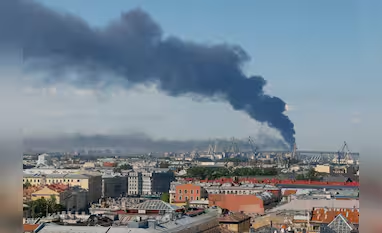
Diesel shortages do not stay where refinery operations are disrupted. Fuel cargoes are redirected, importers compete for the same replacement supply, inventories fall elsewhere and the added cost eventually reaches freight, farms and factories. That transmission mechanism is now amplifying the global consequences of reported Ukrainian drone strikes on Russian energy facilities and Russia’s diesel-export ban.
The scale is substantial but remains subject to independent confirmation: around 40% of Russia’s refining capacity is reportedly not operating, while the export ban has removed approximately 800,000 barrels of diesel per day from international trade. Kpler analysts estimate that global refineries are processing about 80 million barrels of oil per day, roughly 6 million below the typical seasonal level of 86 million.
A missing cargo creates competition elsewhere
Before the ban, Russian diesel went primarily to Turkey, Brazil and several African countries where those petroleum products were not sanctioned. Those buyers still need fuel, so they must seek cargoes from other refining centers. That search does not directly replace lost Russian production; it rearranges a limited pool of available diesel.
Europe is especially exposed to that displacement because it is a net diesel importer. Former buyers of Russian fuel are now competing with European importers for supplies, including barrels from the United States. S&P Global reported in early September that Europe had become more dependent on U.S. supply after disruption in the Middle East curtailed exports from that region.
The United States, however, has limited room to compensate. U.S. refineries were already operating near their practical maximum, with utilization reaching 97.4% in the week ending August 21. Delaying scheduled maintenance might preserve output briefly, but it would carry cost and reliability tradeoffs. Restarting mothballed plants or permitting new capacity would take much longer than the current shortage is likely to allow.
This is why a global refining deficit matters more than crude availability alone. Crude oil cannot power a truck or tractor until a refinery converts it into the required product. A market can therefore have oil available while still lacking enough diesel because conversion capacity, regional product inventories and transportation links are constrained.
Repeated disruption extends the industrial burden
Refinery downtime is not simply a question of whether a plant is operating or shut. Industrial facilities can return in stages, and repeated disruptions can complicate repair planning, labor allocation, inspections and the availability of replacement equipment. Columbia University energy expert Tatiana Mitrova has assessed that repeated strikes make repairs more difficult and prolong outages.
The resulting pressure extends beyond refinery hardware. Continued drone activity forces operators to divide resources among production continuity, damage assessment and restoration. At a national level, it also creates an air-defense and readiness burden across a geographically distributed energy network. Available information does not establish how individual defenses performed, and the industrial impact should not be treated as a verified measure of military effectiveness.
August trade data nevertheless show a notable reversal. The Centre for Research on Energy and Clean Air reported that Russia imported a record 172,000 tonnes of oil products during the month more than seven times its previous monthly high since the full-scale invasion began. For a country that was once the world’s largest oil-product exporter, importing refined fuel adds shipping time, handling expense and logistical complexity.
The consumer impact arrives with a delay
Higher diesel costs do not appear across the economy at once. Debnil Chowdhury of S&P Global Energy said the effects could spread over three to six months and influence economic growth through the end of 2026 and into the following year.
Freight operators encounter the fuel cost first, but transportation is embedded in almost every physical product. Farms use diesel-powered equipment and transport. Manufacturers pay to move components and finished goods. Retailers depend on distribution networks. Businesses may initially absorb some of the increase, pass it through selectively or adjust routes and production schedules, making the eventual consumer effect both delayed and difficult to isolate.
Relief also depends on more than one facility or policy decision. Russian refining and exports would have to recover, alternative refineries would need spare capacity, or inventories would need rebuilding without another regional disruption. With global throughput reportedly 6 million barrels per day below its normal seasonal level, replacement cargoes can change direction quickly but the refining system cannot create them just as quickly.
| More aerospace and engineering stories, right in your MSN feed. Follow AMI on MSN |
By Stephen Wallace — Editor for AMI’s aerospace integration and unmanned mobility coverage, focused on drone manufacturing, VTOL systems, autonomous networks, and air-ground mobility links.