Rolls-Royce Cycles Nightingale’s Sideways Trunk 15,000 Times for 100 Cars
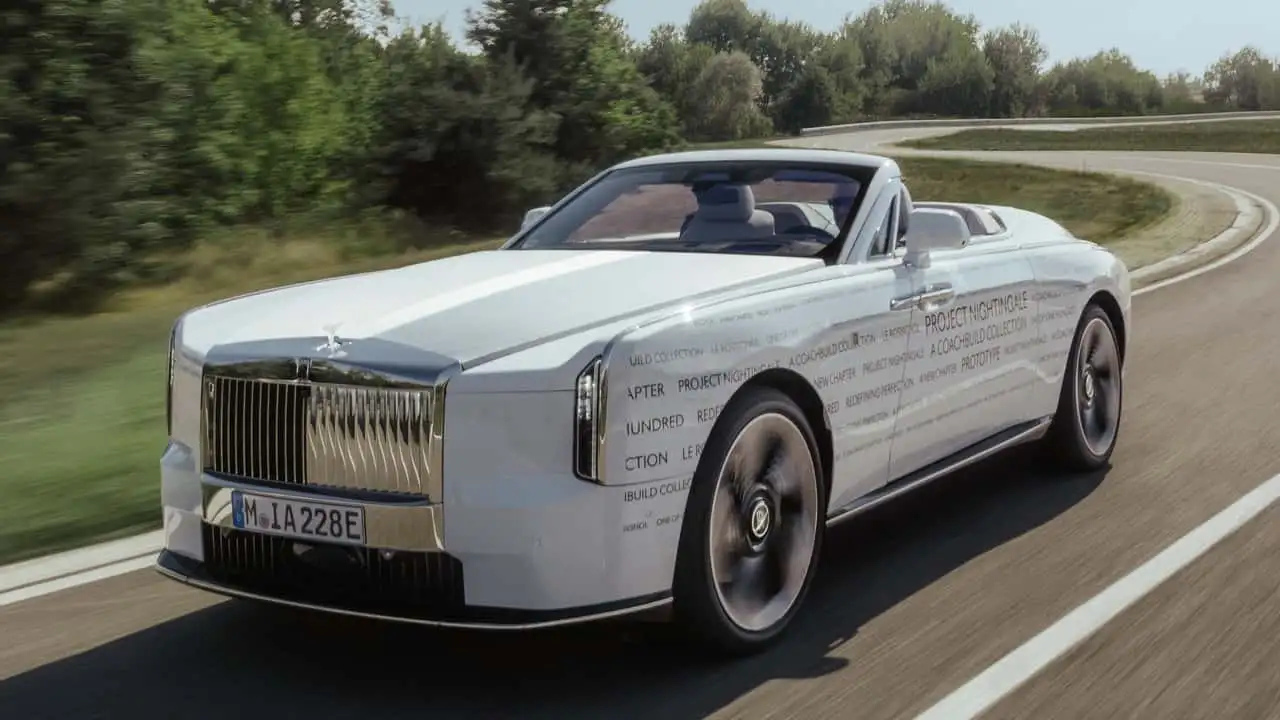
Fifteen thousand opening-and-closing cycles are being assigned to one of the most conspicuous mechanisms on the Rolls-Royce Nightingale: a trunk lid that moves sideways like the lid of a baby grand piano. The unusually large durability exercise is part of the electric roadster’s newly launched global testing program, even though Rolls-Royce plans to build only 100 cars.
The contrast is notable. This is an exceptionally low-volume, two-seat convertible, reportedly estimated at $9.5 million before further personalization, although Rolls-Royce has not confirmed that price. Yet its unusual “Piano Boot” is receiving the kind of repetitive validation associated with a component expected to perform consistently long after its novelty has worn off.
Rolls-Royce says the trunk opens sideways on a cantilever and will undergo up to 15,000 cycles. The company’s stated goal is to ensure repeated operation does not interrupt the mechanism’s theatrical movement or effortless feel “for generations to come.” That language describes the ambition, not a demonstrated service-life calculation: Rolls-Royce has not disclosed how many years or owner operations the test is intended to represent.
What 15,000 cycles can establish
Cycle testing is a practical way to expose changes that may not appear during a small number of demonstrations. Repeated movement can reveal whether alignment, closing behavior or operating effort drifts as a mechanism accumulates use. For a cantilevered body closure, maintaining the intended motion and final fit is central not only to presentation but also to consistent everyday operation.
The published figure nevertheless leaves important engineering questions unanswered. Rolls-Royce has not detailed what constitutes one completed cycle, the loads applied to the lid, the speed or dwell time of each movement, or whether the mechanism is tested with different cargo conditions. It has also not disclosed acceptance limits, component replacements, measurements taken during cycling or results obtained so far.
Environmental context matters as well. A mechanism can perform differently after exposure to heat, cold, dust, moisture and body movement than it does in a controlled indoor test. Rolls-Royce says Nightingale prototypes will travel through Mediterranean conditions, the Arctic Circle and deserts of the Arabian Peninsula, reaching elevations as high as 2,750 meters. The company has not said whether the Piano Boot’s complete 15,000-cycle sequence includes those environmental loads or is conducted separately.
A wider validation program
The trunk trial is one element of 350 collective weeks of planned testing for the Coachbuild Collection. Static prototypes have already completed more than 1,430 hours of aerodynamic modeling, including digital simulation and wind-tunnel work. Rolls-Royce plans to validate that work at a private high-speed facility, where prototypes will operate at speeds up to 155 mph.
That aerodynamic work has particular importance for a long, open-top electric car. The Nightingale measures 5,760 millimeters, or 226.8 inches, and its convertible body must manage airflow around a two-person cabin. Rolls-Royce has developed an electrically operated wind deflector intended to stop high-pressure air from curling forward into the interior. It will be evaluated across different speeds, including for its ability to limit turbulence and retain warmth with the roof lowered.
The roof presents a separate integration problem. Its cashmere, fabric and composite sound-deadening construction is intended to admit the sound of raindrops while suppressing some electric-powertrain noise. Rolls-Royce says the assembly will face 10 tests covering its fabric, closing system and performance at temperatures up to 80 degrees Celsius, or 176 degrees Fahrenheit.
Together, these tests show why production volume alone does not determine validation effort. The Nightingale introduces several specialized moving and aerodynamic systems whose behavior must remain coordinated across temperature, speed and repeated use. For its Piano Boot, however, the most useful evidence is still to come: the company has stated the 15,000-cycle target, but not the pass criteria or final result that would show how the mechanism performed.
| More aerospace and engineering stories, right in your MSN feed. Follow AMI on MSN |
By Thomas Caldwell — AMI’s senior editor for mechanical and mobility engineering, covering vehicle electronics, systems integration, electrification, chassis systems, propulsion, and safety policy.