Navy Equips Second Carrier for MQ-25 Tanker, First Flight Unscheduled
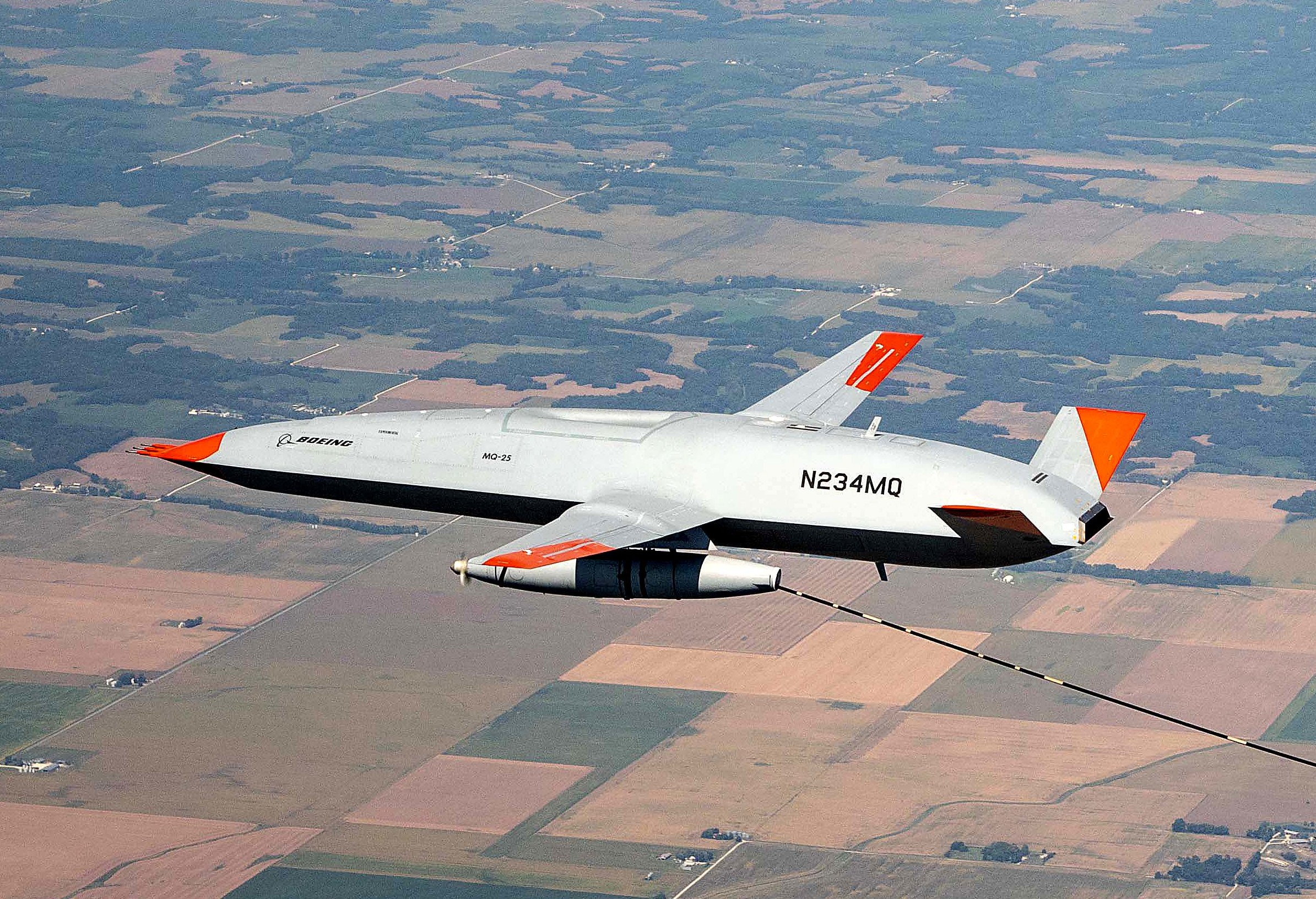
Two US aircraft carriers now have the control infrastructure needed to operate Boeing’s pilotless MQ-25A Stingray tanker. What the Navy still has not provided is a date for the demonstration that matters most: launching the aircraft from a carrier and recovering it there without a remote pilot directly controlling each maneuver.

The Navy completed the installation and integration of its MD-5C ground-control system aboard USS Ronald Reagan in August 2026. That made Ronald Reagan the second equipped carrier after USS Theodore Roosevelt, which received the first operational installation in March. Program manager Capt. Daniel Fucito said both ships are “ready to fly the MQ-25A,” but that statement describes the carriers’ installed control capability not a completed carrier flight trial.
The control room is only one side of the system
Theodore Roosevelt and Ronald Reagan each carry an Unmanned Air Warfare Center housing the MD-5C stations. The system combines Navy communications and computing infrastructure, government-produced equipment, and Lockheed Martin’s MDCX hardware and mission-planning software. Sailors use it to plan and oversee MQ-25 operations.
That arrangement differs from the familiar image of a drone pilot continuously moving controls from a console. The MQ-25A is designed to taxi, launch, fly and recover without direct remote-pilot input. Operators remain responsible for commanding and supervising the mission through the ground-control system, but the aircraft’s automation executes the flight rather than relying on constant manual control from the ship.
This distinction is why the first carrier operation carries more weight than another shore-based flight. Boeing flew a production-model MQ-25A for the first time in April 2026, demonstrating autonomous taxi, takeoff, flight and landing from an airport. A carrier adds the defining environment for the program: shipboard command-and-control equipment, deck operations and launch-and-recovery testing must function together as one operational system.
Ronald Reagan’s installation also remains subject to additional validation. The ship’s crew and program team are expected to conduct pier-side and at-sea test events to confirm that the center is ready to support the Stingray. The Navy has not announced when the first MQ-25A carrier flight will occur or which of the two equipped carriers will host it.
A production contract raises the stakes
The missing flight date is more conspicuous because the program has moved into initial production. In September 2026, Boeing received a $562 million low-rate initial production contract covering three Lot 1 aircraft and long-lead components for three additional Lot 2 aircraft. Boeing has 14 MQ-25 aircraft under firm order toward an expected Navy fleet of 76, including 67 operational tankers and nine test aircraft.
Production authorization does not itself prove carrier suitability. It indicates that the program has advanced beyond its engineering and manufacturing development phase, while carrier trials remain a major practical test of the complete aircraft-and-ship architecture. Boeing defense chief Steve Parker described the remaining task directly in June: We’ve got to go to the boat, prove it out, and give the navy the refuelling capability they need to take that task off the Super Hornet.
That refueling assignment explains why the MQ-25 matters beyond autonomy. F/A-18E/F Super Hornets currently perform buddy-tanking missions for other carrier-air-wing aircraft. Every fighter configured and assigned to carry fuel is one fewer crewed aircraft available for other sorties. The Stingray is intended to absorb that tanker workload, returning part of the Super Hornet force to its primary roles.
The Navy’s fiscal 2027 budget documents project initial operational capability in 2029. The service defines that milestone as three combat-ready MQ-25 aircraft, supported by trained personnel and ready to deploy. Reaching it requires more than installing consoles or placing aircraft under contract; operators, ships and aircraft must be validated as a deployable combination.
For now, the Navy has doubled the number of carriers equipped to command the Stingray, and Boeing has a $562 million production award behind the aircraft. The unresolved step is still the one aviation followers want to see: an MQ-25 launching from a carrier, completing its mission under shipboard supervision and landing back aboard on a date the Navy has yet to announce.
| More aerospace and engineering stories, right in your MSN feed. Follow AMI on MSN |
By Stephen Wallace — Editor for AMI’s aerospace integration and unmanned mobility coverage, focused on drone manufacturing, VTOL systems, autonomous networks, and air-ground mobility links.