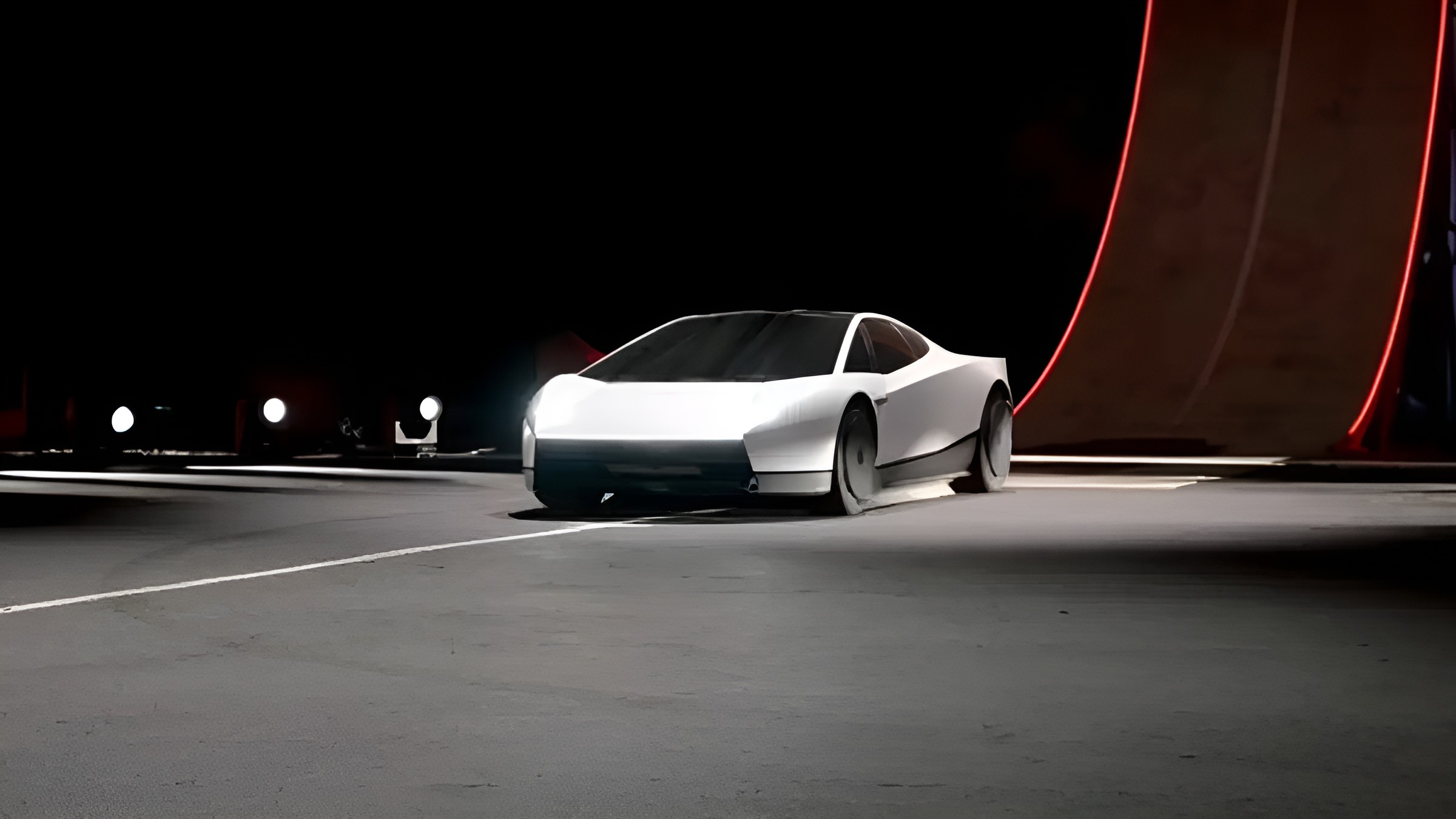
Tesla Roadster Prototype Carries 10,000-PSI Tank Feeding Four Rear Thrusters
Behind the Tesla Roadster prototype’s two front seats sits the component that makes its unusual propulsion system possible: a large composite-overwrapped pressure vessel capable of storing gas at up to 10,000 pounds per square inch. Two pipes route that gas toward four metal nozzles above the rear bumper, producing thrust without combustion.
The hardware documented after Tesla’s recent demonstration makes the Roadster an unexpected meeting point between electric-car architecture and rocket-derived pressure systems. The nozzles look broadly like exhaust outlets, but no fuel is burned inside them. Instead, actuator-controlled valves release compressed gas described as primarily nitrogen which expands through the four nozzles as a cold-gas propulsion system.
How the Roadster produces thrust
A cold-gas thruster converts stored pressure into directed motion. Opening a valve allows compressed gas to move from the pressure vessel through plumbing and out of a nozzle at high velocity. The reaction force pushes the vehicle in the opposite direction. In the Roadster prototype, the departing gas has been described as reaching supersonic speed.
The pressure vessel is black, approximately spherical and roughly the size of a large exercise ball. Its capacity is believed to be about 200 liters, although that figure has not been firmly established. Large flanges at the vessel’s ends, each secured by 12 bolts, connect it to the outlet pipes and associated valve hardware.
Each end also carries two piston-like actuators. These operate the valves that meter gas from the vessel before the flow divides among the four rear nozzles. The actuator motors apparently originated in the ankle mechanism developed for Tesla’s Optimus robot, making the prototype an example of hardware crossing between the company’s robotics and automotive programs.
Valve control is central to the system. A pressure vessel by itself only stores energy; the usable thrust depends on how rapidly and consistently the valves admit gas to the plumbing and nozzles. Timing, repeatability and synchronization determine how the four outlets contribute to the commanded force. The available documentation identifies the actuators and flow path but does not provide confirmed figures for individual-nozzle thrust, total impulse or gas consumption.
The tank is established technology in an unusual setting
Composite-overwrapped pressure vessels are established aerospace hardware rather than a new Tesla invention. Earlier high-pressure vessels commonly relied on steel, aluminum or titanium construction. Later designs combined a liner with continuous wraps of strong, lightweight fibers such as Kevlar or carbon fiber.
In that arrangement, the liner limits gas permeation while the composite overwrap carries much of the structural load without the weight of an equivalently strong all-metal vessel. NASA’s Space Shuttle team helped pioneer metal-lined, composite-wrapped vessels, and SpaceX uses multiple pressure vessels of this general class. SpaceX also purchased composite-pressure-vessel manufacturer Hexagon Masterworks earlier in 2026.
High-pressure composite vessels remain demanding engineered systems. A 2023 review of advanced composite pressure-vessel technology identified permeation, manufacturing and standards coverage as continuing challenges for the newest linerless designs. The Roadster vessel is described as having a metal liner, so it should not automatically be classified as the linerless Type V technology examined in that review. The broader point is that material selection, fabrication consistency and gas containment remain inseparable from pressure-vessel performance.
A demonstrated mechanism, not a production specification
The prototype establishes a visible mechanical chain: compressed gas is stored behind the seats, released through controlled valves, carried by two pipes and expelled through four cold-gas nozzles. It does not establish the specifications of a customer vehicle. The reported 200-liter volume remains an estimate, while final tank configuration, operating limits, inspection provisions and consumer availability have not been confirmed.
Those unresolved details are especially consequential because the pressure hardware occupies passenger-adjacent space in a road vehicle. Moving a rocket-derived vessel into that environment would require the complete system not only the tank to be evaluated around mounting, plumbing, valve behavior, long-term containment and predictable control. No production certification or legal-use pathway has been established for the demonstrated configuration.
The prototype’s most concrete achievement is therefore narrower, but still striking: Tesla has shown how an electric Roadster can generate non-wheel thrust without combustion. Its four rear outlets are supplied by a composite vessel carrying gas at pressures reported as high as 10,000 psi, placing aerospace-style stored-pressure hardware directly behind the seats of a familiar road-car form.
| More aerospace and engineering stories, right in your MSN feed. Follow AMI on MSN |
By Thomas Caldwell — AMI’s senior editor for mechanical and mobility engineering, covering vehicle electronics, systems integration, electrification, chassis systems, propulsion, and safety policy.