Ukrainian Drones Restrict Four Moscow Airports, Force Presidential Aircraft to Circle
A Ukrainian drone attack restricted all four Moscow airports for roughly six to seven hours on Friday, October 9, delaying four aircraft assigned to Russia’s presidential Special Flight Squadron. Flight-tracking data showed government jets circling near Moscow or diverting before they could land, extending the disruption beyond civilian schedules to aircraft serving Russia’s senior leadership.
The aircraft were returning from Turkmenistan, where Vladimir Putin had attended a summit. All four ultimately landed, but no confirmed account establishes whether Putin was aboard any of them. The documented consequence is the delay to the presidential squadron: some aircraft made looping maneuvers around Moscow, while one reportedly diverted to St. Petersburg before continuing to the capital.
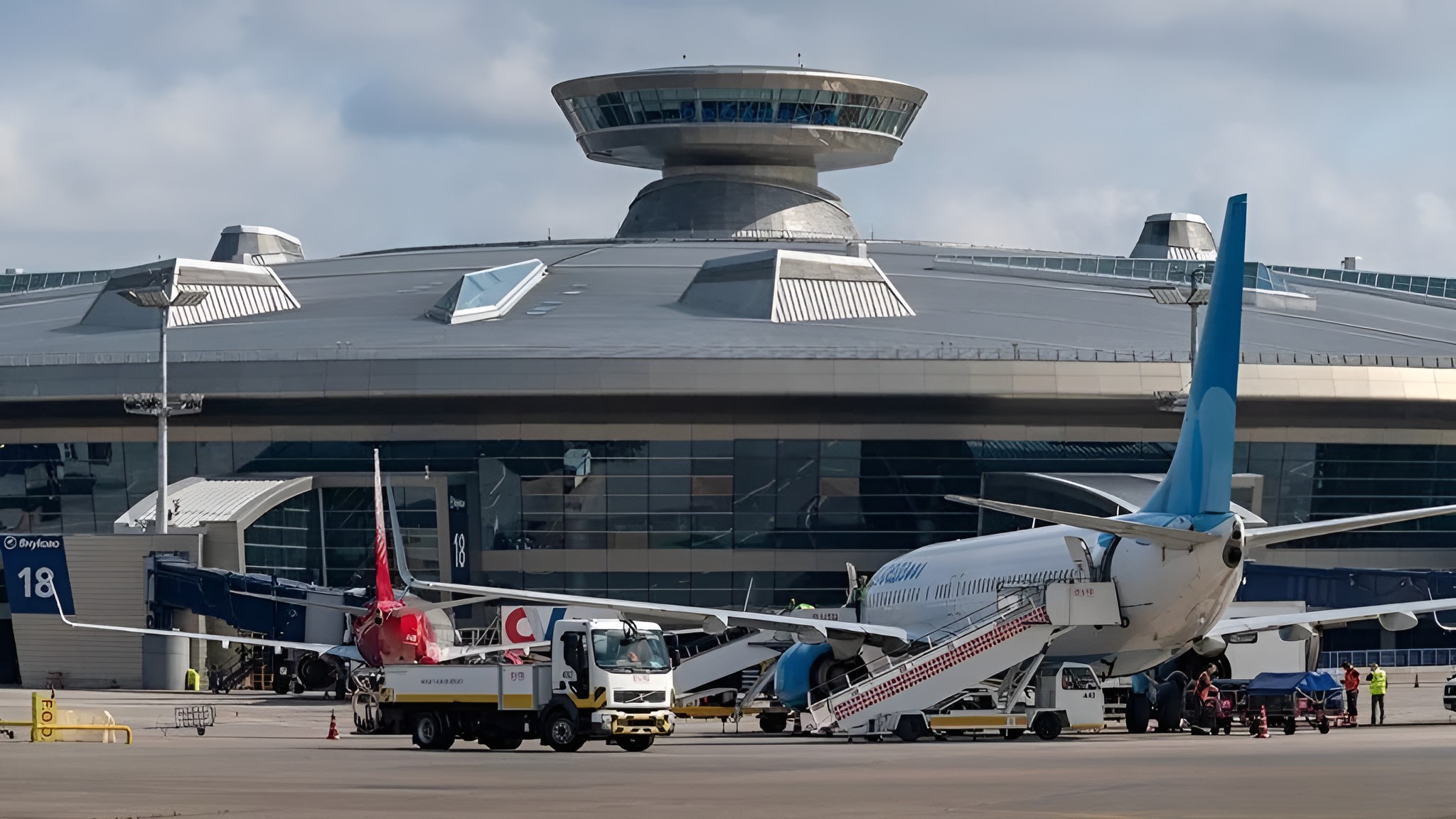
Russia’s aviation regulator imposed restrictions at about 3:40 p.m. local time at Vnukovo, Sheremetyevo, Domodedovo and Zhukovsky, according to a contemporaneous account of the regulator’s announcement. Residents had reported explosions and air-defense activity before flights were suspended. No strike on any of the four airports was reported.
Closing four airports removes the nearest alternatives
A metropolitan airport network normally provides options when one field becomes unavailable. Controllers and airline dispatchers may redirect arriving traffic to another airport in the same region, limiting the additional distance and simplifying recovery once the original destination reopens.
Simultaneous restrictions at all four Moscow airports removed that straightforward alternative. Aircraft already in the air had to wait, return toward another destination or proceed to a more distant alternate based on fuel, weather and operational planning. The government aircraft that went to St. Petersburg illustrated how a citywide restriction can push disruption far beyond the affected metropolitan area.
Circling is also a finite operating choice rather than an indefinite pause. Each circuit consumes fuel included in the aircraft’s flight plan, steadily reducing the time available before a diversion becomes necessary. Crews and dispatchers must weigh the possibility that access will reopen against the fuel and time required to reach an alternate with the mandated reserves intact.
The same constraint applies to civilian flights at much greater scheduling scale. Aircraft held at their departure points can lose assigned operating times and occupy gates needed by later services. Flights already airborne may divert and refuel before trying again. A late aircraft can then delay its next scheduled flight, spreading the interruption across routes that never pass near Moscow.
Reopening the airspace does not clear the queue
Airport capacity depends on coordinated arrival sequences, departure slots, gates, crews and ground services. After hours of restrictions, those resources cannot process every displaced flight simultaneously. Controllers must rebuild traffic flows while airports handle aircraft and passengers arriving outside their planned windows.
The October 9 event was part of a much larger interruption to Moscow aviation. Agentstvo calculated that Moscow’s four airports were closed for a combined 101 hours during the first 14 days of October, compared with 46 hours throughout September. That comparison shows how repeated restrictions can turn individual drone alerts into a continuing capacity and reliability problem.
Another shutdown on October 16 demonstrated the diversion burden more directly. More than 20 inbound aircraft diverted during overnight restrictions, and reported cancellations at Moscow’s airports exceeded 200. All four airports had reopened by 5:43 a.m. Moscow time, but reopening restored access rather than instantly restoring the timetable.
Moscow Mayor Sergei Sobyanin said defenses brought down 15 drones approaching the capital during the October 9 attack. That official figure has not been independently verified and cannot establish how many drones created the aviation disruption or measure interception performance. Drone count and airport impact are different measures: an uncertain airborne hazard can trigger broad restrictions even when there is no reported runway or terminal damage.
Suspending civilian movement reduces the immediate coordination burden while air defenses address an unresolved threat in shared airspace. The operational cost appears elsewhere in holding fuel, diversions, cancellations and a backlog that persists after restrictions lift. On October 9, that cost reached every airport serving Moscow and four presidential-squadron aircraft, while the identity of their passengers remained unconfirmed.
| More aerospace and engineering stories, right in your MSN feed. Follow AMI on MSN |
By Stephen Wallace — Editor for AMI’s aerospace integration and unmanned mobility coverage, focused on drone manufacturing, VTOL systems, autonomous networks, and air-ground mobility links.