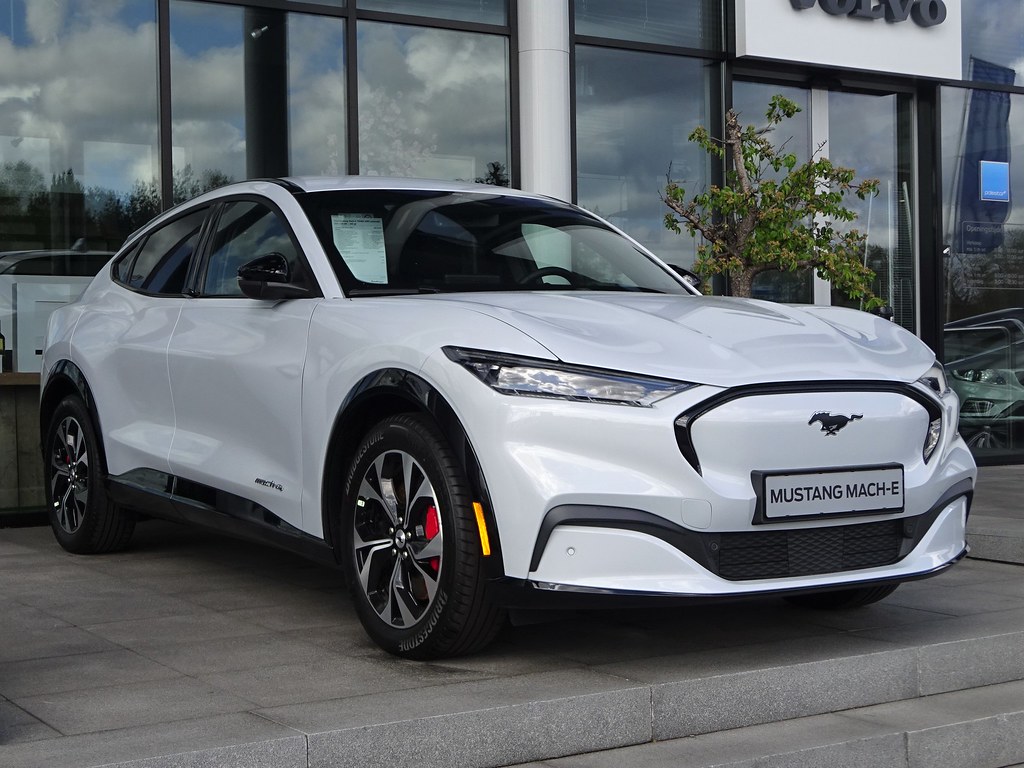
Ford Says EV Batteries Retain Over 90% Health After 100,000 Miles
More than 90%: That is the average battery health Ford says its electric vehicles retain after 100,000 miles. The figure, disclosed in a 2026 manufacturer field-data update, offers a reassuring fleet-scale result for owners concerned about deterioration of an EV’s most expensive component. It is an average, however, and Ford has not published enough methodology to turn it into a prediction for every vehicle.

Ford’s most detailed dataset covers approximately 36,000 model-year 2021 Mustang Mach-E vehicles in the United States and Canada. By August 2026, the cohort had accumulated two billion miles and averaged 5.2 years of ownership. Ford reports that these vehicles retained 92% of usable battery capacity on average.
The distribution provides more useful context than the average alone. Ford says 95% of the 2021 Mustang Mach-E cohort fell between 87% and 97% battery health. That 10-percentage-point range shows that two nominally similar vehicles can reach materially different outcomes as operating conditions, charging patterns and individual battery characteristics diverge.
High-mileage vehicles provide a tougher test
More than 2,000 vehicles in the 2021 cohort have passed 100,000 miles on their original batteries, according to Ford. Those vehicles averaged better than 91% health. More than 30 had exceeded 200,000 miles, with average battery health of 88%.
Those higher-mileage groups are important because they move the discussion beyond age alone. Battery aging combines calendar effects the chemical changes that occur over time with cycle and operating effects associated with energy throughput, temperature and charging. A vehicle driven 200,000 miles in roughly five years represents a substantially different duty cycle from one covering an average annual distance.
Across Ford’s broader battery-electric lineup, including the Mustang Mach-E, F-150 Lightning and E-Transit, the automaker says packs retain greater than 90% health on average at 100,000 miles. Ford describes that broader result as coming from a 2026 manufacturer field study, but it does not provide the same cohort detail supplied for the 2021 Mach-E vehicles.
What battery health does and does not describe
Ford says its figures reflect usable battery capacity. In practical terms, a 90% state of health means the pack can store about 90% of the usable energy attributed to it when new. That can affect available driving range, but it does not establish an exact 10% range reduction because vehicle efficiency also changes with speed, weather, tires, payload and climate-control use.
The disclosure does not explain the state-of-health calculation, measurement uncertainty or treatment of repaired and replaced packs in sufficient detail for an independent reproduction. It also does not break the results down by climate, charging behavior, mileage, chemistry or vehicle use. Those variables are needed to determine why one vehicle sits near 87% while another remains near 97%.
Independent fleet data supports treating degradation as a distribution rather than a fixed rate. A Geotab analysis of more than 22,700 EVs found average degradation of 2.3% per year across 21 models, while also reporting differences associated with charging power, climate, utilization and vehicle design. That dataset spans multiple unnamed models and should not be used as a direct Ford comparison, but it illustrates why measurement definitions and operating profiles matter.
Battery chemistry adds another boundary. The 2021 Mustang Mach-E vehicles in Ford’s cohort use nickel-cobalt-manganese chemistry. Some newer Ford batteries use lithium iron phosphate chemistry, which has different operating characteristics and charging guidance. Results from one chemistry and vehicle generation therefore cannot be transferred automatically to every newer pack.
Charging guidance depends on the battery
Ford recommends Level 2 home charging for routine use when practical and reserving direct-current fast charging for longer trips. It also advises owners to precondition the battery in extreme temperatures, park in shade during hot weather when possible and follow vehicle-specific recommendations in the Ford App.
Those recommendations are not identical across Ford EVs. Frequent full charging generally is not needed for the 2021 Mach-E’s battery chemistry, while Ford advises periodically charging some lithium iron phosphate packs to 100% to help the battery-management system remain calibrated.
The strongest result is therefore not that every Ford EV will retain more than 90% capacity at 100,000 miles. It is that more than 2,000 high-mileage vehicles from a defined five-year cohort averaged above 91% on their original batteries and that even within the much larger Mach-E fleet, measured health spans a visible range that Ford’s next methodological disclosure will need to explain.
| More aerospace and engineering stories, right in your MSN feed. Follow AMI on MSN |
By Thomas Caldwell — AMI’s senior editor for mechanical and mobility engineering, covering vehicle electronics, systems integration, electrification, chassis systems, propulsion, and safety policy.