NASA Opens $10 Billion Competition to Supply a Permanent Moon Base
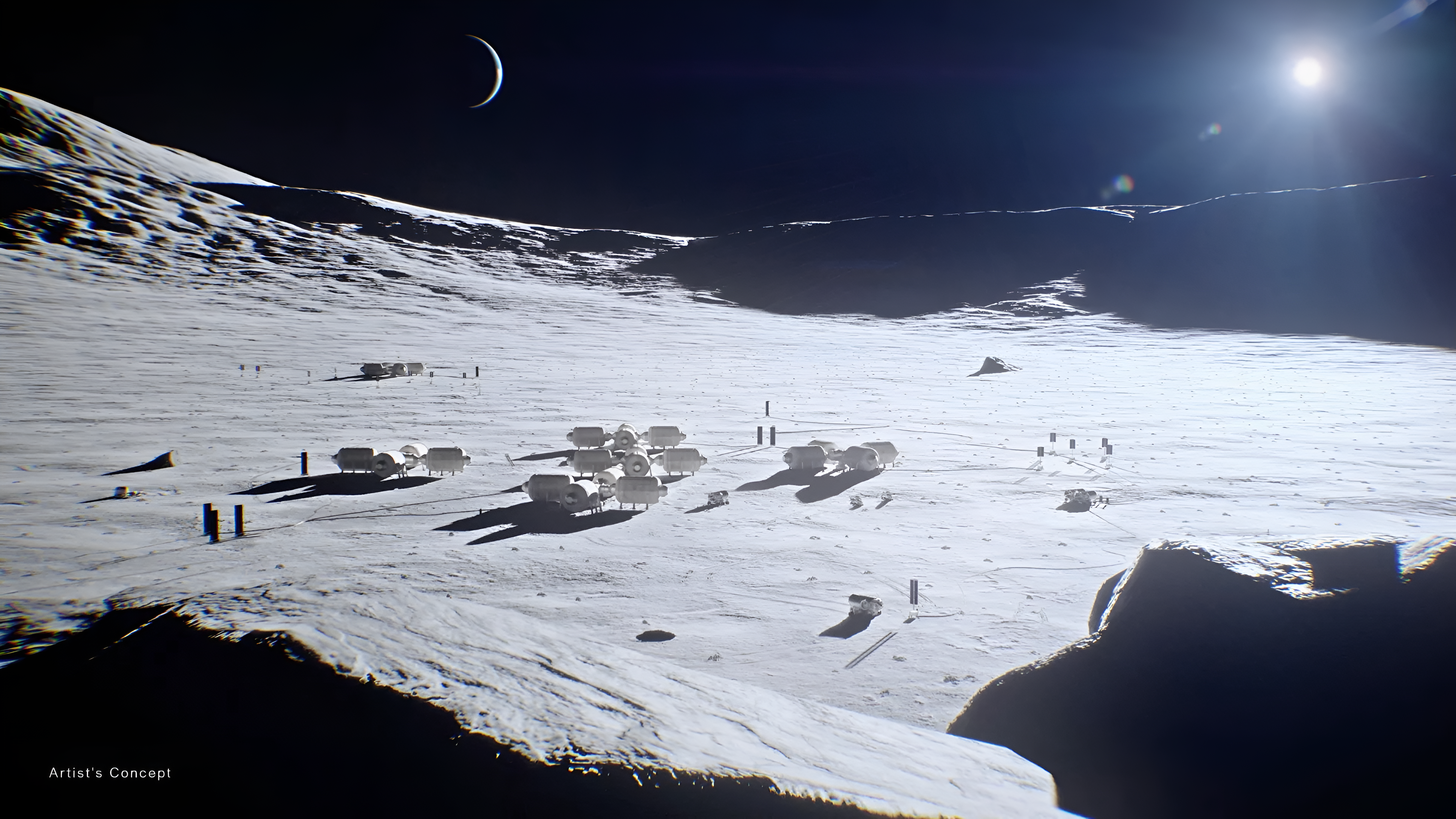
$10 billion is the ceiling on NASA’s new lunar cargo competition, not a check already written. The agency’s 10-year commercial delivery framework is intended to move science instruments, power equipment, communications hardware and other infrastructure to the Moon before astronauts arrive.
Announced November 7 at Kennedy Space Center, the second phase of Commercial Lunar Payload Services, or CLPS 2, is a multiple-award, indefinite-delivery/indefinite-quantity contract. NASA’s official announcement identifies eight eligible companies: Blue Origin, Firefly Aerospace, Intuitive Machines, ispace-U.S., Lockheed Martin Space, Northrop Grumman Space Systems, SpaceX and Voyager Technologies. They can compete for future delivery orders, but selection for the framework does not guarantee any company a mission or a fixed share of the $10 billion maximum.
NASA is buying delivery services, not a single lander
The contracting structure separates the long-term spending ceiling from individual flight decisions. NASA can issue task orders as payloads and schedules mature, then compare proposed landers, prices and mission approaches for each delivery. Companies are expected to manage, build and operate the landers carrying NASA hardware to the lunar surface.
That arrangement gives the agency access to multiple providers rather than committing the entire campaign to one vehicle. It can also create repeat business for companies that demonstrate reliable delivery. The tradeoff is that a large pool and a large ceiling do not, by themselves, produce dependable cargo capacity. Each task order still has to fund a defined mission, and each provider must turn its proposed system into tested flight hardware.
The scale is substantial compared with the first CLPS framework. NASA increased the ceiling on the existing contract from $2.6 billion to $4.2 billion for initial Moon Base objectives. That contract remains in place through November 2028, with additional time through November 2033 to complete previously awarded deliveries. CLPS 2 would extend the competitive model across another decade while broadening its role from carrying experiments toward supplying infrastructure.
For taxpayers, the framework offers flexibility: NASA orders missions as needed instead of paying the full maximum in advance. It also leaves the final public cost unresolved. Spending will depend on how many task orders NASA issues, their complexity and whether commercial competition produces workable prices. The clearest accountability points will therefore be the value, scope and performance requirements of individual awards not the $10 billion ceiling alone.
Cargo has to precede sustained crews
A lasting lunar presence requires more than a crew lander. Power must remain available through difficult lighting conditions, communications must connect surface systems with controllers, and robotic mobility must survey terrain and inspect resources before crews depend on those locations. Regular cargo delivery is the layer that puts those supporting systems in place and replaces or expands them over time.
NASA’s accompanying projects show what that cargo network may carry. The six-wheeled PROMISE rover short for Polar Rover for Observation, Mapping, and In-Situ Exploration is planned for the lunar South Pole. Nuclear power would let it operate during long lunar nights and in permanently shadowed regions where solar vehicles face limits. NASA is targeting late 2028 for launch and an 18-month mission.
The Jet Propulsion Laboratory plans to build PROMISE partly from spare flight components and engineering test hardware developed for the Curiosity and Perseverance Mars rovers. Reusing established hardware and operational approaches is intended to reduce cost and shorten integration and testing, although NASA has still had to assess whether those components can tolerate the South Pole’s lunar environment.
NASA awarded Blue Origin a $94 million base contract to deliver PROMISE, with a performance-dependent option worth another $140 million. That defined award illustrates how the broader procurement model works: a specific payload and delivery service receive an individual price, while the much larger CLPS 2 figure remains the combined limit for future competitions.
Another project, the Mini-Communications and Solar Tower, combines power generation, batteries, communications and wireless power-transfer hardware. NASA expects the initial work to begin with components rather than a complete operational network, with a separate solicitation for integrated power systems anticipated in early 2027. That phased approach lowers the size of the first technical step, but it also means the agency must later integrate hardware supplied by different organizations into a functioning surface system.
NASA Administrator Jared Isaacman said the agency is building its Moon Base “mission by mission” and intends to have its first elements waiting when astronauts return. CLPS 2 is the logistics mechanism behind that plan. Its real measure will not be the size of the ceiling, but whether repeated competitions can turn separate landers, rovers, power units and communications equipment into infrastructure that crews can actually use on arrival.
| More aerospace and engineering stories, right in your MSN feed. Follow AMI on MSN |
By David Whitaker — Associate editor for AMI’s aerospace and drone systems desk, translating flight systems, aircraft programs, spaceflight, and UAV developments into accessible technical stories.